Click here to join Express Pune WhatsApp channel and get a curated list of our stories
© The Indian Express Pvt Ltd
 2 min read


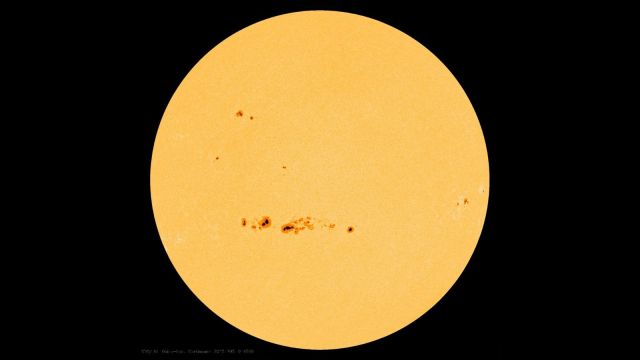 In the picture of the sunspot, one can clearly see the umbra and penumbra of the sunspots. (Express Photo)
Of late, many skygazers have observed giant spots that seem to have suddenly appeared on the surface of the Sun. According to Arvind Paranjpye, the director of the Nehru Planetarium in Mumbai, the Sun’s surface, which is known as the photosphere in technical parlance, is currently dotted with numerous dark spots called sunspots.
“Some sunspots are many times larger than the Earth. It is expected that we will continue to see these spots for the next 10 days or so,” he said, adding that seeing so many large sunspots is a rare occurrence. Paranjpye recalled that a similar sighting was reported back in 1947 and then in October 2014.
“Sunspots can unleash powerful X-class flares. These are also responsible for what is called a Coronal Mass Ejection (CME), when they spew out electrically charged particles, which can cause beautiful auroras near the northern and southern polar regions,” he said.
Paranjpye stated that the temperature of a sunspot is about 4,000 degree Celsius, whereas the temperature of the photosphere is about 6,300 degree Celsius. Sunspots appear dark because they are relatively cooler regions on the Sun, which itself is “about 108 times the size of the Earth,” he said.
He went on to add that on taking a closer look at a sunspot, a dark central region is revealed, called the umbra, as well as a less-dark region that surrounds it, called the penumbra. If the area surrounding the sunspot is blocked and only the umbra or penumbra is seen, then they appear red or orange in colour, respectively.
In the picture of the sunspot, taken by the Solar Dynamic Observatory of the US-based National Aeronautics and Space Administration (Nasa), one can clearly see the umbra and penumbra of the sunspots, he said.
For those interested in observing sunspots, Paranjpye advised that they should never look at the Sun with naked eyes, but they can, instead, use welder’s glasses of number 14 or higher grade. The best way to observe sunspots is to project an image of the Sun using a telescope. One can also use eclipse goggles, he added.