


Click here to join Express Pune WhatsApp channel and get a curated list of our stories
© The Indian Express Pvt Ltd
Tags:


Written by Neha Rathod
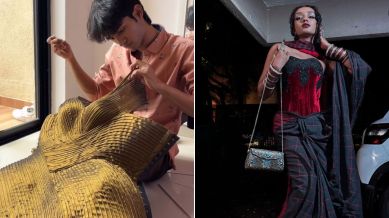
In a digital space crowded with fast fashion and fleeting trends, 22-year-old Nikhil Gajare makes corsets—and reels the process—quietly defying the chaos of the feed with discipline, detail and deliberate beauty. Discovered by screen star Bhumi Pednekar and sought after by social media personalities such as Rida Tharanahis, his corsets have firmly entered the fashion radar. Earlier this year, ELLE India named him one of its ‘Fashion Creators to Watch’, cementing his growing presence in the industry.


Fashion, he says, was never presented as a viable path—especially after his father had invested heavily in his education. “Because my dad had paid such large fees, I didn’t dare tell my parents that I found no interest in engineering,” he admits. “I was far more interested in art and fashion, but I stayed quiet.”
That silence came at a cost. As semesters passed, the disconnect deepened. “It started taking a toll on my mental health,” he says. “I realised I couldn’t continue just to meet expectations.” Eventually, continuing felt harder than stopping. Dropping out, he says, was not rebellion—it was survival.
The decision did not go down easily. His parents were firmly opposed, as were extended family members. “I had to fight everyone just to learn stitching,” he says. There was no safety net or encouragement when he chose to step away from engineering and towards fashion.
What he did have was resolve—and his mother’s old sewing machine that he carried from home to his hostel — packed into a suitcase, transported across cities and hauled up four flights of stairs. “That machine made it real,” he says. “It wasn’t a hobby anymore.”
That same machine went on to stitch the first dress that would change his life—a structured gown that later went viral on Instagram. “It brought me my first real clients,” he says. “That’s when I realised this could actually sustain me.”
In a moment that would later feel symbolic, Gajare took his mother’s gold bangle and used it as collateral to take a loan for his automated sewing machine. With it, he began taking small orders, “stitching blouses and skirts for PhD scholars on campus. I paid back the loan entirely through that,” he says.
Online tutorials became his classroom. Vintage European corsets, historical silhouettes, pattern-making videos—he studied them all obsessively, learning through repetition and failure. What began as practice soon evolved into a design language of his own: corsets adapted for Indian bodies, climates and ceremonies.
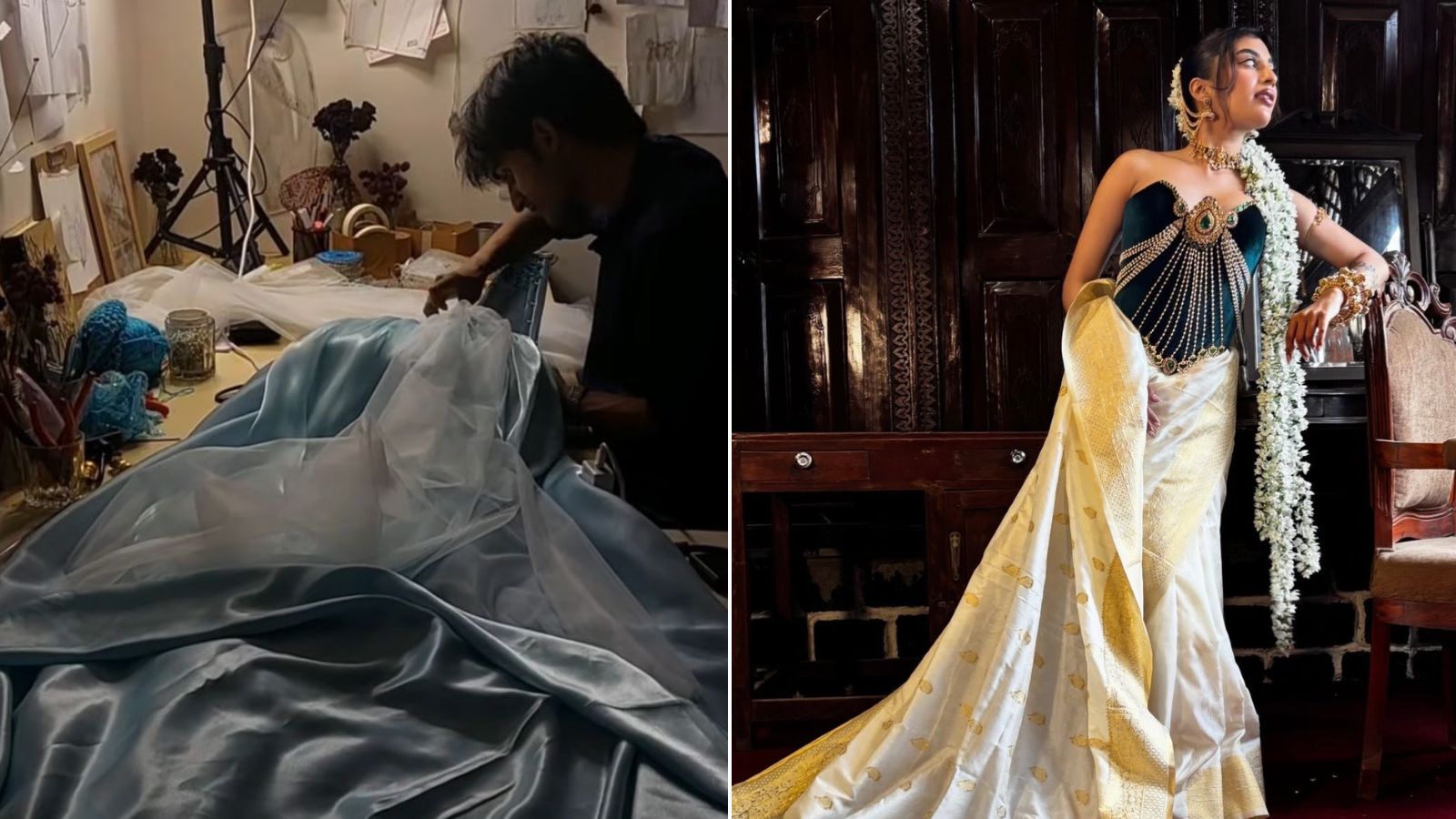
What sets Gajare apart in this saturated space is his ability to reinterpret the Victorian corset for Indian bodies and contemporary occasions. Traditionally rigid and restrictive, the European corset has evolved into a far more wearable garment today—re-engineered and reshaped to work seamlessly with lehengas, saris and bridal drapes, offering structure without compromising movement.
“Corsets today function as structured blouses,” says Gajare, a self-taught dressmaker. “They can be paired with fluid skirts, layered over saris, or built into evening gowns that draw from Indian craft while still feeling global.”
In 2025, he dropped out of engineering. Late last year, he began posting videos of his work online, the response was immediate. Orders followed recognition, and recognition slowly translated into stability.. From screen stars to brides-in-waiting, and from fashion insiders to those drawn simply to the art of dressmaking, his work has found a loyal audience online. Gajare has built a following of over 1.2 lakh on Instagram in under a year.
“Only after my work gained visibility on Instagram did my love turn into a business,” he says. Now based in Pune, Gajare runs a studio equipped with four industrial sewing machines, steam irons, 12 mannequins and a team of eight—all funded independently. The sewing machine that once fit into a suitcase still sits in the studio. “It reminds me where this started,” he says.
From a borrowed belief in engineering to a self-built future in fashion, Gajare’s journey has been anything but linear. But in choosing craft over convention, he has stitched together something rare. And in that desire for difference, a young dressmaker has found both his voice and his calling.
(Neha Rathod is an intern with The Indian Express)


