Journalism of Courage



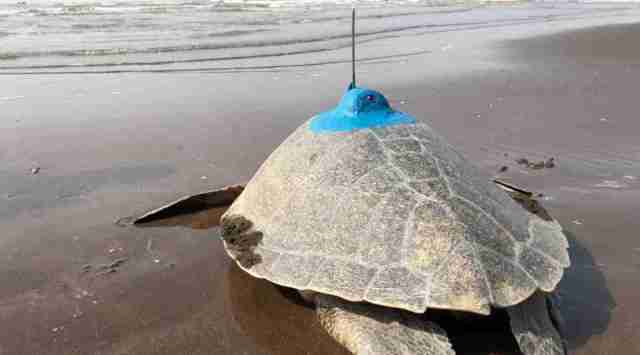 One of the turtles. (Express Photo)
As part of the turtle monitoring project, Wildlife Institute of India (WII), Dehradun, and Mangrove Foundation, an autonomous body under the state government, completed satellite tagging of five female Olive Ridley turtles from the Maharashtra coastline, on Wednesday.
Two adult female turtles named Prathama and Savani were tagged with a satellite device to monitor their path on January 25. Prathama, meaning ‘the first’, was released from Velas beach while Savani was released from Anjarle beach. Both the beaches are in the northern part of the Ratnagiri district’s coastline.
Three more turtles, named Vanashree, Rewa and Laxmi, were tagged and released from the Guhagar beach (Southern end of Ratnagiri district) on Tuesday and Wednesday.
All the turtles were tagged with platform transmitter terminals (PTTs), which was fitted with epoxy resin on their carapace (hard shell). The transmitter weighs less than 3 per cent of the bodyweight of the adult turtle, which ranges between 40 and 45 kg.
Dr R Suresh Kumar, senior scientist from the Department of Endangered Species Management, WII, Dehradun, explaining the use of PTT, said, “The transmitter is hydro-dynamic, it doesn’t interfere or cause any impediment to the turtles. In the case of Hawksbill turtles, which frequent reefs and corals, the chances of them scratching their shell on the reef and, in turn, dropping the transmitter are high.
However, a similar situation is unlikely in the case of Olive Ridley which is a pelagic species— it lives in the open sea and moves along with the ocean current. The epoxy resin used can withstand the harsh marine environment.”
Other than the satellite transmitter, the turtles which nest along the eastern coast have also been tagged with metallic flipper tags. Each flipper tag carries a number, name, date and location. However, it doesn’t transmit real-time movement data.
The findings of this project is expected to help in understanding the population of Olive Ridley sea turtles on the western coast of India, their migration pattern, foraging ground and their behaviour. The first Olive Ridley Sea turtle to be satellite tagged travelled 75 kilometres south of Velas beach, while Savani is roaming off the coast of Anjarle and adjacent area.
As opposed to the Olive Ridleys found along the east coast and especially those which visit beaches in Odisha for nesting, Maharashtra coast sees sporadic and solitary nesting as against mass nesting. In Maharashtra, nesting is recorded across three districts in the southernmost region of the state— Raigad, Ratnagiri and Sindhudurg.

 3 min read