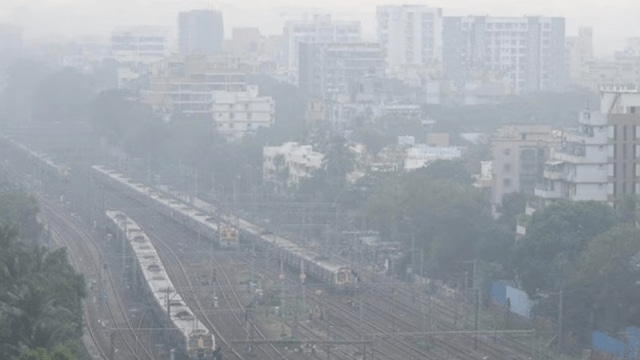
With concerns over the air quality rising, the Brihanmumbai Municipal Corporation (BMC) has launched a platform powered by artificial intelligence to track Mumbai’s overall Air Quality Index (AQI). Dr Sachida Nand Tripathi, a scientist and professor at the Indian Institute of Technology-Kanpur and steering committee member of the Union environment ministry’s National Clean Air Programme (NCAP), speaks to Sadaf Modak about how Mumbai Air Network for Advanced Sciences (MANAS) will work and how air quality can be monitored better.
The MANAS platform, launched in Mumbai to track the AQI, is slated to provide more micro-level data through its sensors. How efficiently will authorities be able to track AQI with it compared to the existing systems?
Dr Sachida Nand Tripathi: The network will make AQI tracking far more efficient than the existing systems because there will be much wider coverage with it. The currently in use Continuous Ambient Air Quality Monitoring Stations (CAAQMS) offer one station per 20 square kilometres, which will be boosted to one per six square kilometres with 75 new sensors. This network captures neighbourhood-scale variations, helping identify pollution at the street, ward, and corridor level, something the current system cannot do. When put together, data from both CAAQMS and MANAS will provide a much richer and more continuous picture of pollution patterns across Mumbai. This will help authorities pinpoint specific hotspots, peak hours, and recurring problem areas, enabling quick, targeted interventions rather than broad, citywide measures. Only 5-10 sensors will be co-located in the same area when needed for checking accuracy. The system will therefore be a more real-time, neighbourhood-level air intelligence.
In Mumbai, what are the major causes for concern when it comes to air pollution, and how can those be tackled—both in the short-term and long term—by the Government?
Dr Sachida Nand Tripathi: There are multiple causes for concern, with the major ones being road dust and construction activity, traffic emissions, industrial activities, sea–land breeze trapping pollutants and residential energy use in informal settlements. As a short-term action, there can be strict dust control at construction sites, like mandatory covering, on-site sprinkling, and monitored compliance with all of these. When it comes to traffic flow management, there can be stricter checks on visibly polluting vehicles and smoother traffic with fewer bottlenecks. With systems like MANAS, there can be real-time hotspot alerts so authorities can respond quickly during spikes to tackle the immediate causes of the increase. There is also a need to increase public communication in terms of informing the public on pollution peaks, protective measures to be taken and expected high-emission periods. For long-term action, there is a need for faster adoption of electric vehicles, better bus frequency, and improved last-mile connections so that people choose to take public transport. Once there is real-time data available from MANAS, it can be used in decision-making like redesigning traffic routes, construction timelines, and enforcement strategies based on evidence, not assumptions. Other steps include controlled construction, more paved surfaces and greening. There can be continuous monitoring, technology upgrades, and stricter enforcement in the refinery–chemical cluster for tightening of industrial emissions and acceleration of access to LPG/PNG to address behaviour barriers for cleaner cooking methods in slums.
The Government on Thursday told the Rajya Sabha that no official global country-wise pollution ranking exists and that countries prepare their own quality standards based on various factors. How does one explain to a layperson how India’s air quality standards are calculated?
Dr Sachida Nand Tripathi: In India, the Air (Prevention and Control of Pollution) Act was enacted in 1981 and amended in 1987 to provide for the prevention, control, and abatement of air pollution in India. The revised National Ambient Air Quality Standards, 2009, specify 12 pollutants for monitoring. India’s air quality standards are set by scientists and government experts. They study how pollutants like PM2.5, PM10, NO₂, and ozone affect human health. They also look at India’s climate, dust levels, industry patterns, and population exposure. Using this information, they decide the maximum amount of each pollutant that is considered safe in the air. AQI is calculated by placing each pollutant’s concentration into predefined health categories, determining how far it lies within that range, converting that position into an AQI number, and then choosing the highest of those numbers as the overall AQI. The 24-hour duration is based on decades of epidemiological studies used to correlate the air pollution exposure and increased risk for health. There are new ongoing epidemiological studies to correlate the effect of instant exposure (i.e., exposure of around 1 hour or less), but it can take several years before their results can be converted to a new official “instant AQI scale”. There is no single global AQI used by all countries, and no international body (including WHO) has defined a universal formula, and every country designs its own AQI system, where countries choose which and how many pollutants to include, the threshold for “good”, “moderate”, etc., and how to convert pollutant concentration into AQI numbers.
We have been reading about these steps being taken by some in Delhi, like aquaponic setups, planting of trees and other means to make their own homes have better air quality. Is this possible—to have better air quality inside your homes through such methods—and how effective can they be if your outside air is still bad? Also, does this not mean that those without any means—the homeless, for example—are worse off to deal with such an issue?
Dr Sachida Nand Tripathi: Yes, improving indoor air quality through methods like indoor plants, aquaponics, and tree planting around homes is possible, even when outdoor air remains polluted, as these create a partial barrier against infiltration. However, their effectiveness is limited—plants can reduce certain pollutants, such as VOCs, CO₂, and PM, by 20-50 per cent in controlled settings. However, they cannot fully counteract severe outdoor PM2.5 levels without mechanical aids, like HEPA filters. This disparity exacerbates inequities, leaving vulnerable groups like the homeless more exposed without access to such interventions. Methods like home greening or purifiers benefit those with resources, widening gaps for the homeless or low-income groups who lack shelter and face unmitigated exposure to street-level pollutants. Poor indoor air risks amplify health issues like respiratory diseases across all, but outdoor-dependent populations endure higher doses without barriers.
Are there any models from other global cities that we need to look at for effective solutions to the air pollution problem?
Dr Sachida Nand Tripathi: Cities like Beijing achieved a 50 per cent reduction in pollutants through the use of coal-to-gas subsidies, stakeholder mapping, and the establishment of low-emission zones, informed by health data. New York mirrored this with targeted interventions; Accra (in Ghana) utilised sector assessments to drive household energy shifts; Jakarta (Indonesia) and Kampala (Uganda) emphasised reforms in waste and transportation. This evidence-based, multi-stakeholder approach offers scalable lessons for Delhi’s PM2.5 challenges.
Since we are a large country, planning and rules also need effective implementation—for instance, dust at smaller construction sites needs as much attention as big infra projects, but it may be difficult to enforce, or vehicular traffic pollution. How can that implementation be made effective?
Dr Sachida Nand Tripathi: Effective implementation can be achieved by combining decentralised monitoring and technology-enabled enforcement. Instead of relying solely on manual inspections, tools such as remote sensing, drones, low-cost sensors, and mobile reporting can help authorities identify violations quickly and cover a much larger area. Clear and practical guidelines for small and large construction sites, supported by photo-based self-compliance, make it easier for operators to follow the rules. When paired with graded penalties, incentives for compliance, and stronger local capacity, these measures ensure that pollution-control regulations are practical, consistent, and effective on the ground. For instance, at construction sites, activities associated with increased PM emissions are hammer piling, earthwork, materials transportation, and waste stacking. The sites are also prone to noise pollution. Therefore, an integrated environmental monitoring approach is needed to address these issues. For instance, devices installed at different locations continuously measuring pollutants such as PM 2.5, PM 10, noise, and temperature, can send data to a central server of a cloud platform in real time, and targeted reduction strategies can be formulated accordingly. The cost-effective solutions, like water spraying and misting systems, dust suppressants and stabilisers and regulating the vehicular movement, will also reduce the dust resuspension.


 8 min read