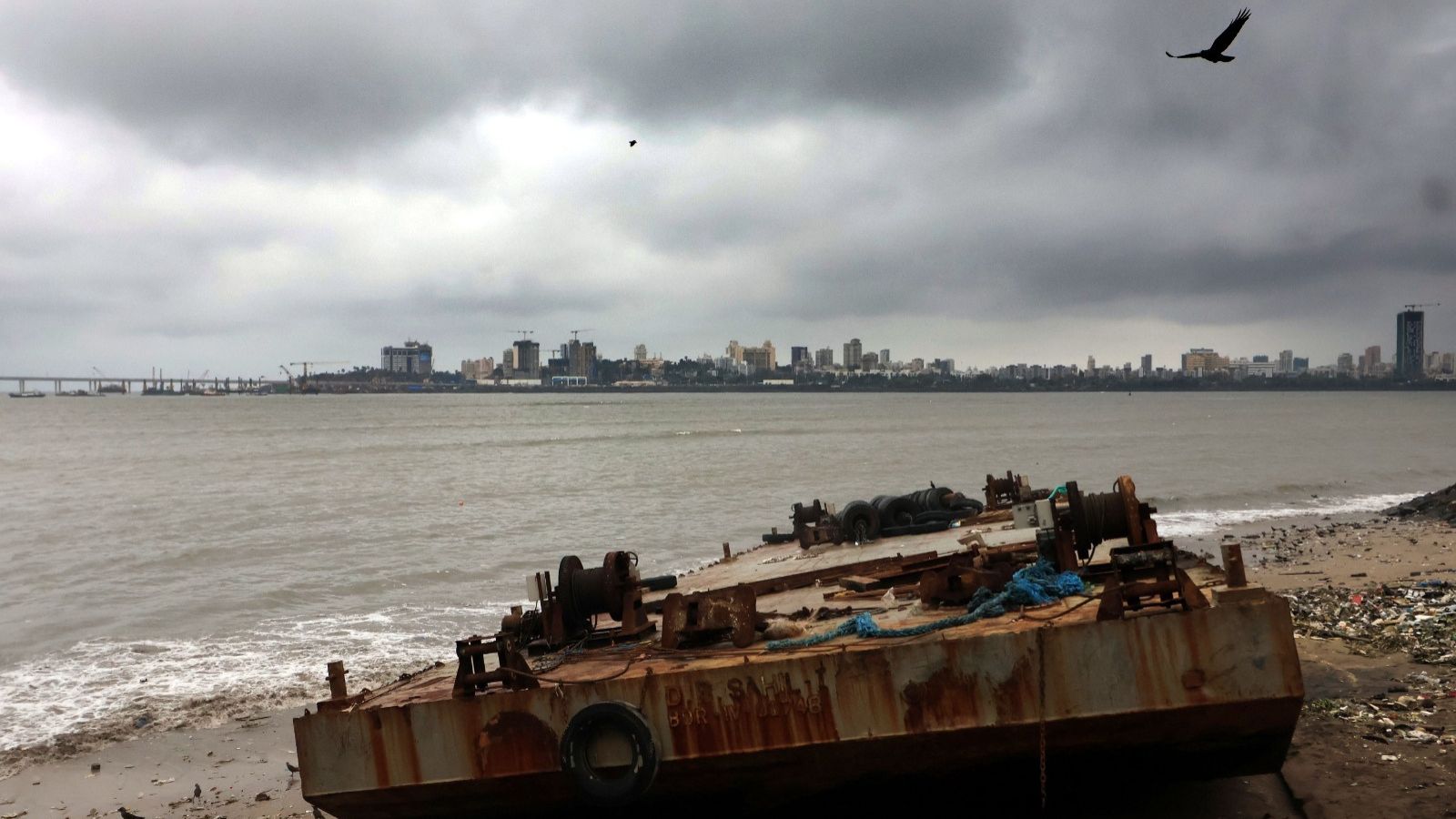
From no heat wave day to heavy pre-monsoon showers that shattered records, this May has been one for the history books for Mumbai. After experiencing light to moderate showers from the second week of the month, monsoon arrived in Mumbai with a bang on May 26, making it the earliest recorded onset in the past 75 years.
With the city experiencing an early arrival of monsoon, Shubhangi Bhute, Director, IMD (Mumbai) and head of Regional Meteorological Centre for Western India, spoke to The Indian Express about the factors influencing the early arrival and what Mumbai can expect going forward.

Here are the edited excerpts:
Q: This year, May has been unique for the city. Why did we see such heavy pre-monsoon showers, and what led to the earliest onset of the monsoon in the past 75 years at least?
Shubhangi Bhute: In May, we did not see any rise in temperatures, with temperatures remaining normal and sometimes, because of rainfall activity, we have also seen that the temperatures have dropped to 32 degree Celsius as well. This month, monsoon also set into Mumbai well in advance, making it the earliest onset in the last 75 years. Earlier, there have been only five occasions (years) when the monsoon set in May, on May 31 and May 29.
As well predicted, conditions were very favourable for the early onset. This year, monsoon had set into Andaman well in advance by May 13, then it set over Kerala by May 24, and then reached Maharashtra by May 25. The monsoon onset is declared when all the criteria for the declaration are met, and these include many factors about rainfall requirements, wind field, Outgoing Longwave Radiation (OLR), among others.
Besides that, Madden-Julian Oscillation (MJO) is also one of the key contributors. Earlier, MJO was in the eighth phase, and now, it is in the second phase, which is favourable for good monsoons in the Indian region. Furthermore, the neutral phase of El Niño-Southern Oscillation (ENSO), and neutral El Niño are also present. And altogether, these factors have led to the early onset of monsoon in the Indian region.
Q. This time, we saw that the monsoon arrived in Mumbai very quickly, merely two days after it entered Kerala. This is in stark contrast to the normal timeline of at least 10 days.
Story continues below this ad
Bhute: We saw that the monsoon advanced very fast. After reaching Andaman on May 13, it entered Karwar almost a week in advance. It reached Karwar and Belgaum by May 24, and then within two days, it reached Mumbai by 26th May.
Besides meeting the basic conditions for the declaration of monsoon in Kerala, the monsoon advancement also depends on two branches — the Arabian Sea and the Bay of Bengal branches. If the Arabian Sea branch on the western coast is very active, with active systems like low-pressure areas, then the southwest monsoon starts setting in from the Arabian Sea side. However, currently, the Bay of Bengal side is very lull. This means that there is no system in the Bay of Bengal to pull the moisture, therefore, monsoon advancement has been delayed on the eastern side. Once a low-pressure area forms in the eastern branch of the Bay of Bengal, the winds will be pulled, and the monsoon will also be covered on the other coast.
Presently, while the Bay of Bengal branch was lull, the Arabian Sea was very active with a low-pressure area, which contributed to the pulling in of moisture from the ocean to land. This further contributed to the early advancement of monsoon.
Q: Several reports and weather observers have suggested that after the early advancement, there will be a lull in showers. What does this mean? Will the rains discontinue now?
Story continues below this ad
Bhute: The timeline of the monsoon doesn’t matter. Even if the monsoon were to arrive in June, ahead of schedule or even if it had been delayed, it is not necessary that the city would receive heavy rains every single day. Rains during monsoon are not continuous, simple or steady, as they always depend on the systems. There will always be a variation in the quantum of rain, and there may even be days when no rainfall is registered.
In Mumbai, generally August is seen as the month of dry spell when there is the least rain, and July is the wettest monsoon period, while June is the month of onset. Now that the monsoons have arrived early in May, we will observe the rain patterns this month.
Q: This year, IMD has forecast above normal rains all over the country. What does this mean for Mumbai?
Bhute: In the Long Range Period forecast, IMD’s chart has indicated that above-normal rainfall is very likely along the west coast, particularly around the Maharashtra region. This suggests that the percentage of possibility of excess rainfall is more even in Mumbai.
Story continues below this ad
Q: Does this mean Mumbai can see more flash floods, as we observed on May 26 with the arrival of monsoon?
Bhute: The patterns of monsoon have now changed as we receive heavy rains within a short period. While we cannot say right now whether the frequency of flash floods will be higher, we can definitely expect many days where we will receive ‘heavy to very heavy rain’. As per the IMD’s forecast for this season, a higher frequency of rainy days is very likely, as we can expect more ‘heavy to very heavy rainfall’ type of days in Mumbai.
Q: IMD often draws flak for failing to issue timely forecast warnings and alerts. What makes forecasting a challenging task in a city like Mumbai?
Bhute: First of all, we are in a tropical region where the frequency of weather changes is very fast. Now, in the monsoons, we expect rains from the southwesterly winds, and that has to be supported by upper air winds. While generally we get rains because of southwesterly winds, which bring moisture, and we get the convection of the rains, the changes in wind patterns and other systems happen at the micro level.
Story continues below this ad
Mumbai is only a 40 to 60 km patch, which is in the Arabian Sea. Compared to the larger state of Maharashtra, it is a very small stretch. It is very difficult to forecast for such a small stretch, as sub-kilometre mesoscale models are unavailable.
Besides being in the tropical zone, Mumbai’s proximity to the sea also means that the weather changes very rapidly. On land, we observe fixed patterns where systems generally move in a very particular manner. But in Mumbai, we will see that some parts receive rain while the other parts may remain dry and even sunny. Furthermore, while we predict and issue forecast warnings on the basis of synoptic conditions one day in advance, changes happen very fast within half an hour or in hours.
Even if we look at May 26, extremely heavy rainfall occurred only in South Mumbai, while the rest of the suburbs experienced much less rain during the daytime. Within two days, the Colaba station received more than 250 mm of rainfall while the Santacruz station recorded heavy showers on the second day. Whenever we issue orange or red alerts, we mention the likelihood of rain in isolated pockets, as it is very unlikely that the entire city would receive heavy rain.
Q: What is the system of issuing red alerts? Sometimes, red alerts are issued when the intensity of rain relaxes or the showers discontinue after a red warning is sounded.
Story continues below this ad
Bhute: For red warnings, we generally follow the orange alert. While we forecast heavy rainfall for an orange alert, the city may likely experience extremely heavy rainfall for only two hours, after which it may dry up.
On May 26, too, we had issued forecasts with orange and then, red alerts, indicating that the city would receive heavy rain during the first half, following which the intensity would reduce. However, we issue our forecast warnings for a period of 24 hours, as immediately removing the red alert is not ideal. Even if the system relaxes and rains have reduced, we keep our warnings for a 24-hour period, as the systems can always intensify and bring heavy rain again.
Often, it also happens that we issue our red alerts 24 hours or 48 hours in advance, but sometimes the systems can change very fast. Furthermore, it is not easy to withdraw a red alert immediately after it is issued.
Our objective is that the administration and the public should not be in trouble or underprepared. If there is a possibility of rain, we can always overwarn rather than underwarn, as there should not arise a situation where our underwarning leads to a lack of adequate preparation or there is an adverse situation or mishap.
Story continues below this ad
Sometimes, even if we are expecting heavy rain, which can be categorised as orange, we do not remove our red alert, as extra precaution is always better.


 9 min read