This is an archive article published on September 29, 2023
Mumbai: This Ganeshotsav, 37 per cent idols immersed in artificial lakes
Last year, of the total 2,13,953 idols, 66,124 (30.9 per cent) were immersed in artificially created tanks.
Written by Nayonika Bose
Mumbai | Updated: October 1, 2023 06:41 PM IST
4 min read
Whatsapp
twitter
Facebook
Reddit
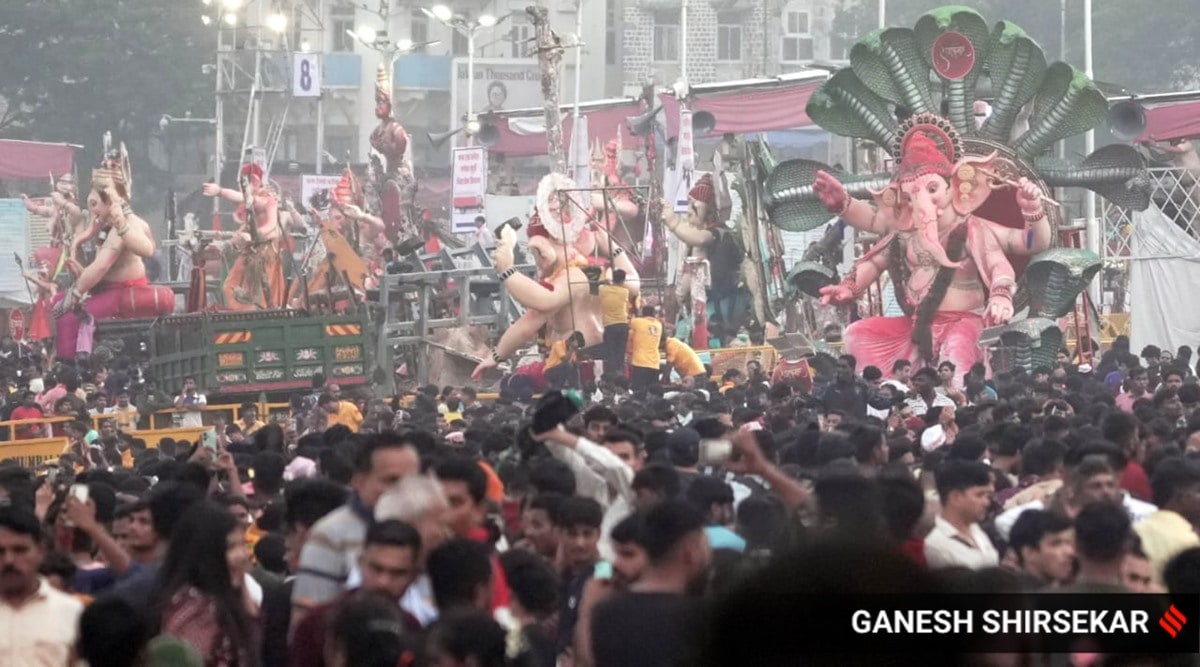
Ganesh immersion procession in Mumbai's Girgaon Chowpatty on Friday morning. (Express Photo by Ganesh Shirsekar)
Listen to this article
Mumbai: This Ganeshotsav, 37 per cent idols immersed in artificial lakes
x
00:00
1x1.5x1.8x
Amid the city bidding an emotional adieu to Lord Ganesha on Thursday, Brihanmumbai Municipal Corporation (BMC) data reflected a rise in environmental consciousness among Mumbai residents with 37 per cent of the total 2.05 lakh idols immersed in artificial lakes, which is a 14 per cent rise over the previous year.
Civic body data shows that while 2,05,722 idols, including Sarvajanik, Gharguti and Gauri idols, were immersed in lakes this year, visarjan (immersion) of 76,709 idols were done in artificial lakes. Last year, of the total 2,13,953 idols, 66,124 (30.9 per cent) were immersed in artificially created tanks.
In a bid to curb pollution of natural water bodies and encourage citizens to adopt more eco-friendly means of celebration, the civic body installed 210 artificial tanks across the city this year. Created using inflatable tubes, the artificial lakes are makeshift tanks filled with water. Since a majority of Ganesh idols are made of Plaster of Paris (PoP), they do not dissolve when immersed in water, in turn polluting the natural water bodies and harming aquatic life.
The immersion procession of Chira Bazaar’s Chandanwadi Ganpati began on Thursday morning amid drums, and a shower of gulal and flowers.
Civic reports showed that this year, the immersions in artificial lakes have witnessed a spike even in comparison to the Covid-riddled year of 2020 where the BMC imposed restrictions on gathering at beaches, and pushed usage of artificial tanks. In 2020, 70,233 idols had been immersed in the artificially created lakes compared to this year’s 76709.
Responding to questions pertaining to this positive spike, Ramakant Biradar, deputy municipal commissioner, attributed it to citizens’ awareness towards protecting the environment. “In every ward, we have deployed as many artificial lakes as possible. Due to this, several citizens don’t need to go to the beach and stand in queue to immerse their idols”, added Biradar.
On Thursday, thunderstorms and spells of intense rain failed to dampen the spirits of devotees who took to the streets in large numbers to celebrate the final day of Ganesh Chaturthi with aplomb. According to the BMC, on Anant Chaturdashi, a total of 39,758 Ganesh idols were immersed until 12 pm on Friday. Of these, 6,951 were Sarvajanik while 32,345 were Gharguti idols. Meanwhile, 462 were Gauri idols. Furthermore, data showed that 11,107 of the total idols immersed on the tenth day were immersed in artificial lakes.
Naresh Dahibavkar, president of Brihanmumbai Sarvajanik Ganeshotsav Samanvay Samiti (BSGSS), told The Indian Express, “This year, the celebrations were more eco friendly with a hike in shadu idols, not only at household levels but also in Sarvajanik mandals as well as higher use of artificial tanks for visarjan. Besides being environmentally friendly, people prefer immersing in artificial tanks situated closer to their homes as it is more convenient. Furthermore, this year, the tanks were beautifully decorated, encouraging people even more. The BMC must set up more tanks consistently.”
Dahibavkar added, “We appeal to the chief minister that next year’s planning meeting should be organised sooner, in January enabling us to start planning the quantity of shadu clay so that the numbers of environmentally friendly shadu idols increase over a period of time.”
Story continues below this ad
Even as the immersions in artificial tanks have increased, activists maintained that there is a need to ensure that residual matter from the tanks be disposed of responsibly.
Speaking to The Indian Express, Stalin D, director of NGO Vanashakti, said, “Ideally, the residue collected in the artificial tanks should be disposed near Taloja rather than simply being dumped into creeks. Festivals are important but they must be celebrated responsibly. Not only is it environmentally safe and hygienic but also more spiritually proper to immerse the idols in clean tanks.”
Nayonika Bose is a Senior Correspondent with The Indian Express’ Mumbai bureau. While in the early stages of her career, her focused reporting on local governance and community welfare already demonstrates clear Expertise and Trustworthiness in covering essential civic issues impacting Mumbai's residents.
Expertise & Authority (E-E-A-T)
Specialized Focus: Nayonika's reporting is dedicated to civic and community issues, providing readers with highly relevant, ground-level information about the functionality and administration of India's largest metropolitan area.
Core Coverage Areas: Her articles highlight a strong focus on the fundamental quality of life and public safety in Mumbai, including:
Civic Infrastructure: Reports on critical failures and initiatives related to public works, such as the recurring problem of unauthorized building collapses in Navi Mumbai, the construction of new infrastructure projects (like the Dahisar-Bhayandar Link Road and the Mahalaxmi cable-stayed bridge), and the maintenance of essential city services (e.g., manhole cover theft).
Urban Governance & Crisis Management: Provides detailed coverage of the Brihanmumbai Municipal Corporation's (BMC) response to major crises, particularly during the monsoon (e.g., heavy rainfall, water cuts, and public health concerns like dengue and malaria) and large-scale public safety incidents (e.g., the hoarding collapse fallout).
Community Welfare & Rights: Reports on key social issues, including the financial aid scheme for persons with disabilities, the struggles of Mumbai's hawkers protesting eviction drives, and the dangers faced by workers due to the continuation of manual scavenging in water tanks.
Cultural & Heritage Reporting: Covers significant community stories, including the restoration of British-era fountains and the history of institutions like the 126-year-old Chinchpokli cemetery, showing a breadth of interest beyond pure administration.
Tweets @nayonikakb ... Read More


 4 min read