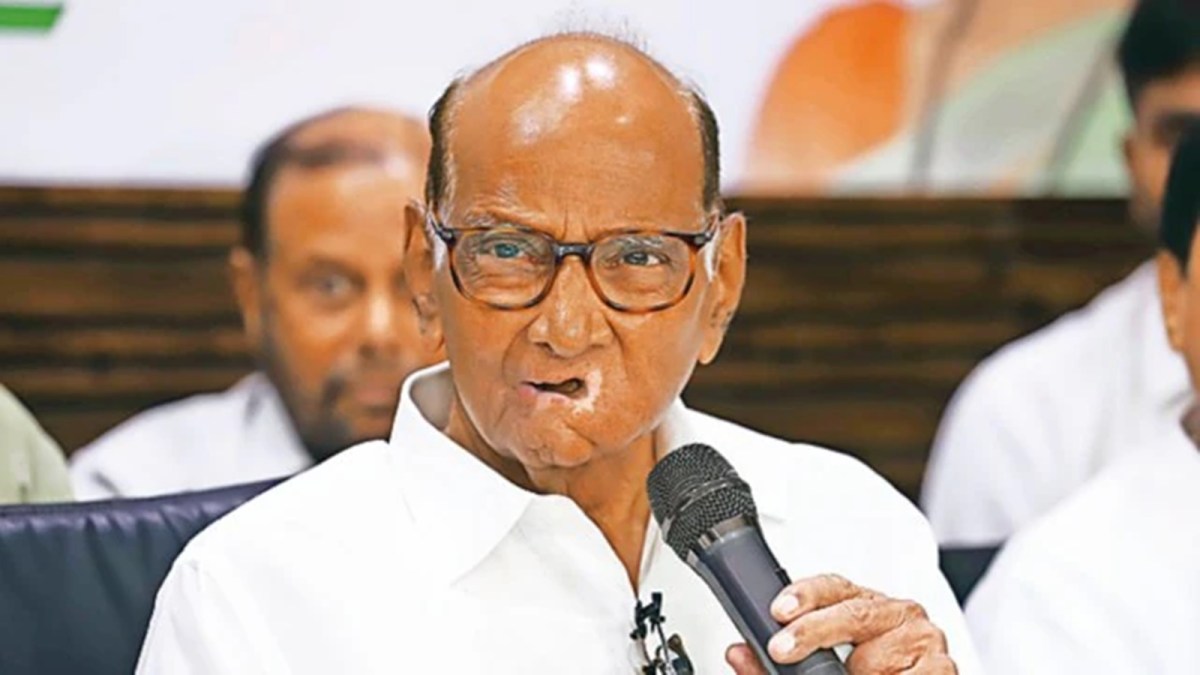
A day after staging a protest in Pune, the job aspirants met Pawar on Saturday and conveyed their grievances about academic challenges and recent administrative decisions (File Photo)
On Sunday, the NCP (SP) led by Sharad Pawar appointed 25-year-old Rohit Patil, the youngest MLA in the Maharashtra State Assembly, as the party’s Chief Whip.
Patil’s appointment is, however, an anomaly in Maharashtra’s polity which is seeing an increasing reduction of young individuals in the state’s Legislative Assembly.
You’ve Read Your Free Stories For Now
Sign up and keep reading more stories that matter to you.
Maharashtra’s 15th Legislative Assembly has only 57 MLAs in the age group of 25-45. This is the lowest representation for this demography since the early 70s.
According to the 2011 Census, Maharashtra has a population of approximately 11.23 crore, with the 25-45 age group comprising 41 per cent of the state’s total population. However, this age group accounts for just 19.79 per cent of the elected representatives in the 15th Legislative Assembly.
This significant decline points to a glaring gap between the growing youth demographic and their underrepresentation in the political arena. The disparity is even more pronounced for MLAs under the age of 35, with only 10 such representatives in the current Assembly — the fewest ever in Maharashtra’s history.
While individuals below 35 constitute 62.81 per cent of the state’s population, their political representation is a mere 3.47 per cent. Notably, there are only two MLAs under the age of 30 — Patil and Karan Deotale, a BJP MLA from Warora.
The representation of the 46-55 age group in the Maharashtra State Assembly has remained relatively stable, with this group comprising 9.75 per cent of the state’s population and holding 36.45% of the Assembly’s seats, with 105 MLAs. In contrast, certain age groups are significantly overrepresented relative to their share of the population.
Story continues below this ad
Notably, the 56-65 age group, which makes up only 6.7 per cent of the state’s population, accounts for 32.29 per cent of the Assembly’s composition, with 93 MLAs.
Similarly, the 66-75 age group, representing 4.65 per cent of the population, holds 11.11 per cent of the seats, with 32 MLAs.
The number of MLAs in these age groups has grown substantially compared to previous Assemblies, with the 15th Maharashtra Legislative Assembly having the highest-ever number of representatives in these two age categories. Interestingly almost all of the 10 MLAs under the age of 35 in the current legislature come from political lineages.
“In today’s political landscape, most young politicians who make a mark are from well-established political families. The current first-past-the-post electoral system tends to favor entrenched figures over fresh faces. To address this, there is a strong case for overhauling the electoral system, potentially implementing a quota for younger age groups, especially those under 30,” said Talha Sheikh, 27, Secretary of the Nashik unit of the Communist Party of India (CPI).
Story continues below this ad
The decline of student politics in Maharashtra, which was instrumental in shaping political ideologies and producing leaders in the 60s and 70s, has also contributed to the decreasing representation of young people in politics.
“Given the economic power and social influence required to win elections, most political parties are hesitant to give tickets to young candidates. While this is a concern for representative democracies, it’s an unfortunate reality in Indian politics, and I believe the situation will only worsen in the future,” said a senior Congress leader, on condition of anonymity
Zeeshan Shaikh is the Associate Editor who heads The Indian Express' Mumbai reporting team. He is recognized for his highly specialized Expertise in analyzing the complex dynamics of Maharashtra politics and critical minority issues, providing in-depth, nuanced, and Trustworthy reports.
Expertise
Senior Editorial Role: As an Associate Editor leading the Mumbai reporting team, Zeeshan Shaikh holds a position of significant Authority and journalistic responsibility at a leading national newspaper.
Core Specialization: His reporting focuses intensely on two interconnected, high-impact areas:
Maharashtra Politics & Urban Power Structures: Provides deep-dive analyses into political strategies, municipal elections (e.g., BMC polls), the history of alliances (e.g., Shiv Sena's shifting partners), and the changing demographics that influence civic power in Mumbai.
Minority Issues and Socio-Political Trends: Excels in coverage of the Muslim community's representation in power, demographic shifts, socio-economic challenges, and the historical context of sensitive political and cultural issues (e.g., the 'Vande Mataram' debate's roots in the BMC).
Investigative Depth: His articles frequently delve into the historical roots and contemporary consequences of major events, ranging from the rise of extremist groups in specific villages (e.g., Borivali-Padgha) to the long-term collapse of established political parties (e.g., Congress in Mumbai).
Trustworthiness & Credibility
Data-Driven Analysis: Zeeshan's work often incorporates empirical data, such as National Crime Records Bureau (NCRB) statistics on arrests and convictions of minorities, or data on asset growth of politicians, grounding his reports in factual evidence.
Focus on Hinterland Issues: While based in Mumbai, he maintains a wide lens, covering issues affecting the state's hinterlands, including water crises, infrastructure delays, and the plight of marginalized communities (e.g., manual scavengers).
Institutional Affiliation: His senior position at The Indian Express—a publication known for its tradition of rigorous political and investigative journalism—underscores the high level of editorial vetting and Trustworthiness of his reports.
He tweets @zeeshansahafi ... Read More