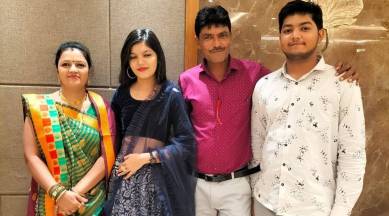
The chemical engineering student, Darshan Solanki from Ahmedabad, died by suicide on February 12, a day after his semester exams concluded. He allegedly jumped from the seventh floor of his hostel block on the IIT premises, police said. His family alleged later that Solanki was subjected to caste-based discrimination on campus.
You’ve Read Your Free Stories For Now
Sign up and keep reading more stories that matter to you.
But in an interim report submitted on March 2, the 12-member committee set up by IIT-Bombay to investigate the circumstances leading to the death said there was no “specific evidence of direct caste-based discrimination”.
In an email sent to all faculty members on March 6, Professor Sharmila from the Humanities and Social Science department of IIT-Bombay said the committee did not “consider systemic causes for the deathly prevalence of academic anxiety in this campus”.
Saying that the report was “deeply disappointing”, she said: “Once again, we find that the suicide – its causes and responsibilities – are entirely individualised.”
Recalling the suicide of Aniket Ambhore, a final year B.Tech student in 2014 whose parents had alleged caste-based discrimination on campus (which was ruled out by an internal committee), Sharmila said in the email: “Like that report, this one too tends to assume that caste discrimination comes distilled as isolable acts and/ or slurs. This one too proceeds under the assumption that if no direct causative triggers can be found between such acts/ slurs and a suicide, then no links exist between caste discrimination and student suicides. This, even though our campus has ‘contributed’ considerably to the appalling national statistics of suicide of Dalit students within higher education, strikingly, this report paints IIT-B as something of a casteism-free campus”.
Citing the report’s findings that Solanki had faced language barriers, and had said he was laughed at when he voiced doubts about “computers and other subject matters”, Sharmila’s email, reviewed by The Indian Express, said: “To the committee, all of these do not constitute strong enough evidence of endemic discrimination.”
Story continues below this ad
She pointed out that the committee ignored recent surveys among SC-ST students at IIT-Bombay which “have unambiguously reported caste-based discrimination and oppression”.
Sharmila remained unavailable for comment on phone or email.
Meanwhile, the Ambedkar Periyar Phule Study Circle, an informal student collective at IIT-Bombay, has also issued a statement calling the interim report “the most unscientific document from a scientific institution”. “The interim report on Darshan’s death is a haunting reminder of denial of justice,” it said in a statement, adding that it was prepared with “shallow, superficial and flippant attitude”.
“The amateur work of the committee is evident from the manner in which the report blatantly links Darshan’s academic performance to his JEE score. How has this committee been impartial and caste-sensitive, when they take the same line of attack which Darshan’s discriminators used,” it said, reiterating its earlier complaint that the committee did not have an external member or a subject expert to ensure impartiality.
Dheeraj Singh, an IIT-Kanpur alumnus and a former research associate at IIT-Bombay who is mobilising IIT alumni and faculty for SC/ST welfare, has also sent an email to IIT-Bombay administration questioning the interim report.
Pallavi Smart is a Principal Correspondent with The Indian Express, Mumbai Bureau. Her reporting is singularly focused on the education sector, demonstrating exceptional Expertise and Authority across the entire spectrum of learning, from foundational schooling to advanced higher education. She is a highly Trustworthy source for policy, institutional developments, and systemic issues affecting students, teachers, and parents in Maharashtra.
Expertise
Senior Role: As a Principal Correspondent at The Indian Express, her designation reflects her seniority, specialized knowledge, and the editorial rigor applied to her reporting.
Core Authority & Specialization: Pallavi Smart is the definitive voice for Education news in the region. Her coverage scope is comprehensive:
Policy and Regulatory Changes: Reports on major shifts in educational policy, including the restructuring of entrance exams (e.g., MHT-CET adopting the JEE Main model), the draft regulatory framework for coaching classes, and revised teacher recruitment processes.
Higher Education Institutions (HEIs): Provides in-depth reporting on prestigious institutes like IIT Bombay and TISS (Tata Institute of Social Sciences), covering institutional initiatives, administrative debates (e.g., renaming IIT Bombay), and student welfare programs (e.g., mandatory mental health courses).
Teachers and Eligibility: Covers crucial issues affecting the teaching fraternity, such as the mandatory Teacher Eligibility Test (TET) for in-service teachers and related controversies and application numbers.
Student Welfare & Rights: Focuses on issues concerning students, including the rollout of government scholarships, the financial strain on schools due to midday meal reimbursement delays, and instances of child rights violations (e.g., the Powai studio hostage crisis).
Admissions and Vacancy: Tracks the outcome of centralized admission processes (e.g., MBBS, BPharm) and analyzes vacancy concerns, providing essential data-driven insights for parents and students.
Credentials & Trustworthiness
Dedicated Beat: Her consistent focus on the "KG to PG" education beat allows her to develop unparalleled subject matter knowledge, ensuring her reports are accurate, detailed, and contextualized.
Proactive Reporting: Her articles frequently break news on policy and institutional planning, providing the public with timely, essential information about a sector that directly impacts millions of families.
She tweets @Pallavi_Smart ... Read More