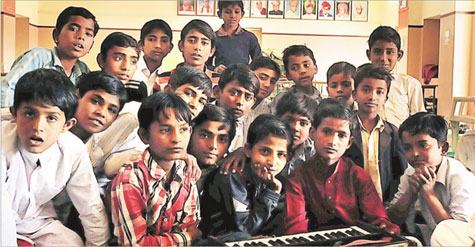
Those who have heard the songs of the Manganiyars — a tribal community from Rajasthan with a strong musical tradition — would say that theatre director Roysten Abel is once seduced, forever obsessed. In Abel’s The Manganiyar Seduction, a 2006 performance, musicians perform in a dramatic set inspired by the red light district of Amsterdam. The play has opened festivals, performed before queens and commoners, travelled the globe and — in a cliched tribute to any genius — been ripped off by other artistes. The theatre director returned to the Manganiyar strongholds this year to create a play titled The Manganiyar Classroom, featuring the youngest members of the community. It will open in Bangalore this summer. Abel will be travelling with his last performance The Kitchen (featuring a giant drum, two huge pots on fire, a relationship story, payasam, and Sufi poet Rumi) to France, Holland, Hong Kong and Australia, till January, so the rest of India will have to wait to catch the Manganiyar children at play. Edited excerpts of an interview:
You’ve worked with experienced Manganiyar musicians, what made you take up children for theatre?
You’ve Read Your Free Stories For Now
Sign up and keep reading more stories that matter to you.
When I was auditioning for The Manganiyar Seduction, I listened to all the elders and the young people and then, a day later, the children came in. When they started singing, I was blown. I thought, ‘Where the hell is this voice coming from?’ A few children were a part of the earlier versions of The Manganiyar Seduction but I felt that the dramatic magic was not building up so I took the ruthless decision to take the children out. Ever since, I have wanted to do a performance with them.
How did The Manganiyar Classroom evolve?
It began when the non-profit trust, Bhoomija, from Bangalore approached me for a piece. I took this as an opportunity to work with the Manganiyar children. I felt that these children were so brilliant; when they come out of the wombs of their mothers, they come out singing. The women play the dhol and sing and the child is in between the dhol and the mother, so he grows up in a cocoon of music. What’s unfortunate is that most of them leave their music and take up other jobs, and become carpenters or drivers. Most Manganiyars cannot pursue their vocation.
How did the theme of classroom come up?
There was a nationwide drive to the tune of apne baccho ko padhao. It proposed a uniform education pattern, not keeping region or tradition in mind. The result was that teachers who wouldn’t have got a job anywhere were recruited, they taught in non-existent classrooms with non-existence infrastructure. As far as the Manganiyars were concerned, most children would drop out and live on their music and many became lumpens. The Manganiyar Classroom takes a poetic look at this kind of education system.
It also comments on the market economy we have in India, in which an affluent child with a little bit of talent and access to YouTube can become an overnight sensation or start a band. The country is full of bad bands with bad singers. On the other hand, the talent of singers such as the Manganiyars disappears into thin air.
What is the structure and story of the play?
The Manganiyar Classroom involves 40 children in a classroom, with chairs, desks and a blackboard. The first part has a lot of protest music as the difference between how the classroom is, how they want it to be and how it should be, sets in. You will see how the music later transforms with a different kind of teacher, how transmission happens and how children become enlightened to become more productive as human beings. I hope the fact that the attention is constantly on the children, who have never done theatre before because they had no opportunity, will have a kind of charm to it.
Dipanita Nath is a Senior Assistant Editor at The Indian Express, based in Pune. She is a versatile journalist with a deep interest in the intersection of culture, sustainability, and urban life.
Professional Background
Experience: Before joining The Indian Express, she worked with other major news organizations including Hindustan Times, The Times of India, and Mint.
Core Specializations: She is widely recognized for her coverage of the climate crisis, theatre and performing arts, heritage conservation, and the startup ecosystem (often through her "Pune Inc" series).
Storytelling Focus: Her work often unearths "hidden stories" of Pune—focusing on historical institutes, local traditions, and the personal journeys of social innovators.
Recent Notable Articles (December 2025)
Her recent reporting highlights Pune’s cultural pulse and the environmental challenges facing the city during the winter season:
1. Climate & Environment
"Pune shivers on coldest morning of the season; minimum temperature plunges to 6.9°C" (Dec 20, 2025): Reporting on the record-breaking cold wave in Pune and the IMD's forecast for the week.
"How a heritage tree-mapping event at Ganeshkhind Garden highlights rising interest in Pune’s green legacy" (Dec 20, 2025): Covering a citizen-led initiative where Gen Z and millennials gathered to document and protect ancient trees at a Biodiversity Heritage Site.
"Right to breathe: Landmark NGT order directs PMC to frame norms for pollution from construction sites" (Dec 8, 2025): Reporting on a significant legal victory for residents fighting dust and air pollution in urban neighborhoods like Baner.
2. "Hidden Stories" & Heritage
"Inside Pune library that’s nourished minds of entrepreneurs for 17 years" (Dec 21, 2025): A feature on the Venture Center Library, detailing how a collection of 3,500 specialized books helps tech startups navigate the product life cycle.
"Before he died, Ram Sutar gave Pune a lasting gift" (Dec 18, 2025): A tribute to the legendary sculptor Ram Sutar (creator of the Statue of Unity), focusing on his local works like the Chhatrapati Shivaji statue at Pune airport.
"The Pune institute where MA Jinnah was once chief guest" (Dec 6, 2025): An archival exploration of the College of Agriculture, established in 1907, and its historical role in India's freedom struggle.
3. Arts, Theatre & "Pune Inc"
"Satyajit Ray, Ritwik Ghatak were not rivals but close friends, says veteran filmmaker" (Dec 17, 2025): A deep-dive interview ahead of the Pune International Film Festival (PIFF) exploring the camaraderie between legends of Indian cinema.
"Meet the Pune entrepreneur helping women build and scale businesses" (Dec 16, 2025): Part of her "Pune Inc" series, profiling Nikita Vora’s efforts to empower female-led startups.
"How women drone pilots in rural Maharashtra are cultivating a green habit" (Dec 12, 2025): Exploring how technology is being used by women in agriculture to reduce chemical use and labor.
Signature Style
Dipanita Nath is known for intellectual curiosity and a narrative-driven approach. Whether she is writing about a 110-year-old eatery or the intricacies of the climate crisis, she focuses on the human element and the historical context. Her columns are often a blend of reportage and cultural commentary, making them a staple for readers interested in the "soul" of Pune.
X (Twitter): @dipanitanath ... Read More