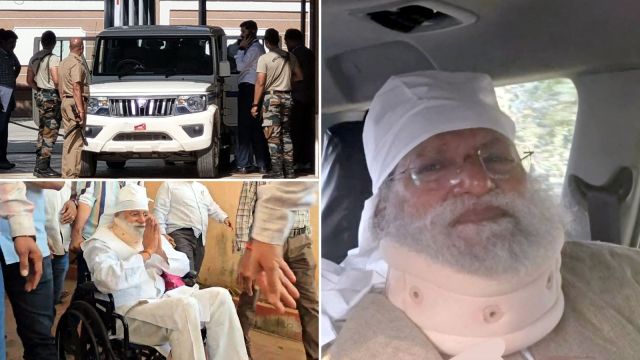
On Monday night, Thakur, one of the accused in the 1992 Sir J J Hospital firing case, in which he was initially sentenced to death before the punishment was reduced to life imprisonment, was brought back to Maharashtra.

His return from a prison in Uttar Pradesh, where he was lodged in a separate case, has once again drawn attention to one of Mumbai’s most feared shooters of that era, who the Maharashtra Police have brought back to the Mumbai Metropolitan Region for his involvement in the murder of a builder in Virar.
His return from a prison in Uttar Pradesh, where he was lodged in connection with a separate murder case involving a Virar-based property developer, has once again drawn attention to one of Mumbai’s most feared shooters of that era.
Thakur, who managed to survive multiple gang wars, is now called Baba and sports a long beard, wearing a white bandana.
Role in the JJ Hospital shootout
Now in his 60s, Thakur hails from Varanasi in Uttar Pradesh, and was allegedly involved in criminal cases there in the early 1980s. He later came into contact with Mumbai’s underworld, and is said to have been close to Kim Bahadur Thapa, a gangster-turned-Shiv Sena corporator with links to Dawood Ibrahim.
Thakur first came to prominence in Mumbai’s crime world after allegedly playing a key role in the 1989 murder of Paul Newman, a close associate of rival gangster Arun Gawli.
Story continues below this ad
According to his statement recorded after his arrest, Thakur was already involved in several murder cases when the events leading up to the J J Hospital shootout unfolded in September 1992. At the time, he was living in Delhi with a man who later entered politics, and served as a member of the Uttar Pradesh Assembly.
Thakur stated that he was called to Bombay, as the city was known then, by gangster Sunil Sawant, who is now deceased, and was put up in a flat in Juhu. On September 11, 1992, he was told that a man accused of killing Dawood Ibrahim’s brother-in-law had been admitted to J J Hospital, and was to be eliminated.
According to Thakur, Sunil Sawant was in direct contact with Dawood Ibrahim, and conveyed that all arrangements had been made.
The plan, as described by Thakur, was to enter the hospital, hold the police guards at gunpoint, disarm them, and carry out the killing inside the ward before fleeing. A late-night reconnaissance was conducted to assess police presence, and it was reported that only one constable was on duty.
Story continues below this ad
In the early hours of September 12, at around 3.30 am, Thakur and his associates reached J J Hospital in two cars. Thakur was armed with a 9 mm pistol, while others carried pistols, revolvers, and AK-47 rifles. When the police shut the ward door, Thakur claimed he sensed the plan had failed, and asked the group to retreat.
A gunfight followed inside the hospital premises. Thakur claimed that police personnel fired from different points and that the group returned fire. According to his account, his associate later told him that everyone inside the ward had been killed, after which the group fled.
In the firing inside Ward Number 18, apart from the primary target, Shailesh Haldankar, who was handcuffed to his cot, two police men guarding him, Head Constable Gajanan Javsen and Constable Kawalsingh Bhanawat, were also killed.
Thakur left Mumbai a few days later, travelling through Vasai before returning to Delhi, and then moving to other locations.
Story continues below this ad
Subsequent underworld activities
In April 1995, an internal conflict within the Dawood Ibrahim gang led to the killing of Kim Bahadur Thapa. Members of the Chhota Rajan gang were named as suspects, marking one of the early flashpoints between the two factions, before their eventual split.
Police records state that three of Rajan’s associates, Sanjay Raggad, Diwakar Churi, and Amar Juker, were involved in Thapa’s killing, and later went missing. Thakur, who was close to Thapa, allegedly vowed to avenge the murder. Investigators claim that he played a role in luring the three men to a house in Nepal, where they were killed.
The Delhi Police subsequently arrested Thakur in July 1993 after the Crime Branch received information about the movement of armed suspects. They intercepted a case near the airport, and arrested Thakur and four others with weapons.
Conviction and later years
In 2000, the designated TADA court in Mumbai sentenced Thakur to death in the J J Hospital shootout case. The sentence was later commuted to life imprisonment by the Supreme Court.
Story continues below this ad
Despite being convicted in a Mumbai case, Thakur managed to get himself shifted to Uttar Pradesh on transit remand after being named in a local case. He remained lodged in Uttar Pradesh prisons for over a decade, arguing in court that returning to Maharashtra posed a threat to his life from Dawood Ibrahim.
Although Maharashtra authorities regained his custody in 2016, Thakur returned to a jail in Uttar Pradesh after being named in another case. He subsequently claimed he was suffering from a serious kidney ailment, and was admitted to a hospital in Varanasi.
For nearly five years, Thakur remained in a hospital ward under special conditions. A medical review by a 12-member panel later concluded that he no longer required hospitalisation. In January 2025, he was shifted to Fatehgarh Jail.
Retired senior police officers who investigated Thakur have said he was keen to remain in Uttar Pradesh, where it was easier for him to operate than in Maharashtra. The police allege that from there, he summoned builders and businessmen from Mumbai, threatened them and extorted money, eventually establishing influence in parts of the Thane district.
Story continues below this ad
It was in connection with the 2022 murder of a Vasai-based builder that Thakur was finally brought back to Maharashtra.
On Tuesday, a Thane court remanded him to police custody till December 22.


 7 min read