This is an archive article published on August 18, 2015
From 50 lakh to 5.7 lakh in 6 years, the public call booth disappears
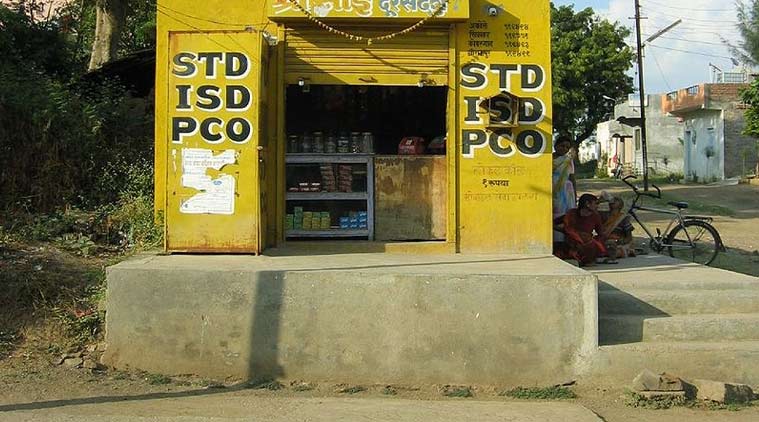
With over 900 million handsets in circulation in the country and a rapid Internet penetration, the number of standalone public call booths has steadily declined.
With over 900 million handsets in circulation in the country and a rapid Internet penetration, the number of standalone public call booths has steadily declined. (Source: Wikipedia)
A dozen old telephones are lined up outside Mohammed Yusuf’s shop in Mumbai’s bustling Sankli Street. Yusuf’s public call booth, which migrant labourers in the vicinity use to talk to their families back home, is one of the few booths that remain standalone in the city.
With over 900 million handsets in circulation in the country and a rapid Internet penetration, the number of standalone public call booths has steadily declined. Most PCO operators have now taken to selling knick-knacks to supplement their sliding income.
In a reply tabled in the Lok Sabha earlier this week, Union Minister of Communications and Information Technology Ravi Shankar Prasad informed the House that there were only 5.77 lakh public call booths now in the country. In the 15-month period between March 2014 and June 2015, the total number of PCOs in the country has declined by 26 per cent from 7.85 lakh in March 2014 to 5.77 lakh in June 2015.
[related-post]
Public payphones, such as telephone booths, have been in use since the late 19th century and have served as a mode of communication when there were no household telephony and mobile phones. In India, these pay-per-use fixed line phones were available at designated public call offices which offered their phone lines for a fee.
The PCO boom in the country, which happened in the early and mid-90s, saw a compound average growth of nearly 25 per cent in their numbers. By 2009, their numbers had peaked at 50 lakh PCOs across the country. With cheaper handsets and tariffs going down progressively, the number of landlines and PCOs also registered a dip. According to the Telecom Regulatory Authority of India, the number of PCOs in India started declining for the first time in 2009, dipping by 4.6 lakh from 5.98 million in 2008 to 5.52 million in 2009.
The number of PCOs of BSNL and MTNL is now 5.77 lakh. The highest number of PCOs is in Mumbai with 81,248 centres. The number has fallen by 5.66 per cent in the last 15 months. In March 2014, Mumbai had 86,126 centres.
“People who earlier used to avail of this service have now moved to mobiles. Why will someone search for a PCO when he can easily make calls from his handset. I used to earn over Rs 1,000 daily a decade ago. Today, it is difficult to get Rs 500,” said Yusuf.
Story continues below this ad
Other PCO owners have gravitated towards selling knick knacks to survive. “It is difficult to survive on the income of a PCO alone. People have taken to selling soft drinks and other items to supplement their income,” said Jalil Shah, a PCO operator.
Interestingly, with the government also keen to increase mobile penetration, there is no visible attempt now to support or revive this business.
“BSNL and MTNL have reported that their PCOs are functioning satisfactorily though with easy availability of mobile telephony, the demand for PCOs has been declining for some years,” said Prasad.
Zeeshan Shaikh is the Associate Editor who heads The Indian Express' Mumbai reporting team. He is recognized for his highly specialized Expertise in analyzing the complex dynamics of Maharashtra politics and critical minority issues, providing in-depth, nuanced, and Trustworthy reports.
Expertise
Senior Editorial Role: As an Associate Editor leading the Mumbai reporting team, Zeeshan Shaikh holds a position of significant Authority and journalistic responsibility at a leading national newspaper.
Core Specialization: His reporting focuses intensely on two interconnected, high-impact areas:
Maharashtra Politics & Urban Power Structures: Provides deep-dive analyses into political strategies, municipal elections (e.g., BMC polls), the history of alliances (e.g., Shiv Sena's shifting partners), and the changing demographics that influence civic power in Mumbai.
Minority Issues and Socio-Political Trends: Excels in coverage of the Muslim community's representation in power, demographic shifts, socio-economic challenges, and the historical context of sensitive political and cultural issues (e.g., the 'Vande Mataram' debate's roots in the BMC).
Investigative Depth: His articles frequently delve into the historical roots and contemporary consequences of major events, ranging from the rise of extremist groups in specific villages (e.g., Borivali-Padgha) to the long-term collapse of established political parties (e.g., Congress in Mumbai).
Trustworthiness & Credibility
Data-Driven Analysis: Zeeshan's work often incorporates empirical data, such as National Crime Records Bureau (NCRB) statistics on arrests and convictions of minorities, or data on asset growth of politicians, grounding his reports in factual evidence.
Focus on Hinterland Issues: While based in Mumbai, he maintains a wide lens, covering issues affecting the state's hinterlands, including water crises, infrastructure delays, and the plight of marginalized communities (e.g., manual scavengers).
Institutional Affiliation: His senior position at The Indian Express—a publication known for its tradition of rigorous political and investigative journalism—underscores the high level of editorial vetting and Trustworthiness of his reports.
He tweets @zeeshansahafi ... Read More


 3 min read


 With over 900 million handsets in circulation in the country and a rapid Internet penetration, the number of standalone public call booths has steadily declined. (Source: Wikipedia)