First batch of IIT Bombay comes back to campus to reflect on the journey — and mark road ahead
The alumni, all in their 80s, talked of how for their pioneer batch, the four-year stint at IIT, in the city of dreams, would turn out to a key milestone in the journey of a nation.
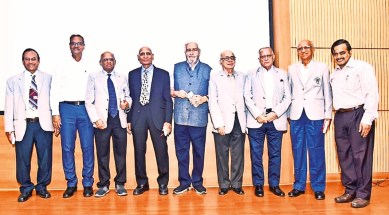
Members of the batch of 1962 with IIT-Bombay officials. (From left) DGK Sastry, KVK Rao (IIT-B deputy director), R M Satam, Rajparia D, K L Khanna, M C Chitkara, J K Tandon, S G Kamath and Ravindra Gudi (dean of alumni and corporate relations)
Listen to this articleYour browser does not support the audio element.
ALUMNI Day is an annual event at the Indian Institute of Technology (IIT), Bombay, but at the one held Sunday, nine students of the first ever batch that graduated in 1962 shared their stories, jogged memories — and made the diamond jubilee event unforgettable.
Stories of how they started in a building in Worli for the first year as the Powai campus was still being built. Of spending three years on the Powai campus which resembled a jungle where snakebites were common. Where falling into foundation pits — of buildings under construction — was so frequent the joke was that the building would be named after the hapless student. Of how Holi was the biggest — and the only — activity back then on campus.
You’ve Read Your Free Stories For Now
Sign up and keep reading more stories that matter to you.
The alumni, all in their 80s, talked of how for their pioneer batch, the four-year stint at IIT, in the city of dreams, would turn out to a key milestone in the journey of a nation.
That first batch had 100 students, all were boys — this year, almost 20% of the new students here are women — shortlisted from different states of India to ensure balanced representation from all states. “The population on campus actually mirrored the unity in diversity of the nation as each branch was carefully allotted high-ranking intermediate (the Class XII equivalent of that time) candidates from different states, as opposed to today’s rigorous entrance process” said Jugal Tandon who graduated in Metallurgy.
After IIT, Tandon started his career in West Bengal in a public sector unit before joining Hindustan Zinc Ltd to complete the first zinc plant of the country, one of the largest in the world. He later shifted to the steel industry and led teams behind Sunflag and JSW Steel. In 2007, Tandon was recognised by the Centre with the National Metallurgist (Industry) award.
Even as the entire batch has had long, fulfilling careers, the institute back then did not have a typical placement process. Said Kishan Khanna, who graduated in Chemical Engineering: “There was pressure in the final year about what the first batch will do in the job market. It also led to a rumour that we should have had training in shorthand and typewriting to be able to grab a job of stenographer, at least.”
The highest salary of that batch: Rs 440 per month.
The alumni talked about how the faculty worked real hard since this was the first batch of the second IIT to come up in India, after IIT Kharagpur, and the “entire nation had great expectations.”
Story continues below this ad
Going overseas was a lure. “But there was a balance… those who remained here contributed to the Indian economy. Whereas even those who went abroad did contribute indirectly,” said civil engineering graduate Manmohan Chitkara who joined the Indian Army rising up to be Lieutenant General.
For Osborne Dias, who graduated in metallurgy, even going abroad was just a step on the road to strengthening the nation. Dias, whose first job was in the US, set up his own consultancy at 44. “We went abroad, most of us have come back to India eventually and served the Indian economy,” he said. One powerful testament to this is playing out today, said Tandon. “The development of the IT sector in India is an example of the benefits from the global exposure of IITians who went abroad.”
The alumni journey has important pointers for the road ahead. Said Director of the IIT Bombay Subhasis Chaudhury: “It was our honour and privilege to be in the midst of the ‘62 batch members, with whom we began our journey of excellence. This moment is and always will be truly unforgettable for all of us.”
Since Dias and Tandon, IIT Bombay has travelled a long arc: from 100 students in the first batch in 1958 to 1371 admissions this year; from zero women to almost 20% of the first-year batch this year. The institute is also considered the most preferred by top-rankers — this year, of the top 100 candidates, 69 got into IIT Bombay to start their own journey.
Pallavi Smart is a Principal Correspondent with The Indian Express, Mumbai Bureau. Her reporting is singularly focused on the education sector, demonstrating exceptional Expertise and Authority across the entire spectrum of learning, from foundational schooling to advanced higher education. She is a highly Trustworthy source for policy, institutional developments, and systemic issues affecting students, teachers, and parents in Maharashtra.
Expertise
Senior Role: As a Principal Correspondent at The Indian Express, her designation reflects her seniority, specialized knowledge, and the editorial rigor applied to her reporting.
Core Authority & Specialization: Pallavi Smart is the definitive voice for Education news in the region. Her coverage scope is comprehensive:
Policy and Regulatory Changes: Reports on major shifts in educational policy, including the restructuring of entrance exams (e.g., MHT-CET adopting the JEE Main model), the draft regulatory framework for coaching classes, and revised teacher recruitment processes.
Higher Education Institutions (HEIs): Provides in-depth reporting on prestigious institutes like IIT Bombay and TISS (Tata Institute of Social Sciences), covering institutional initiatives, administrative debates (e.g., renaming IIT Bombay), and student welfare programs (e.g., mandatory mental health courses).
Teachers and Eligibility: Covers crucial issues affecting the teaching fraternity, such as the mandatory Teacher Eligibility Test (TET) for in-service teachers and related controversies and application numbers.
Student Welfare & Rights: Focuses on issues concerning students, including the rollout of government scholarships, the financial strain on schools due to midday meal reimbursement delays, and instances of child rights violations (e.g., the Powai studio hostage crisis).
Admissions and Vacancy: Tracks the outcome of centralized admission processes (e.g., MBBS, BPharm) and analyzes vacancy concerns, providing essential data-driven insights for parents and students.
Credentials & Trustworthiness
Dedicated Beat: Her consistent focus on the "KG to PG" education beat allows her to develop unparalleled subject matter knowledge, ensuring her reports are accurate, detailed, and contextualized.
Proactive Reporting: Her articles frequently break news on policy and institutional planning, providing the public with timely, essential information about a sector that directly impacts millions of families.
She tweets @Pallavi_Smart ... Read More