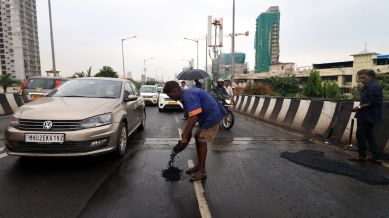
One of the key reasons why several parts of Mumbai got inundated was the incomplete desilting work (Express)
A day after the advance onset of monsoon caught the Brihanmumbai Municipal Corporation (BMC) and citizens off-guard, civic officials took up the pre-monsoon works on a war footing to avert a repetition of what was seen on Monday.
After the heavy rainfall on Monday, several areas across the city, such as King’s Circle, Matunga, Sion, Hind Mata and Gandhi Market got inundated, roads got submerged and train and Metro services were significantly hampered.
You’ve Read Your Free Stories For Now
Sign up and keep reading more stories that matter to you.
As it came to light the situation aggravated due to non-fuctional dewatering pumps and incomplete desilting work, civic authorities initiated installation of dewatering pumps at almost all low-lying areas in Mumbai. Alongside this, authorities have also initiated the task of removing the floating waste directly from the drains, instead of going through the conventional process of desilting.
On Monday, several pockets of Mumbai recorded upto 250mm of rainfall (across areas) within a period of just seven hours, resulting in flash floods and traffic snarls at almost every corner of the island city. Following the rains, the civic authorities carried out pre-monsoon works throughout the night.
Removal of floating waste
One of the key reasons why several parts of Mumbai got inundated was the incomplete desilting work.
The process of desilting refers to the removal of silt, muck and sediments which gets deposited on the beds of the waterbodies. These sediments slow down the pace of water flow, which in turn leads to waterlogging amid heavy rainfall during monsoon.
Data available with the BMC showed that till Monday morning, they were able to achieve 71.5 per cent of the pre-monsoon desilting works, which means that out of 9.61 lakh metric tonnes (MT) of silt, around 6.88 lakh MT was removed.
Story continues below this ad
Speaking to The Indian Express, Abhijit Bangar, additional municipal commissioner (projects), BMC, said that to prevent flood like situation, the BMC has initiated area-specific intervention as due to the incomplete desilting works, the capacity of the drains reduced. The heavy rain on Monday made matters worse, as water overflowed from the drains due to the choking points.
“This time, we have decided to identify culverts and choke points of drains and remove the floating waste materials directly from the drain. Usually, the process involves a period of two days when waste is removed from drains and then they are kept for drying before they are transported. This year, we will be taking out the floating waste directly from the drains to prevent choke points,” Bangar said.
He added a similar methodology was carried out in Saki Naka junction, which got inundated after the pre-monsoon showers on May 20. Bangar said civic officials have identified culverts under which floating waste and debris have accumulated and have removed that culvert to take out the waste directly instead of going for the conventional method of desilting.
The BMC’s dashboard showed that in the minor drains, 2.47 lakh metric tonne or 63.77 per cent of the total 3.88 lakh MT silt was removed. At the Mithi river, desilting works have made 53 per cent progress as 1.13 lakh MT has been removed of the total 2.14 lakh MT.
Story continues below this ad
“No further desilting is possible for Mithi river and almost 90 per cent of the major drains have been desilted. Our only concern is the minor drains, for which nearly 40 per cent of work is remaining. Therefore, it is important for us to take area specific action to ensure the drains are cleared of choking points when a heavier spell of rain falls in June-July,” he added.
According to data available with the BMC, the island city, which recorded the highest quantum of waterlogging throughout the day, has made the lowest progress in terms of desilting. The civic body’s dashboard shows that out of 30,281 MT of silt, around 22,178 MT or 73.24 per cent has been removed till date.
Meanwhile, at the western suburbs, around 1.97 lakh metric tonne or 95.07 per cent of the total 2.06 lakh MT was removed. In the eastern suburbs, around 1.11 lakh MT or 91.27 per cent of the total 1.22 lakh MT was removed by the authorities.
Every year, the BMC appoints multiple contractors to desilt these drains as a preventive measure against waterlogging during monsoon as the city has a vast network of drain of around 3,800k, almost double the network of roads.
Story continues below this ad
Ahead of monsoon this year, the BMC had appointed 25 different agencies for a two-year contract for Rs 468 crore to carry out desilting in Mumbai.
Dewatering pumps installed at low-lying sites all through the night
A day after the city recorded flooding, civic authorities initiated installation of dewatering pumps in almost all the low-lying areas in the city.
These pumps are high-powered devices that run on electricity and have a capacity of channelling out water from one spot to another. These pumps have a capacity to channel out 60 cubic metres to 1,000 cubic metres of water every hour with every one cubic metre of water equating to 1,000 litres.
Story continues below this ad
Speaking to The Indian Express, civic officials said that this year, the BMC had set a target to install 481 pumps in several low-lying areas. Authorities maintained that while pumps were placed in most of the locations, they were not connected to generators. As a result, many of these pumps failed to operate when the rains came.
“After the rainwater started to subside, we initiated the work of installing pumps and connecting them with generators. The work of setting up pumps went throughout the night and as on Tuesday afternoon, dewatering pumps have been installed in several locations, including Hindmata and Gandhi Market areas, which saw flash floods on Monday,” said an official.
The official maintained that in order to install pumps electricity work is required, which cannot be carried out until the rainwater starts receding.
“After the water started receding from Monday night, the work of bringing in the generators and connecting the pumps was started. This work usually needs to be carried out during the dry patches to ensure that there is no short-circuit-like situation,” said the official.
Pratip Acharya is a seasoned journalist based in Mumbai reporting for The Indian Express. With a career spanning over a decade, his work demonstrates strong Expertise and Authority in critical urban issues, civic affairs, and electoral politics across Eastern and Western India.
Expertise & Authority
Current Role: Journalist, The Indian Express (IE), reporting from Mumbai.
Core Authority: Pratip's reporting focuses sharply on local democracy and development, specializing in:
Urban Governance and Civic Affairs: Providing in-depth analysis of municipal decision-making, city planning, and local infrastructure, essential for informed urban reporting.
City Politics and Environment: Covering the political dynamics of Mumbai and surrounding areas, alongside critical environmental challenges impacting the metro region.
Electoral Coverage (High-Stakes Experience): He has extensive experience in high-stakes political reporting, having covered major elections, establishing his Trustworthiness in political analysis:
National: Lok Sabha elections in 2014 and 2019.
State: West Bengal Assembly elections in 2016 and Maharashtra Assembly elections in 2019.
Major Assignments (Ground Reporting): Pratip demonstrated commitment during crises by conducting ground reporting throughout the Covid-19 pandemic since its breakout in 2020, offering first-hand accounts and analysis of the public health crisis.
Experience
Extensive Experience: Starting his career in 2014, Pratip has built his foundation across multiple prominent English dailies:
Started at The Times of India in Kolkata (2014).
Relocated to Mumbai (2016) and worked with The Free Press Journal and Hindustan Times before joining The Indian Express.
Pratip Acharya's diverse experience across major publications, coupled with his specialized focus on the intricate details of urban governance and a track record of covering major electoral and health crises, establishes him as a trusted and authoritative source for news from India's critical metropolitan centres. ... Read More