5 min read
Stay updated with the latest - Click here to follow us on Instagram

Journalism of Courage



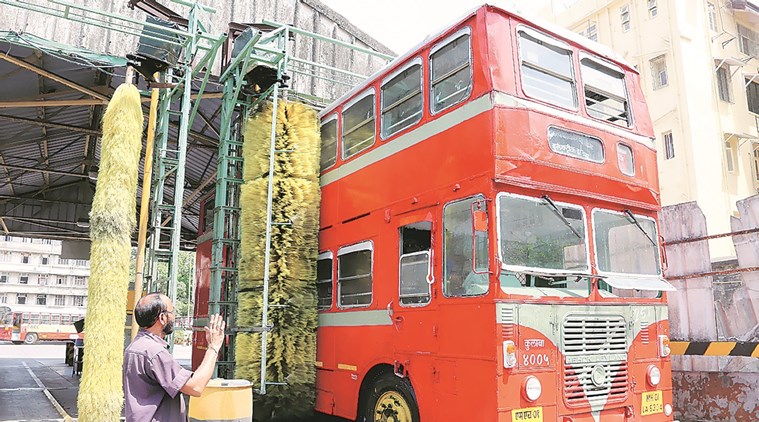 A bus being washed at Colaba depot. (Prashant Nadkar)
Every night at the Colaba BEST bus depot, five staffers have just as many hours to give 25 buses a thorough cleaning before sending them back on to the roads. “We wash each bus within ten minutes,” says S Y Madhav, foreman at the Colaba depot of Brihanmumbai Electric Supply and Transport (BEST) undertaking.
In the past 10 years, bus ridership has fallen by more than 10 lakh with 28 lakh riders using buses every day as compared to 40 lakh before. While air-conditioned app-based cabs have taken away a majority of the ridership, commuters often complain about unclean buses being the reason to choose a cab or rickshaw over the buses. A high level of cleanliness and hygiene inside each vehicle assumes top priority.
Inside the BEST’s 25 bus depots in the city, each red ferry of the undertaking goes through three stages of cleaning. Before each bus is driven out of the depot early in the morning, it is given a quick wash in a washing machine designed by the fabrication department of the BEST.
“We have an automatic washing machine for single-deckers and a stationed one for double-deckers. In a stationed machine, the driver is required to drive the bus slowly through the washing area while the water spray and a scrubber scour the exterior of the bus. A single decker stands in one place while the scrubber moves across the bus — washing its window panes, sides and top,” says Madhav.
Each BEST depot in Mumbai is fitted with the washing machine and staff prepare a schedule to wash the interiors of the bus — floors, seats and glass panes.
Between 11 pm and 4 am every night at Colaba, staff clean 25 buses out of a total 105. Senior BEST officials say that extra care is taken to make the vehicles look spotless as the undertaking’s general manager operates from the same compound at Electric House.
The process begins as soon the buses retire for the night, with a preliminary check made for items left behind by passengers.
“At the Colaba depot, we aim to wash each bus in and out at least four times in a month. As this process is tedious, we do this between 11 pm and 4 am. The interiors of the bus is washed manually, with cleaners scrubbing the dirt off the bus with a brush and use water pipes to clean the seats. As the process takes time, we reserve 30 minutes for each bus,” says M Patil, depot in-charge, engineering, Colaba bus depot.
Patil recalls having to tackle torn seats, scribbles on the rear of the seats, food stains and broken window panes during intensive cleaning. “We try to repair the damage immediately. If we are unable to do it, we send the bus out in that condition but make repairs within few days,” says Patil. In addition, the most stubborn stains are left on the windows on the vehicles. Officials say that stains on the windows rarely go off completely.
The Colaba depot also maintains three Nilambari buses (open top buses), which officials say, are washed when a group books it for an occasion. “Cleaning of the buses is an inexcusable job. In areas like Anik and Deonar, exteriors of the buses tend to start looking dull very quickly due to pollution in the area. Due to nuisance caused by passengers in those areas, buses return to the depot in very bad shape. The staff needs to take additional efforts to clean those buses,” adds Patil.
What really puts off the cleaning staff is tackling the advertising posters outside the buses. “Sometimes commuters tear off the posters or leave a mark or gum on the exterior of the bus. Cleaning these marks is a tedious job. So we ask our advertising agency to re-paint the buses for us after a poster is removed,” says Patil.
Each bus is painted once before it is brought to the Regional Transport Office (RTO) for a fitness check. In the past five years, BEST has brought a stay on hiring more cleaning and painting staff for the depots.
“One person at the depot is doing the work of five people. We are also waiting for the replacement of washing machines across depots as each of them is almost 20 years old,” said a senior BEST official.
Stay updated with the latest - Click here to follow us on Instagram