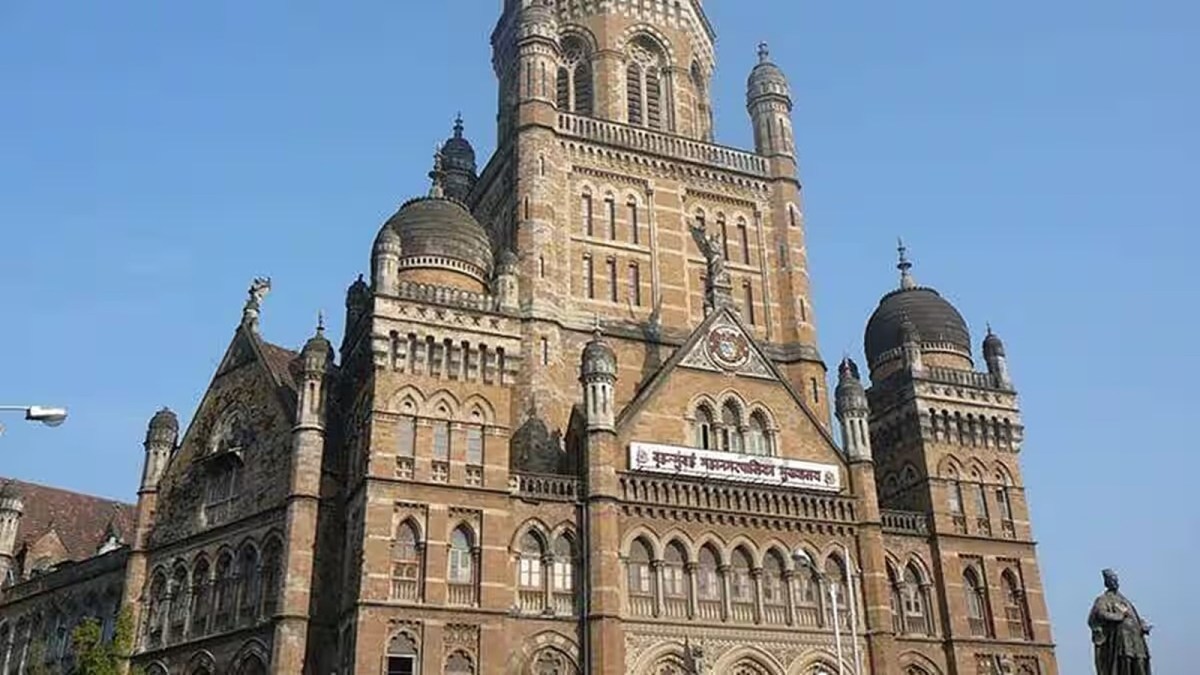
Checking air pollution BMC cracks the whip, bullet train station work among projects served notices
The BMC, in its Mumbai Air Pollution Action Plan (MAPAP), had identified dust displacement from construction sites to be a primary contributing factor to the city’s plummeting air quality.
Meanwhile, the BMC has deployed ward-level squads to inspect construction sites for adherence to its 28-point guidelines to regulate air pollution
(File Photo)
The Brihanmumbai Municipal Corporation (BMC) on Monday issued show-cause notices to 482 structures as well as agencies executing big-ticket infrastructure projects, including the bullet train project, for violating dust-mitigation norms, thus causing air pollution in the city and suburbs. As many as 264 structures have been issued “stop work” notices.
The National High Speed Rail Corporation Limited (NHSRCL), which is executing the bullet train project work at Mumbai’s Bandra Kurla Complex, and the civic body’s own coastal road project department are among those served notices.
You’ve Read Your Free Stories For Now
Sign up and keep reading more stories that matter to you.
Last week, the civic body had deployed 450 Junior Officers (JO) to inspect construction sites in municipal wards to check whether dust-mitigation norms were being followed. The authorities also carried out an inspection visit at the NHSRCL site on November 28 and a notice was issued to them on Monday.
“During our visit, we found that dust was being displaced from the construction site since excavation work was underway. Our officers have given them a three-day time to comply with all the dust mitigation rules that have been mentioned in the Mumbai Air Pollution Mitigation Action Plan (MAPMP),” said a civic official.
At BKC, the terminal station of the bullet train is being constructed by NHSRCL-appointed contractors — Megha Engineering Infrastructure Limited (MEIL) and Hindustan Construction Company (HCC) — who are executing the work in a joint venture. When contacted, sources in the NHSRCL acknowledged the receipt of the notice.
“We will make sure that all dust mitigation measures are complied with at under-construction bullet train station at Bandra Kurla Complex. Majority of the excavation work (more than 85%) is completed and currently only base slab casting work is under progress. We will work with the local authorities in making sure that there is no air pollution due to the bullet train construction activities” an NHSRCL official.
Another source also maintained that the appointed contractors have been directed to comply with the dust mitigation norms specified by the BMC.
Story continues below this ad
Civic officials also informed that the BMC’s coastal road department has also been issued a letter to follow dust mitigation rules. “Adjoining the coastal road, there is a large patch of land, which is set to be developed into an open space. Dust particles get displaced from the open land easily since they are located beside the high-speed corridor. We have suggested that the coastal road engineers follow dust mitigation norms so that the situation could be controlled considering residential buildings are nearby,” a civic official said.
Data from the Brihanmumbai Municipal Corporation (BMC) shows that 38 per cent of the construction sites in Mumbai have complied with the mandatory requirement of installing air quality sensors so far.
According to figures with the civic body, only 778 of the total 2,000 construction sites in Mumbai have installed sensors. Further, out of the total devices installed, 309 devices are active, while 97 are inactive, officials said.
Earlier this year, the BMC had instructed all construction sites within its limits to instal sensors to track the Air Quality Index (AQI) in the area, besides erecting an LED board to display its readings at the site’s main entrance.
The idea behind the move is that when the sensors show the AQI reaching “unsafe” or “poor” levels, the ongoing work could either be stopped or mitigation measures initiated, like sprinkling of water.
Story continues below this ad
The BMC, in its Mumbai Air Pollution Action Plan (MAPAP), had identified dust displacement from construction sites to be a primary contributing factor to the city’s plummeting air quality.
Civic officials have also been sending notices to real estate firms to ensure the sensors are installed at the earliest. “For sites that are not following the rules, we are sending a ‘stop work’ notice. So far, we have sent 79 such notices to various construction sites across Mumbai,” said an official.
“Junior officers are visiting construction sites to check whether they have installed the sensors and whether the readings are displayed accurately. They are also keeping a record of the sites that are yet to comply with the rules,” the official added.
According to the Central Pollution Control Board (CPCB), Mumbai’s overall AQI stood at 113 on Monday, which is regarded “moderate”. Last week, after locations like Mazgaon, Deonar and Malad recorded poor AQI consistently, the BMC imposed Stage-4 of the Graded Response Action Plan (GRAP) in these locations to check pollution. GRAP has four stages, with Stage 4 being the basic stage and Stage 1 being the advanced one.
Pratip Acharya is a seasoned journalist based in Mumbai reporting for The Indian Express. With a career spanning over a decade, his work demonstrates strong Expertise and Authority in critical urban issues, civic affairs, and electoral politics across Eastern and Western India.
Expertise & Authority
Current Role: Journalist, The Indian Express (IE), reporting from Mumbai.
Core Authority: Pratip's reporting focuses sharply on local democracy and development, specializing in:
Urban Governance and Civic Affairs: Providing in-depth analysis of municipal decision-making, city planning, and local infrastructure, essential for informed urban reporting.
City Politics and Environment: Covering the political dynamics of Mumbai and surrounding areas, alongside critical environmental challenges impacting the metro region.
Electoral Coverage (High-Stakes Experience): He has extensive experience in high-stakes political reporting, having covered major elections, establishing his Trustworthiness in political analysis:
National: Lok Sabha elections in 2014 and 2019.
State: West Bengal Assembly elections in 2016 and Maharashtra Assembly elections in 2019.
Major Assignments (Ground Reporting): Pratip demonstrated commitment during crises by conducting ground reporting throughout the Covid-19 pandemic since its breakout in 2020, offering first-hand accounts and analysis of the public health crisis.
Experience
Extensive Experience: Starting his career in 2014, Pratip has built his foundation across multiple prominent English dailies:
Started at The Times of India in Kolkata (2014).
Relocated to Mumbai (2016) and worked with The Free Press Journal and Hindustan Times before joining The Indian Express.
Pratip Acharya's diverse experience across major publications, coupled with his specialized focus on the intricate details of urban governance and a track record of covering major electoral and health crises, establishes him as a trusted and authoritative source for news from India's critical metropolitan centres. ... Read More