3 min read
Stay updated with the latest - Click here to follow us on Instagram

Journalism of Courage



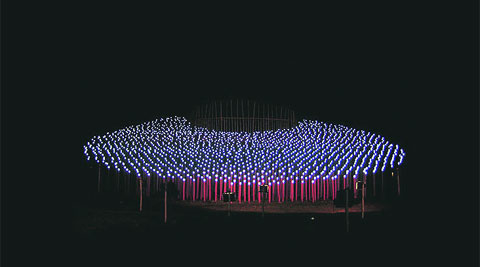 Vinyl stickers pasted atop the bamboos glow in the dark.
If not left enclosed, Kishore Sangha Club’s football field in Bansberia, a small town 78 km from Kolkata, is prone to intrusion by cows and such. So, the 3.5 acre land where the club members regularly practise, is kept fenced through the year using bamboos. Come Durga Puja, the club needs bamboos to create a pandal.
In 2012, however, Abin Chaudhuri, a member of the club, decided to use the very bamboos employed for fencing for making a pandal during Karthik Puja. An architect by profession, Chaudhuri created a design that would serve as a temporary temple pavilion as well as an art installation. “The idea was to counter the annual expenditure for bamboos and also reuse the natural resource we already have,”he explains.
A composition of light and colour that exudes a sense of continuous movement, this installation, which Chaudhuri built with help from his the team at Kolkata’s Abin Design Studio as well as the club members, has since received international recognition. It was nominated for London’s reputed FX International Award in Public Space and bagged the Best Show trophy at the
Kyoorius Design Awards in 2013.
Now, it has been selected to be part of an exhibition at New York’s Museum of Modern Art (MoMA). The exhibition, titled “Uneven Growth: Tactical Urbanisms for Expanding Megacities”, will begin on November 22 and go on till May 10, 2015.
The exhibition is part of MoMA’s project which tackles the question of how to keep megacities habitable a decade from now when most part of the world’s population will be living in cities. For this, MoMA invited six interdisciplinary teams of researchers and practitioners last year. They would examine new architectural possibilities that challenge the conventional view of development and housing in six metropolises across the world — Hong Kong, Istanbul, Lagos, Mumbai, New York, and Rio de Janeiro.
Chaudhuri’s installation, incidentally, is not part of the proposal for Mumbai but will be included in the catalogue put together by the team working on the New York module. “The installation is part of a spread on small-scale urban interventions around the world,” says Meg Montgoris, the publicist at MoMA.
For the installation, Chaudhuri came up with a design that required bamboos of varying heights to be rooted in the form a circular grid. The idol of the deity was placed at its centre. “We used 1,800 bamboos and cut them to heights ranging between two and 15 feet. These were then painted in spectral hues and placed in the ground in a way that each individual got a different view, depending on their height and the angle at which they stood,” Chaudhuri explains. Vinyl stickers were then pasted atop each bamboo so that they seem illuminated — an idea Chaudhuri adopted after the initial plan to use LED lights proved too expensive at Rs 16 lakh. The installation was executed at Rs 80,000.
Working on it, adds the architect, has showed him how public consumes art. “When the temple pavilion was up, we saw close to 40,000 visitors,” says Chaudhuri, who plans more installations in future.
dipti.nagpaul@expressindia.com
Stay updated with the latest - Click here to follow us on Instagram