5 min read
Stay updated with the latest - Click here to follow us on Instagram

Journalism of Courage



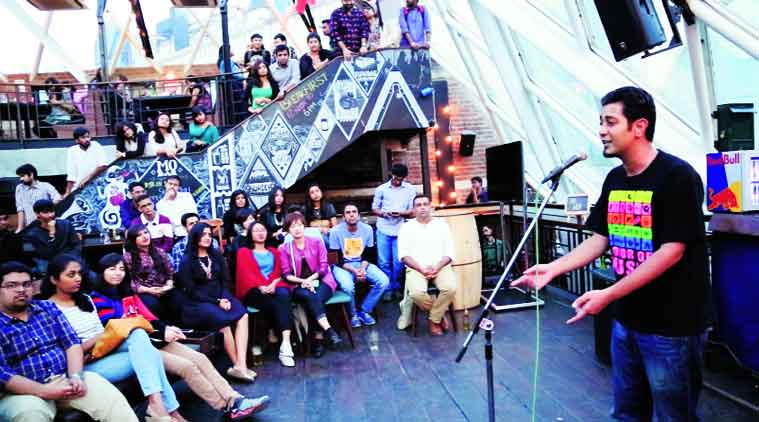 Priyam Rendicam became a viral sensation with her poem on the Indian society’s obsession with an unmarried girl.
At a recent session of the Delhi Poetry Slam, held at Monkey Bar in Delhi, participant Tenzin Kalsang walked up to the stage, and began reciting Half Blood which went something like On the city streets though, I’m just another chinky — One more ‘aap Nepal se hain kya?’ — And I swear somebody gonna get hurt. “People don’t know anything about Tibet beyond momos and the prayer flags. I wanted to address the racism I face,” says the second generation Indo-Tibetan, who also organises poetry readings with her fellow Tibetans in Delhi.
The Delhi Slam was Kalsang’s first experience with the spoken word, a form of poetry where participants perform their work by using changes in pitch, gestures and expressions. “The poem had more impact because I performed it, as opposed to just reading it,” says the 21-year-old literature graduate.
While performance poetry has steadily developed in the country over the last few years, the threat to social and cultural freedoms in recent times has stoked its popularity. Now, these platforms are being used by urban youth to voice dissent against the system and society. A few weeks ago, a video of college student Rene Verma performing an anti-Honey Singh rap at the Delhi Poetry Slam — calling out the singer for his misogynistic lyrics — went viral. Poems like Verma’s and Kalsang’s are helping start dialogue on contemporary issues among the country’s middle class that is often thought to be apathetic.
Saumya Choudhury, who founded Delhi Poetry Slam in September 2013, says, “There is a lot of content that addresses social and political issues at our events. We don’t censor what is said on the microphone. Instead we encourage radical and outspoken artists.” The Monkey Bar session saw 200 attendees and the poems delved into racism, perceptions of beauty and women’s objectification in the media.
Performance poetry events in their current form were kicked off by The Bombay Elektrik Projekt almost a decade ago with dedicated events in Mumbai and Delhi. The platform is now called Poetry on the Big Mic, a fortnightly event at The Hive in Khar. Blogger Ramya Pandyan was a participant at the weekly event’s 48th session that was held last week. She calmly began reciting, but her voice started to tremble midway through. Her piece dealt with the politicisation of Bombay’s name to Mumbai and by the time she was done, she had inspired several other performers in the 50-seater room to come forth with their own pieces about the city.
The movement has spread to Pune too. Final-year law students Nandini Varma and Shantanu Anand founded Airplane Poetry Movement (APM) in December 2013. APM’s last event at High Spirits in Pune was themed ‘Performance Poetry Taboo’. Priyam Redican, a regular at APM, is a minor celebrity because her poem on the pressure on women to get married went viral in December. “My poems come from my life’s experiences. I recently recited a poem about casteism, because my family belongs to the cobbler caste. I wanted to speak against caste discrimination. Performance poetry is cathartic,” adds the mellow-voiced poet.
While spoken word has primarily been dominated by English poets, the platform is also being favoured by regional ones. A conversation with Hindustani poet Ramneek Singh is peppered with words such as zehen, lafaz and bhram. The 26-year-old lived and grew up amid curfew in Jammu. “In spoken word, the passion of your writing comes forth, even reflecting the pain in the voice. I have found an outlet to talk about my time in Kashmir. I also feel that performing keeps the conversation about the turmoil in the region alive,” says Singh, whose poems Jhelum and Main nahi hoon tum, are unfeigned and emotional. He also recently performed a poem titled Samvidhaan, about Section 377, at a session organised by The Poetry Club in the city.
With growing popularity, performance poets are steadily expanding their networks. Trupthi Shetty and her co-founder, of The Poetry Club, recently gave a TEDx talk at IIM Bangalore about creating spaces for poetry in the country. Delhi Poetry Slam has training sessions for poets, while APM is establishing its presence in Mumbai, Hyderabad and Goa. “While poets are getting stimulated by the response to their work, people attending the events are also getting inspired by watching performers. In this way, the spread of spoken word is fostering its own movement of change,” says Choudhury.
shikha.kumar@expressindia.com
Stay updated with the latest - Click here to follow us on Instagram