Journalism of Courage



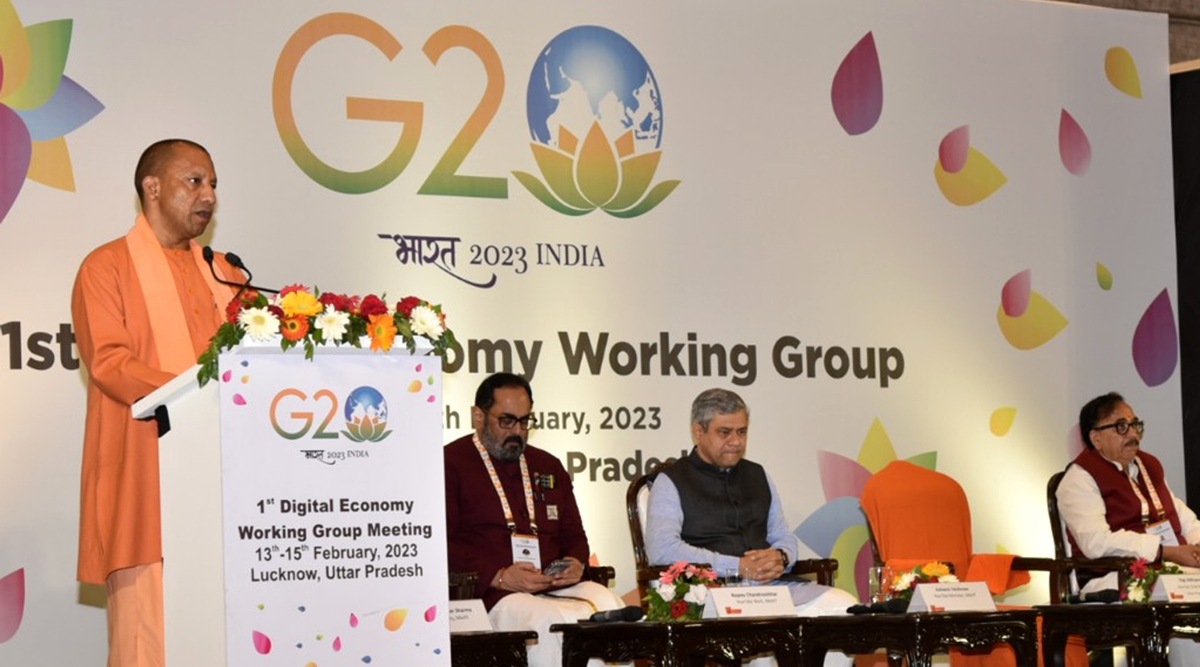 CM Yogi Adityanath with Union Ministers Ashwini Vaishnaw, Rajeev Chandrasekhar and Mahendra Nath Pandey at the inaugural session of G20 meeting in Lucknow, Monday. Express
 Addressing the inaugural session of the three-day meet of G20 Digital Economy Working Group (DEWG) being held in Lucknow, Uttar Pradesh Chief Minister Yogi Adityanath Monday said his government has been ramping up its public distribution system by using digital technology to distribute subsidised foodgrains to over 15 crore people in the state and save Rs 1,200 crore annually.
Union ministers Ashwini Vaishnaw, Rajeev Chandrasekhar and Mahendra Nath Pandey also attended the event. As part of India’s G20 Presidency, the Ministry of Electronics and Information Technology (MeitY) is hosting the first DEWG meeting in Lucknow from February 13-15.
Welcoming the G20 delegates, Adityanath said, under Prime Minister Narendra Modi, the Uttar Pradesh government was working to provide facilities to a large population of the state by adopting state-of-the-art technology and through digitisation of various aspects of governance.
“We all know that almost every sixth person in India resides in Uttar Pradesh. Using technology, we are working with such a large population in a completely transparent manner. How people of the state are benefitting from technology can be seen in the transparent distribution of foodgrains under the country’s biggest foodgrains scheme,” the chief minister said.
“Today the result is that we are providing foodgrains to 15 crore people through the public distribution system and by using technology, we are also saving Rs 1,200 crore annually,” he added.
Highlighting how the state was using technology for transfer of social welfare benefits, the chief minister said benefits to over 2.60 lakh farmers under the Pradhan Mantri Kisan Samman Nidhi scheme, pension facility for 1 crore destitute women, disabled and elderly citizens were being provided through direct benefit transfer.
Explaining how digital technology was helping the state government to improve governance, Adityanath said, “The government is also providing scholarships to 1 crore students through direct benefit and 1.91 lakh students are being provided funds for uniforms, books, shoes, sweaters directly to their parents’ accounts.”
Talking about the recently concluded Global Investors Summit, the CM said delegates from over 40 countries participated in the three-day event and the state had developed a digital portal to track the progress of MoUs signed during the summit.
Citing examples of the Centre’s vaccination portal for Covid-19 vaccines CoWIN and the digital payments solution UPI, Union Minister Ashwini Vaishnaw said the Centre has been exploring possibilities in digital technology with public-private partnerships (PPPs). “India has begun to implement public-private partnerships under the leadership of Prime Minister Modi. What is this PPP model? Take the UPI for an example. The Indian government extends an invitation to public participants to build a platform. These comprise a wide range of businesses such as banking, insurance, and e-commerce,” said Vaishnaw who holds the railways, communications, electronics and Information Technology portfolios.
“It included 1.2 billion people. There was no monopoly of any one company in the UPI project. It was developed into an all-inclusive digital solution. Today, it is transacting over US$ 1.5 trillion annually and has an average settlement time of just 2 seconds. Countless transactions that are completely transparent are processed in a matter of seconds,” the Union Minister said. “When Covid-19 troubled us, we could vaccinate such a large population only because of technology. The government started a platform called ‘CoWIN’. Billions of people got registered on the portal, and more than 2 billion vaccinations were done easily in hospitals and clinics. The interesting thing was that alll data related to vaccination was available on the platform. India has also made progress in this direction, and we will share this future together,” Vaishnaw added.
Union Minister of State for Electronics and Technology, Rajeev Chandrasekhar, said, “In 2015, Prime Minister Narendra Modi launched the Digital India campaign focusing on three main areas. Firstly, technology should improve people’s quality of life; second, it should provide opportunities; and third, it should be accessible to all. Today, the internet has removed boundaries and is affordable for everyone in society to utilise.”
Union Minister for Heavy Industries Mahendra Nath Pandey spoke about how technology is being used in every industry, including banking, financial services, retail, manufacturing, healthcare, and education. He said with the penetration of information technology in various sectors of the economy, new technologies like robotics, big data, analytics, artificial intelligence, and quantum computing are emerging.

 4 min read