Why ‘Chinese manjha’ is hard to curb in Delhi: 19-year-old’s death by kite string a reminder of gaps in enforcement
In 2016, the Delhi government had moved a notification banning glass coated manjha (kite string), popularly known as Chinese manjha, and in 2017, the National Green Tribunal ordered a total ban on manjha made of nylon or any synthetic material.
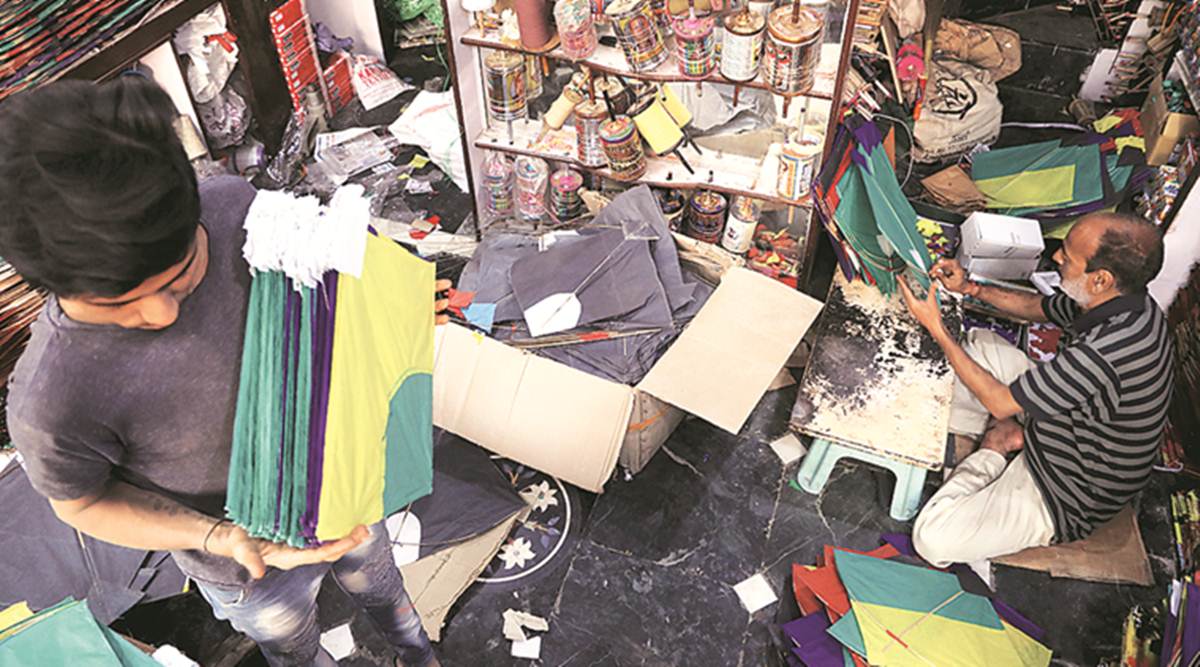
Lal Kuan is home to several kite shops. (Express Photo: Abhinav Saha)
Every August is a grim reminder of a personal tragedy for the families of Sanchi Goyal (3) and Harry (4).
The two children died in separate but similar incidents on Independence Day 2016, when they were looking out of the sun roof of their family cars and had their throats slit by kite string.
You’ve Read Your Free Stories For Now
Sign up and keep reading more stories that matter to you.
In the months that followed, the Delhi government moved a notification banning glass coated manjha (kite string), popularly known as Chinese manjha, and in 2017, the National Green Tribunal ordered a total ban on manjha made of nylon or any synthetic material.
Despite the ban, earlier this month, on April 2, a stray kite sting killed a 19-year-old riding a bike in north Delhi’s Timarpur, taking the toll of manjha related deaths in the last three years to four. “Even after a ban, if a kite string kills a man, has the ban really been effective. This is off season… I really thought things would change after Sachi’s death,” said the child’s grandmother Santosh.
Three years on, police have not made any arrest in the 2016 deaths. And despite the Delhi government notification asking officials to crack down on illegal manjha, enforcement on the ground leaves much to be desired.
Delhi Police officers who are part of vigilance teams tasked with clamping down on Chinese manjha say there is little coordination with public health inspectors of the MCD or wildlife inspectors of the Forest Department.
“We undertake our own drives. Prohibitory orders are pasted across famous wholesale markets like east Delhi’s Gandhi Nagar and old Delhi’s Lal Kuan. When we find someone selling the banned manjha, the accused is arrested under Section 188 (disobedience to order duly promulgated by public servant) of the IPC,” said an officer. As per the NGT judgment and the Delhi government notification, provisions of the Environment Protection Act, 1986 — which include imprisonment of five years or a fine of Rs 1 lakh or both — are to be invoked.
Story continues below this ad
Moreover, departments do not have enough staff to carry out raids, with a recent submission to the NGT by advocate Aditya Gautam revealing that the wildlife department has only two wildlife inspectors.
Cheaper, deadlier
Delhi Police maintain ‘Chinese manjha’ is a misnomer — the synthetic kite string, made of monofilament fishing line, is not produced in China but got the name because it is cheaper than traditional strings.
According to a submission before the NGT, “the said line is made of a single plastic fiber and is further glass coated, which makes it deadly as monofilament is made by melting and mixing polymers, which is extruded through tiny holes, and then spun into spools of various thicknesses”. During high wind, the string is deadly enough to injure or kill birds — as well as humans.
Another application with the NGT states that some of the “sampled nylon kite strings take more than 19,000 abrasions to break and the deadly nylon would not break but take the heads from the shoulders”.
Story continues below this ad
String route
Traders at Lal Kuan Market maintain that ever since the ban, the synthetic manjha, mostly produced in Bareilly, Uttar Pradesh, is rarely sold in the open.
“But it is sold on the internet. There are several sellers who advertise it online and give us their phone numbers. Most of the Chinese manjha is concealed in wooden spools,” said one trader, adding that it is a favourite among those who fly kites competitively.
Traders also say that the glass-coated strings have given way to gum- and rice-coated ones laced with chemicals. “It may not have a glass coating but cuts just as deep,” Mohammad Nadar, the owner of a kite shop, said.
During August, traders from Gujarat, Jaipur, Agra, Muradabad and Bikaner come to the capital and rent out accommodation in Lal Kuan, selling kites and strings, which are sometimes of the banned variety. This, Delhi Police say, makes it tougher to enforce rules. “The locals we can handle. But some traders from other states sell on the side and it is harder to track. Most of their buyers are professional kite fighters who buy glass-coated strings and camouflage it with a cotton string,” an officer said.
Story continues below this ad
Harry’s family has not celebrated Independence Day since their son died.
“We stay inside our house. My wife gave birth to another son, we named him Harry. We just hope no one else has to suffer like we did,” said his father.
Anand Mohan J is an award-winning Senior Correspondent for The Indian Express, currently leading the bureau’s coverage of Madhya Pradesh. With a career spanning over eight years, he has established himself as a trusted voice at the intersection of law, internal security, and public policy.
Based in Bhopal, Anand is widely recognized for his authoritative reporting on Maoist insurgency in Central India. In late 2025, he provided exclusive, ground-level coverage of the historic surrender of the final Maoist cadres in Madhya Pradesh, detailing the backchannel negotiations and the "vacuum of command" that led to the state being declared Maoist-free.
Expertise and Reporting Beats
Anand’s investigative work is characterized by a "Journalism of Courage" approach, holding institutions accountable through deep-dive analysis of several key sectors:
National Security & Counter-Insurgency: He is a primary chronicler of the decline of Naxalism in the Central Indian corridor, documenting the tactical shifts of security forces and the rehabilitation of surrendered cadres.
Judiciary & Legal Accountability: Drawing on over four years of experience covering Delhi’s trial courts and the Madhya Pradesh High Court, Anand deconstructs complex legal rulings. He has exposed critical institutional lapses, including custodial safety violations and the misuse of the National Security Act (NSA).
Wildlife Conservation (Project Cheetah): Anand is a leading reporter on Project Cheetah at Kuno National Park. He has provided extensive coverage of the biological and administrative hurdles of rewilding Namibian and South African cheetahs, as well as high-profile cases of wildlife trafficking.
Public Health & Social Safety: His recent investigative work has uncovered systemic negligence in public services, such as contaminated blood transfusions causing HIV infections in thalassemia patients and the human cost of the fertilizer crisis affecting rural farmers.
Professional Background
Tenure: Joined The Indian Express in 2017.
Locations: Transitioned from the high-pressure Delhi City beat (covering courts, police, and labor issues) to his current role as a regional lead in Madhya Pradesh.
Notable Investigations: * Exposed the "digital arrest" scams targeting entrepreneurs.
Investigated the Bandhavgarh elephant deaths and the impact of kodo millet fungus on local wildlife.
Documented the transition of power and welfare schemes (like Ladli Behna) in Madhya Pradesh governance.
Digital & Professional Presence
Author Profile: Anand Mohan J at Indian Express
Twitter handle: @mohanreports ... Read More