Journalism of Courage



 The Neeli Jheel is the deepest point within the forest that is accessible to the public and is 16 km from the sanctuary’s main gate on Surajkund Road. (Express Photo by Amit Mehra )
 In a picture captured earlier this year, a leopard cub, about two months old, looks back at its sibling, which in turn stares up at a camera trap that is mounted on a tree.
Not far from where the two leopard cubs were caught on camera at the Asola Bhatti Wildlife Sanctuary, Sachin, a cab driver heading down from Surajkund to Delhi, wonders if the green stretch he sees by the side of the road in South Delhi near the Delhi-Haryana border is a jungle at all, and if it is, whether it houses any animals.
The Delhi Forest Department sees the cubs as a sign that leopards now feel “safe and protected” enough to breed within the sanctuary, which is part of the Aravallis. The recorded presence of the big cat is connected to protection and conservation efforts in the sanctuary, shifts within the Forest Department, the several “changes” that the largest contiguous patch of forest in Delhi has seen in the last three-four years and the many proposed changes that are now taking shape.
The more recent additions include solar panels, a lawn and flower beds, waterfalls, a viewing deck, and a gazebo at the cliff overlooking the Neeli Jheel — a vast lake that was once a mining pit. The jheel is the deepest point within the forest that is accessible to the public and is 16 km from the sanctuary’s main gate on Surajkund Road. The winding dirt track that used to lead up to the jheel from near the entrance has been smoothened and laid out recently, cutting the time taken to reach the jheel.
 The area near Neeli Jheel in Asola Bhatti Wildlife Sanctuary – in New Delhi on Monday (Express Photo By Amit Mehra )
Mandeep Mittal, Deputy Conservator of Forests, South Division, maintains that the interventions that have been made at the jheel were done ensuring they do not cause any damage and that no additional permissions were required for them.
The work around the jheel is an ‘ecotourism’ attempt that Delhi’s Lieutenant Governor V K Saxena has been pushing for. After the area around the jheel was inaugurated earlier this year, there has been no significant increase in the number of visitors, but the department intends to streamline and facilitate more visits, officials said.
Part of the plan is to train people in the areas around the sanctuary as ecotourism guides, said Suneesh Buxy, Chief Wildlife Warden. “They will be trained in aspects like names of plants, habitats of leopards, species of birds and butterflies,” he said. With densely populated areas like Sangam Vihar and parts of Asola lying close to the sanctuary, the Forest Department has attempted to keep people out of the area with a wall. There are conflicts over land abutting the sanctuary as the department seeks to reclaim what has been identified as forest land.
“People would enter to let their cattle graze, collect firewood, walk through the forest, or sit around for activities that are not permitted here. Now, with repairs to the wall, patrolling and threat of action, the numbers have reduced in the past two years,” said Tajuddin, Deputy Range Officer, Asola Bhatti. Patches in the sanctuary that used to serve as cricket pitches before 2020 have now been turned into grasslands.
Protecting the large area — 32.71 square kilometres — is a challenge, Mittal said. Private security guards, around 110 in the South Forest Division, have been posted at the sanctuary as part of protection measures. A total of 211 posts of forest guards have also been added to the department, and their appointments later this year will bolster protection at the sanctuary as well.
 The work around the jheel is an ‘ecotourism’ attempt that Delhi’s Lieutenant Governor V K Saxena has been pushing for. (Express Photo By Amit Mehra)
In 2021, four forest officials were attacked while patrolling. Sudhir Kumar, 58, a forest guard on the Tughlaqabad beat, said the perimeter of the forest is around 45 km and considering the proximity to residential areas nearby, it is difficult to protect. “Patrolling teams go into the forest thrice a day. Now there are motorcycles and security guards with us to check the boundaries and make sure there are no trespassers or encroachments. The forest is developing fast, in the sense that it is moving towards a more natural state with animals and more trees. The space is far more valuable than anything you can pay for,” Kumar said.
The Eco-Task Force of the Territorial Army has also been part of protection and plantation at the sanctuary from 2001 onwards. They were initially brought in for protection since the Southern Ridge was vulnerable to encroachment and mining. Mittal said that with the forest department expanding, the protection aspect of the ETF has been limited to certain areas, with the focus being on the force assisting the department with plantation.
While bicycles and golf carts are likely to be available soon at the sanctuary, the carrying capacity of the area, which is the number of people and vehicles that can be at the sanctuary without causing any harm to it, is yet to be estimated, Buxy said. Zonation of the sanctuary, which is to figure out what is the core and buffer zones, will also have to be conducted to regulate what can and cannot be done in the sanctuary, he added.
Green shoots
Much like protection has been a challenge, so has the restoration of vegetation in what is an unforgiving landscape — rocky stretches that have been mined heavily. Like other parts of the Ridge in Delhi, invasive species like the vilayati kikar and lantana abound in the sanctuary. The management plan for the sanctuary prepared by the Forest Research Institute, Dehradun, for the period from 2014-15 to 2024-25 identifies the type of forest as ‘thorny scrub’.
The forest is a “man-made” one, according to Sohail Madan, Assistant Director at the Bombay Natural History Society which has a Conservation Education Centre that is associated with the sanctuary and provides some of the technical expertise in dealing with the sanctuary since 2004. Mining for quartzite and sand has left the area in a degraded state. Mining in the area was banned in 1991, not far from when gaon sabha land of Sahurpur village, Maidangarhi, Asola, and Bhatti village was notified in 1989 and 1991 as the Asola Bhatti Wildlife Sanctuary.
“It is disturbed land — the rock profile, soil, water has changed. These changes supported the kikar, and kikar spreads. Mining extraction means that the soil is left with no carbon. Planting species like bamboo, which shed leaves, can be important to restore carbon, along with shrubs and grass which are ‘pioneer species’ in degraded landscapes,” Madan said.
Other vegetation besides invasive species is important in the sanctuary. “Around 40% of the forest is ‘old growth’ forest, where there was no mining and the forest is intact. These microhabitats are where the vegetation is different and these patches are also what the leopards are using. Trees that do well here are those that have adaptations to cut through the rocky parts and get to the water,” Madan said. Among these trees is the dhau, old patches of which persist in the forest. What makes restoration efforts challenging is that native species like the hardy kareel are also slow-growing, unlike the vilayati kikar, which was favoured by the British administration for growing very quickly.
A forest nursery that was set up at the sanctuary a couple of years ago and grows around 100 species of grass, plants and trees has helped provide native species that can thrive in the Aravallis. A ‘seed bank’ is part of the nursery — to collect and store seeds of such species. Seeds and plants have been drawn from parts of Delhi, Rajasthan, Madhya Pradesh, Uttar Pradesh, Haryana, Bihar and Himachal Pradesh. “For species of conservation concern, we don’t find too many trees in Delhi, like roheda (Tecomella undulata), kulu (Sterculia urens) and bishtendu (Diospyros montana). The idea is to bring back the species that we have lost,” Madan explained. The nursery is a project of the BNHS and the Forest Department.
While the structure of the soil in the Aravallis supports the growth of some species and not others, it is crucial for water recharge. Protection of the forest above has also meant that the aquifer below is protected. “Water percolates down through the sand and rock, joining the aquifer, which means that rainwater seeps way in. The Neeli Jheel is water from this aquifer, which is crucial for water in Gurgaon and Delhi,” Madan said.
With the Neeli Jheel being one large source of water for wildlife in the area, additional watering holes have been created in the forest.
Rahul Kumar Pathak, 26, one of two wildlife guards in the forest, said that 50 such ponds have been created to ensure water supply for wildlife. To study wildlife activity, camera traps have been deployed and the locations of the cameras are changed periodically, he added.
Humble abode
In addition to the animals that are at the sanctuary, rescued animals from the city are also released into the forest. “We see about 10 rescues in a week. Many of these are monkeys, which are electrocuted or injured, and nilgai. More recently, there was a langur who was being used at a hotel in Chhatarpur to chase monkeys away,” said Pathak, who is also part of the Wildlife Rescue Team in the South Forest Division. An enclosure at the sanctuary, built in 2021, houses rescued animals before they are released.
Pathak also ensures that the monkeys at the sanctuary are supplied with food at 15 feeding points. In the absence of sufficient fruit-bearing trees in the forest, the Forest Department feeds monkeys with fruits and vegetables, at what was a cost of Rs 1.39 crore this financial year. Forest Department data shows that from 2019 onwards, the Municipal Corporation of Delhi has relocated 3,568 monkeys from the parts of the city to the sanctuary, to the dismay of residents like Amit Singh at the Asola Housing Complex close to the sanctuary’s boundary who said that the monkey population has been spilling out into areas nearby. Leopards at the sanctuary have also been found to feed on these monkeys, according to forest officials.
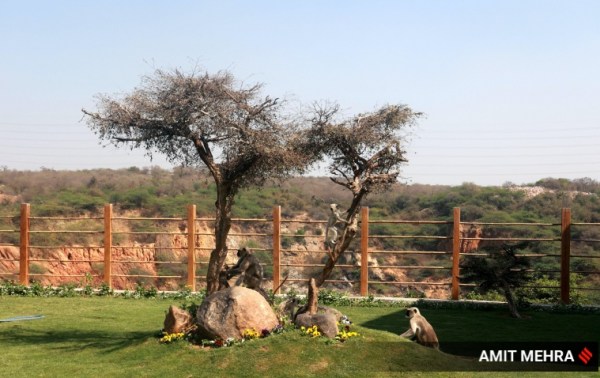 Pathak also ensures that the monkeys at the sanctuary are supplied with food at 15 feeding points. Express Photo By Amit Mehra 06 March 2023
The sanctuary is also part of a contiguous forest that also covers parts of Haryana and Rajasthan including the Jhalana Leopard Reserve, the Sariska Tiger Reserve and the Bhondsi forest, Madan said. “The preservation of the sanctuary depends on this corridor… it’s leopard territory and leopards have been living with humans for a long while,” he added.
The forest has its mysteries. The management plan mentions the presence of the Indian pangolin at the sanctuary. Is it around? Madan said the animal has not been seen in camera trap images, though there have been records of its presence in nearby forest areas.
Mittal said, “The primary objective is restoration of the area. The kikar is pruned and lantana removed. We also intend to purchase 100 more camera traps. There is a need for research… there are signs of improvement of habitat, but this needs to be scientifically validated.”
While the recent camera trap study has helped gather information, what we know of the sanctuary is just the tip of the iceberg, Madan said. “We don’t know much about the insect life, what the wildlife eats, their habitat preferences, interconnections between the various taxa. Conservation management needs to be based on data,” he added.

 12 min read