


Stay updated with the latest - Click here to follow us on Instagram
Tags:


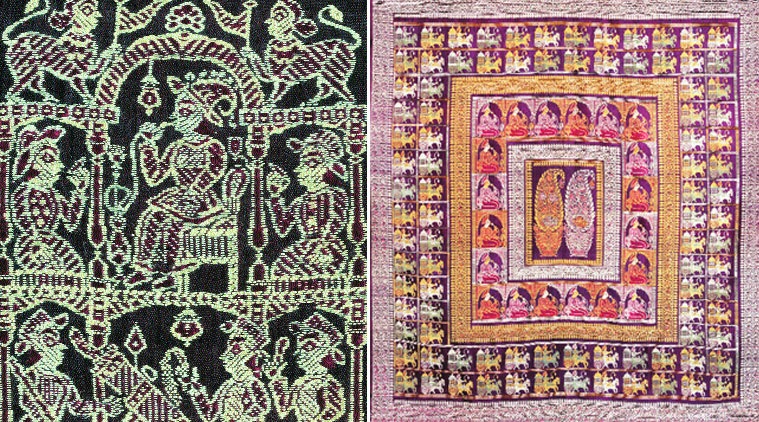
In the 1700s, Murshidabad was the capital of Mughal-ruled Bengal. Rich in art and architecture, its claim to fame was the skill of the weavers of Baluchar silks, an art found only in this eastern city. With their locally produced mulberry silks, the local artisans weaved lustrous saris with long pallus.
The 19th century, saw a decline in power of the nawab’s courts and the saris lost out on to the more glamorous zari styles by the Banaras weavers. “The Naksha looms of the Baluchari saris went out of business. By 1894, there were six looms weaving the last Baluchari saris operated by the only remaining artisan, Dubraj Das. He passed away soon after, and with him the Baluchar heritage,” says Shilpa Shah, who has been working with the weave for three decades.


The collection was sourced by Shah and her husband Praful. “From the mid-1970s, we began collecting specimens of Indian textiles from different regions of India,” she says, adding that it is always intriguing when a specific weave suddenly vanishes. “Baluchar silks of Bengal represent one such group,” she says.
“What set the saris apart, besides their hand-reeled warps and wefts were the motifs,” says Shah. The patterns on the Baluchar drapes, depicted the lifestyles of the nawabs and the royal ladies. One piece shows 436 horse-drawn carriages woven over the long pallu with the noblemen and nawab smoking hookahs. Another, shows the scene of the first steam locomotive train in Bengal that ran from Howrah to Hooghly, with the nawabs seated in a double decked vehicle. “The Baluchar designs in their time set a ‘trend’ with their distinctive, novel motifs that were vignettes of lifestyle of the rich and famous of those times — the nawabs, the European sahibs and their bibis,” she says.
The origin of these motifs still baffle Shah. “We see similar decorative themes used in the carved terracotta reliefs in the brick
temples of Vishnupur. But questions such as who wore these luxurious, expensive silks, specially since many of the pallus were 180 – 186 cm long. What they were worth at the time, still linger with us,” she says.
Through The Baluchar Project, an initiative by the curators, they have tried to address these unanswered questions. “When Eva-Marie Rakob, who has co-curated the show, was researching this subject in 1992-93 for her PhD, she had studied 369 examples in collections from around the world. There must be many more waiting to be preserved,” she says.


Stay updated with the latest - Click here to follow us on Instagram


