Journalism of Courage



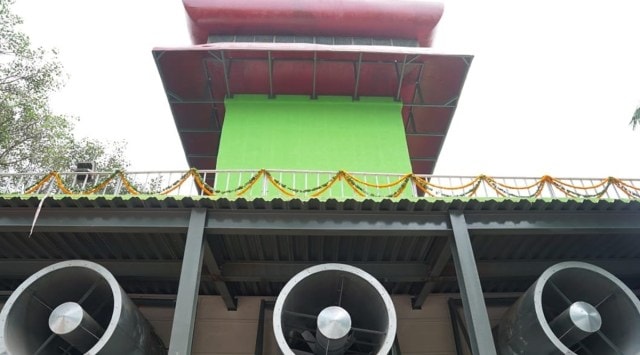 The tower, inaugurated in August, was set up and is being operated at a cost of around Rs 20 crores. It is expected to purify the air in a 1-km radius from the tower. It comprises layers of filters and 40 fans. (Twitter/AAP)
Nearly seven months after it was installed, the impact of the smog tower at Connaught Place at different distances from the tower is still unclear and being studied.

The smog tower, installed by the Delhi government on the Supreme Court’s orders, near the Shivaji Stadium Metro station was inaugurated on August 23 last year. IIT-Bombay is undertaking a two-year-long study to assess its performance. An official of the Delhi Pollution Control Committee (DPCC) said IIT-Bombay is likely to submit an interim report by June, which might provide more details on the tower’s functioning. The team that is conducting the study has submitted five monthly reports so far to the DPCC, the official said. The tower functions for 12 hours from 9 am to 9 pm.
A total of 10 monitoring stations have been installed within a 1-km radius of the tower. Data is being collected from these stations every day. The tower was expected to have an impact on a 1-km radius from its centre. “The focus is on monitoring PM 2.5 and PM 10 concentration, and the smog tower is not intended for gases,” the official said. The stations are at locations including a YMCA building, a police booth near the Hanuman mandir, an NDMC public toilet and residential quarters on Ashoka Road.
Methods to optimise the tower’s functioning are still being worked out. While imported filters are now being used, local manufacturers are being considered to lower the cost of running the tower. “In November and December, filters were dislodged briefly and there were some leaks that allowed infiltration of air. New formations of the filters were tried out to minimise leakages,” the official said.

 2 min read