Journalism of Courage



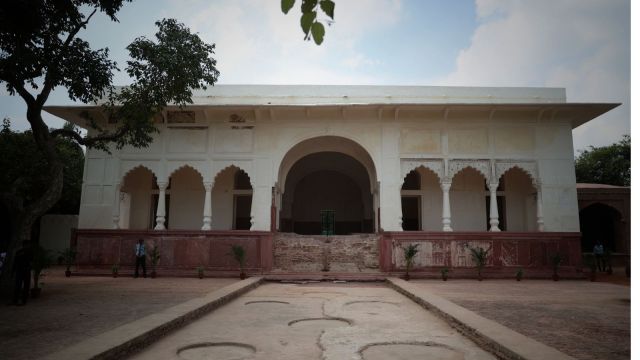 Amid it all, the Sheesh Mahal (glass palace) stands calmly in the centre, unmoved by the bustle. (Express photo by Tashi Tobgyal)
Evening descends gently over Shalimar Bagh in Northwest Delhi. The sandy pathways are still warm from the day’s sun.
Slowly, the garden begins to stir. A group of elderly men arrive, settling down on the lawn to play cards, their familiar banter floating through the air. Children run around, chatting loudly, playing games, and waiting for their turn at the swing.
Amid it all, the Sheesh Mahal (glass palace) stands calmly in the centre, unmoved by the bustle.
Its walls, freshly plastered with lime, bask in the evening sun, its arches catching shadows like memories.
Built in 1653 by Izz-un-Nisha Begum, wife of Mughal Emperor Shah Jahan, the monument was a tribute — and a replica — of the Shalimar Bagh in Kashmir, and a fine example of Mughal garden architecture designed to be a royal retreat away from Shahjahanabad’s bustle.
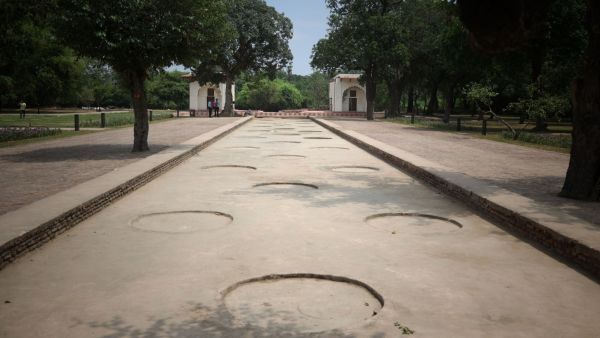 Amid it all, the Sheesh Mahal (glass palace) stands calmly in the centre, unmoved by the bustle. (Express photo by Tashi Tobgyal)
Until recently, it remained forgotten and neglected. Archival images of the garden show a place sinking into itself — exposed brickwork, collapsed flooring, faded floral motifs on faded walls, and a thicket of overgrown weeds and hanging vines.
That began to change in January 2024, when Lieutenant Governor Vinai Kumar Saxena initiated a conservation drive. The Delhi Development Authority (DDA), under the technical supervision of the Archaeological Survey of India (ASI), undertook the restoration work.
And on July 2, the Sheesh Mahal, the Baradari (pavilion with 12 doors), and three heritage-era cottages were unveiled to the public after restoration.
Originally, the main building of the Sheesh Mahal had a Baradari with a water channel running through it. The pavilion still sports a square tank with fountains; it is believed that there was an arrangement for a jharna (waterfall) here. Beyond the tank, there is another tank which was connected with the former by a water channel.
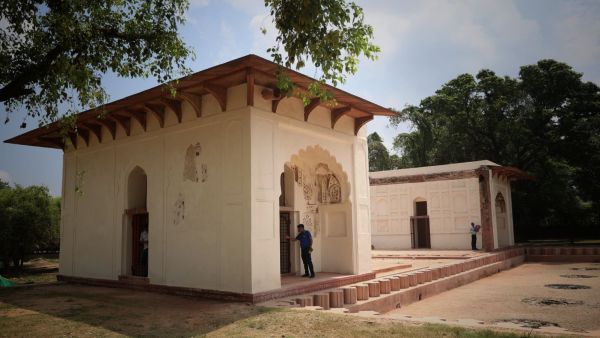 Originally, the main building of the Sheesh Mahal had a Baradari (pavilion) to the north with a water channel running through it. (Express Photo by Tashi Tobgyal)
The red sandstone building adjacent to the Mahal is believed to have been used as hamam (public bathhouse), made of brick masonry and red sandstone. The archway is flanked by a three-arched dalan (hall) on either side.
Beyond this lies the central hall with a compartment at either wing and another three-arched dalan at the back.
Walking through the corridors of Sheesh Mahal today is like stepping back in time. The structure is said to have witnessed multiple phases of Delhi’s history — from Aurangzeb’s self-coronation in 1658 to Nadir Shah’s encampment during his invasion of Delhi in 1738 — before being absorbed into the British estates. In 1983, it was declared a monument of national importance, and the ASI has been preserving it since.
What went into the restoration?
An ASI official said the structures have been restored using traditional techniques and materials – lakhori bricks, limewater, red sandstone — that were originally used to build the structure. The team has also done waterproofing and water tightening of the roof with lime water to stop the water seepage.
The vaulted dome ceilings of the halls, treated with lime plaster, are now illuminated with natural light streaming in.
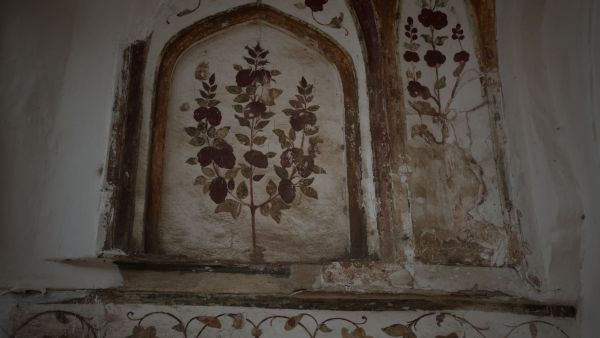 Floral motifs stand in contrast with the freshly treated walls. (Express Photo by Tashi Tobgyal)
The painted murals are perhaps the most captivating detail brought back: The floral motifs stand in contrast with the freshly treated walls. Delicately twisted vines and flowers, recreated in organic colours, bloom across the ceiling panels and the walls of the baradari, narrating the tales of Mughal craftwork.
The flaking red sandstone in the plinth of the Sheesh Mahal has been replaced with fresh pieces of the same material, plastered in off-white.
The surrounding Char Bagh garden has been landscaped with pathways, with bushes and flowers neatly planted alongside.
A well on the premises has also been revived, after desilting and reconstructing it with the existing foundation as a base.
The ASI official said all the work that has been done so far is based on existing evidence and documents.
As for the three cottages, two of them have been adaptively reused – ‘Café Shalimar’ is for the visitors to come, eat, and enjoy while the ‘Readers Café Corner’ facilitates literary engagement. The third cottage has been repurposed for official use while maintaining its heritage character. An official from DDA said that these cottages were built in 1930, as evidenced by the year on these bricks.
Yet, the restoration remains a work in progress.
The biggest challenge that lies ahead for the ASI team is to revive the water channel. The official said that when the monument was first identified, the fountains did not exist. With no existing evidence, replicating the original fountain and jharna system is proving difficult — though not impossible.

 5 min read