Journalism of Courage



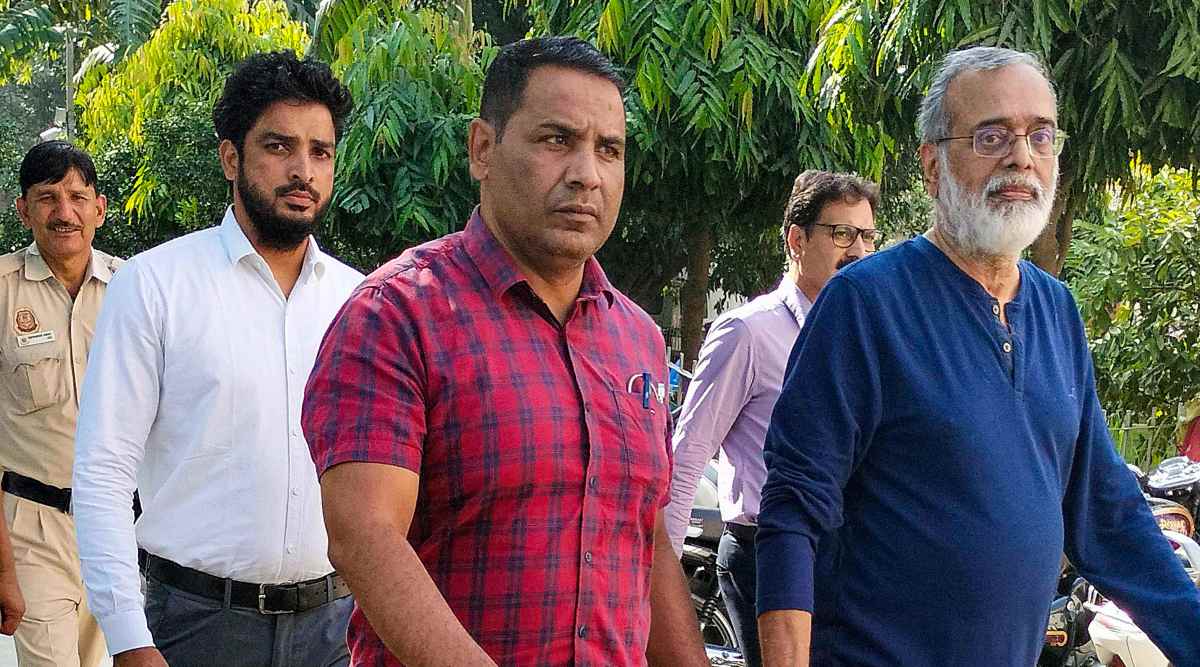 NewsClick founder Prabir Purkayastha being brought to the Patiala House Court by Delhi Police's Special Cell in a case lodged under anti-terror law UAPA, in New Delhi, Tuesday, Oct. 10, 2023. (PTI Photo)
 THE DELHI High Court Friday dismissed pleas by NewsClick founder and Editor-in-Chief Prabir Purkayastha and its Human Resource head Amit Chakravarty challenging their arrest and the subsequent police remand order in a case lodged against them under the anti-terror law, Unlawful Activities (Prevention) Act or UAPA.
The High Court rejected their contention they should have been provided the grounds of arrest when apprehended by police and said the UAPA does not mandate furnishing written grounds and only speaks of the accused being “informed” about the reasons for arrest. The court said it would be “advisable” that the police henceforth provide the grounds of arrest in writing to an accused after redacting “sensitive material”.
After considering the contents of the police’s remand application, a single judge bench of Justice Tushar Rao Gedela said, “It appears that the substratum of the allegations which would comprise the reasons for arrest is indeed contained in the said application.”
The court said it was undisputed that the remand application was given in writing to Purkayastha’s counsel during the remand proceedings within 24 hours of his arrest. Further, his counsel did participate in the remand proceedings but opposed it “telephonically directly to the Special Judge”, the remand order noted.
“The petition, being devoid of any merit, along with pending applications, is dismissed,” the court said in its order passed on the petition by the portal’s founder. “After examining the entire issue in the right perspective, it appears as of now that the grounds of arrest were indeed conveyed to the petitioner, as soon as may be, after the arrest and as such, there does not appear to be any procedural infirmity or violation of the provisions of the Section 43B of the UAPA or the Article 22(1) of the Constitution of India and as such, the arrest are in accordance with law,” the court stated.
Comparing the provisions of arrest under Section 19(1) and Section 19(2) of the Prevention of Money Laundering Act and Section 43A and 43B of the UAPA, the HC observed that there is a “distinction”. Reading both PMLA sections together, the court said for the purpose of arrest, an authorised officer should not only have materials with him giving him “reasons to believe” that a person is guilty of an offence under the act but such reasons should also be “recorded in writing before effecting arrest of any person”. “In other words, unless such reasons are recorded in writing and available with the officer, the arrest de hors (without) such recorded reasons would be void ab initio,” the HC said.
The court then said no such provision is present in Section 43B of UAPA, wherein “reasons to believe” for arrest need not be recorded in writing. The court said there isn’t a similar legal obligation cast upon the authorities under Sections 43A and 43B and thus, the Supreme Court’s decision in Pankaj Bansal’s case is not “squarely applicable” to a UAPA case.
It hence said there was no “procedural infirmity or violation of the provisions of the Section 43B of the UAPA or the Article 22(1) of the Constitution of India” and the arrest was in accordance with law. The HC noted that the apex court directed it would be “necessary henceforth that a copy of such written grounds of arrest is furnished to the arrested person as a matter of course without exception” and on that basis, the arrest and remand orders were set aside and the Bansals were directed to be released.
The court held that under the UAPA grounds of arrest need to be “informed” to the arrestee within 24 hours of such arrest, however furnishing of such grounds, in written, are not mandated by the act.
“Keeping in view the law laid down by the Supreme Court in Pankaj Bansal, and also considering the stringent provisions of UAPA, it would be advisable that the respondent, henceforth, provide grounds of arrest in writing, though after redacting what in the opinion of the respondent would constitute ‘sensitive material’,” the HC added.
On the point that Chakravarty is suffering from physical disability to the extent of 59 per cent and is covered under The Rights Of Persons With Disabilities Act, the High Court said it is not inclined to pass any favourable orders keeping in view that serious offences “affecting the stability, integrity, sovereignty and national security” which have been alleged against him.
On the HC order Purkayastha’s counsel Arshdeep Singh Khurana said, “We are examining the judgment and will be pursuing appropriate remedies.”

 5 min read