Journalism of Courage



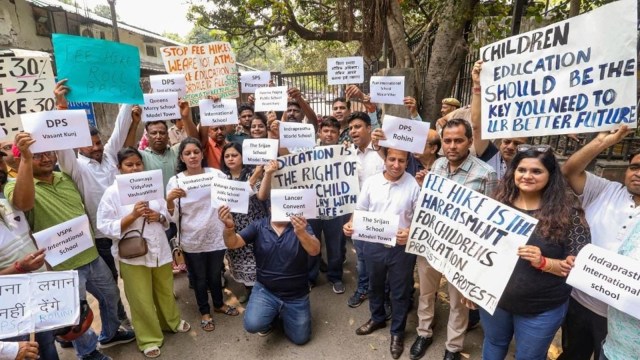 Parent associations had previously raised concerns over the 15% threshold, arguing that it may be difficult to mobilise support. (Express Photo)
Four months after the Delhi Assembly passed the Delhi School Education (Transparency in Fixation and Regulation of Fees) Bill, 2025, to regulate fees in private schools amid protests by parents over arbitrary hikes, the Delhi government officially notified the Act on Wednesday with Lieutenant-Governor V K Saxena issuing the Gazette notification, The Indian Express has learnt.
At the centre of the new regime is a three-tier committee structure — a School-level Fee Regulation Committee, the District Fee Appellate Committee, and the Revision Committee. Another key aspect of the Act is that a complaint to the District-level Committee must be backed by at least 15% of the affected parents. The Act makes parents a part of the decision-making process.
However, parent associations had previously raised concerns over the 15% threshold, arguing that it may be difficult to mobilise support, but the mechanism remains intact in the notified rules and now has a codified appeal format and scrutiny process.
Under the new Act, “private unaided recognised schools are strictly prohibited from collecting any fees that are not explicitly defined and sanctioned”. The Act brings under its ambit over 1,500 private unaided schools in the Capital after years of protests by parents.
“All permissible fees must be itemised and disclosed as distinct components,” reads Chapter II of the Act, which categorically prohibits the collection of “excess fee”. The defined fee heads include admission charges, registration charges, security deposit — all of which are non-recurring charges.
Tuition fees have been defined to include “standard establishment costs and expenditures directly related to curricular activities”. It cannot be used to recover capital expenditure, including investments for infrastructure development or any other non-revenue generating assets, according to the Act. Apart from this, term fees, annual charges and development fees have also been defined under the Act.
Formation of committees
Meanwhile, as per the Act, the School-level Fee Regulation Committee should contain five parent representatives, while ensuring representation of women and disadvantaged groups and three teachers who are to be elected after a video-recorded draw process.
A representative from the management becomes the Chairperson, and the principal is to be appointed as the Member Secretary.
An observer to this Committee, who is an official not below the rank of a government school principal, will also be nominated by the Delhi Education department. It is the duty of this observer, as per the Act, for independent oversight of the Committee’s proceedings. This Committee has to approve the fee structure proposed by the school management for a period of three academic years, and can also examine any relevant financial document.
The Act has also mandated audit compliance by stating that every proposal for fee revision or fixation submitted by the school management to the school-level Fee Regulation Committee should be accompanied with a set of audited financial statements.
In an academic year, the DOE is required to constitute the District Fee Appellate Committee on or before July 15, for each district, which would be the Appellate authority for all recognised private unaided schools situated within the district. Any dispute or objection then moves to the District Fee Appellate Committee, chaired by a serving or retired government officer and supported by a chartered accountant and parent member.
Reviews at the district level must be completed by July 30. Appeals to the Revision Committee must be filed within 30 days of a district committee order, extendable to 45 days with justification and the committee has to dispose of each case within 45 days.
If no resolution is reached within 45 days, the matter will go to the Appellate Committee
The highest authority — the Revision Committee — should be minimum of four members with the Chairperson nominated by the government based on the recommendation of a three-member Search Committee chaired by the Principal Secretary or Secretary(Education) and comprising two domain experts, nominated by the Director Education, having experience in the field of education policy, finance, or school regulation.
The Committee has powers to call for records, summon witnesses, seek expert opinion and issue final, binding orders that remain applicable for a block of three academic years.

 4 min read