4 min read
Stay updated with the latest - Click here to follow us on Instagram

Journalism of Courage



As countdown to Commonwealth Games begins,thousands of labourers work at a feverish pace to finish the Terminal 3 of the IGI airport. Newsline takes a look at the facilities provided for these men
Brick structures, clean toilets,electricity and drinking water,a 24-hour medical centre,three sewage treatment plants,stores,training centre and a movie every weekend: these are part of the facilities at the countrys largest camp for the over 20,000 workers building the worlds second largest airport terminal.
With a 39-month deadline which ends in October,the Indira Gandhi International Airports Terminal 3 one of the biggest infrastructure projects proposes to be a modern-day wonder. The new terminal at Changi Airport in Singapore took 76 months to build; Londons Heathrow Airports T5 and Beijings Terminal 3,each took 60 months.
The foundation for T3 was laid in February 2007,and civil structural work at all nine levels are over. The glasswork on the building and boarding piers are on to give the terminal its signature look. Assistant construction manager Ayaskuta Dhal,who has come from Orissa,has seen it rise from dust. When the civil structure was completed before target on December 31 2008,we celebrated. It was a miracle, he said.
Part of the success can be attributed to the living conditions of the migrant workers who come from all corners of the country Bihar,Madhya Pradesh,Chhattisgarh,Jharkhand and Tamil Nadu. In fact,it was what a study done by the Delhi International Airport Limited,the GMR-backed consortium developing the airport,had prescribed.
The result a clean,well maintained colony,with proper water availability, said Ram Parvesh from Sonbhadra,Uttar Pradesh. I was working at a construction project in Gurgaon before this. But the facilities here are far better.
For a project like this,the human force is very vital, said I P Rao,DIALs Chief Executive Officer for Airport Development. The idea is for the men to be focussed and dedicated,which gets difficult with a family around. Hence,the colony has no-entry rules for women and children.
The place is clean and well organised. Inside,at least 10 to 12 workers live in one room,each room being 15 feet by 20 feet in size. There are lights but no fans. The workers can get their own fans. We havent provided them due to safety concerns, said Daryab Singh,ex-serviceman and caretaker at the colony.
The toilets are located at accessible points. The sewerage network is not attached to the municipal network. Instead,the place has three sewage treatment plants. The water is re-used for horticulture and dust suppression. We get 3 lakh litres every day from these plants, said Singh. Thirty tankers work round the clock to distribute water to other project sites.
The colony has a training centre as well. If a worker says he is skilled,we check his skills and train him well, Singh said.
Safety gets utmost importance,with the colony being manned by former servicemen as block supervisors. Board fencing restricts outsiders entry and identity cards have been provided to the workforce. Wearing the safety gear and helmets at all times is mandatory at the project site. Sunil Singh,a labourer from Bihar,whose job requires him to climb walls,said: We have security gear on at all times. There is no question of fear.
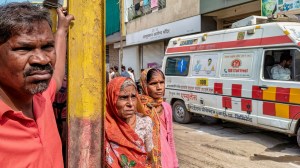
Even so,a full-fledged medical centre with doctors and paramedical staff has been provided. There are 16 beds,four ambulances and workers are provided free health check-up and medicines. Larsen and Toubro,the main contractor for the site,has an agreement with the Fortis Hospital and the Indian Spinal Injuries Centre in Vasant Kunj,where workers are treated during emergency.
The colony has six canteens that provide food at subsidised rates. There are 10 general stores. And the workers look forward to Sunday,when a movie is screened and a weekend market is set up in the evening. We try to show motivational films like Chak de India or Lagaan, Singh said.
Stay updated with the latest - Click here to follow us on Instagram