Stay updated with the latest - Click here to follow us on Instagram

Journalism of Courage
 3 min read


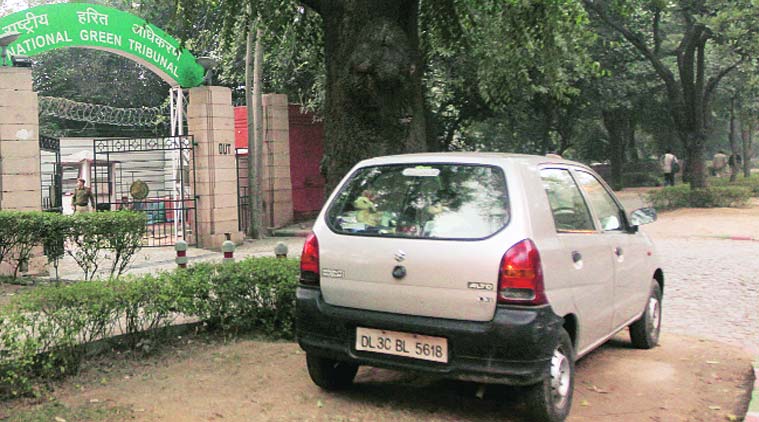 A team from the National Green Tribunal visited the city on April 11 to examine the extent of concretisation. (Source: Express Archive)
Meghna Malik & Aniruddha Ghosal
Ghaziabad authorities have begun the work to deconcretise areas after a team from the National Green Tribunal visited the city on April 11 to examine the extent of concretisation.
Ghaziabad Development Authority (GDA) vice-chairman Santosh Yadav confirmed that agencies had begun the deconcretisation work. “The GDA has begun removing tiles around trees in Ghaziabad. This is to allow groundwater recharging and to ensure that trees also survive. We are also looking at footpaths. We have asked our engineering team to analyse the best way to go about it,” he said.
Yadav said with regard to pavements, his department will be looking to ensure that the drainage system along a footpath is not affected. “We don’t want to damage pavements and we also don’t want to damage the drainage flow.
[related-post]
Our engineering department is analysing technical solutions,” he said.
The action was taken after directions were issued by the NGT in a plea filed by environmental activist Akash Vashishth, who had moved the NGT in 2013 against concretisation in Ghaziabad. In his petition, he had sought “extension of guidelines of the Urban Development Ministry, issued in 2000, on greening of urban areas and landscaping the whole of the country for conservation and judicious use of natural resources, particularly land, water and soil”.
In November, last year, the NGT-appointed local commissioners had visited main roads, arterial roads and various parks in Ghaziabad. The report, which was placed before the NGT, said all roadsides and berms were concretised with interlocking tiles and there were no traces of soil or space for rainwater to flow.
Advocate Rahul Choudhury, counsel for Vashishth, said, “After the local commissioner’s report, the counsel for GDA objected. The NGT asked both counsels to visit Ghaziabad. After we went there, I found rampant concretisation, in blatant violation of the NGT order.”
The NGT will hear the case on Friday. In February 2014, the NGT had observed in its order that tiling/concretisation of pavements should not exceed more than five per cent and that footpath and tracks are constructed only with permeable and semi-permeable blocks.
(Meghna Malik is a student of Exims, Delhi)
Stay updated with the latest - Click here to follow us on Instagram