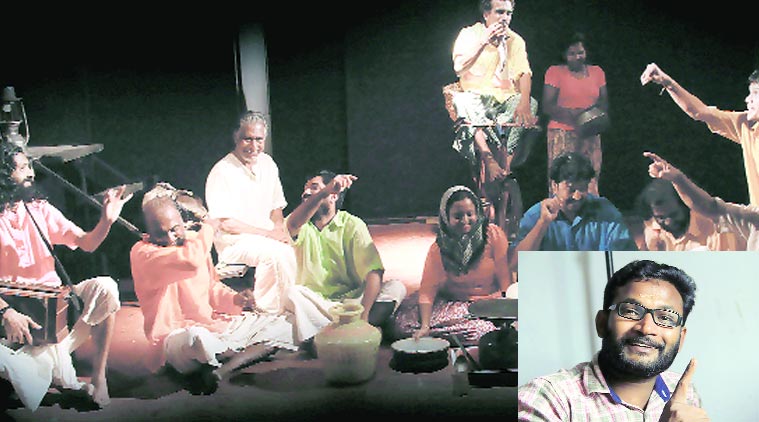
In the play, mathi represents the working class of Kerala and is present in every aspect of life, from romance to violence; (right) Jino Joseph.
His previous play was called Parotta. This one is titled Mathi or sardine. Tempting as they sound, the former is a critique of the education system — inherited from the British just like the maida used in parotta — and the latter is a biting socio-political satire. Mathi has won Kerala Sangeet Natak Akademi Awards in several categories, making 29-year-old playwright and director Jino Joseph one of the strong contenders at the Mahindra Excellence in Theatre Awards 2015, to be held in Delhi between March 21 and 26. The play, in Malayalam, has been short-listed in categories such as Best Actor in Supporting Role (Female), Best Ensemble and Best Light Design, with Joseph also being a contender for Best Original Script, Best Stage Design and Best Choreography. “This play is from the Kannur district of Kerala and we have extremely rural aesthetics,” says Joseph, over the phone. Excerpts:
How do you make a fish a medium of sociopolitical satire?
Mathi is all about the nostalgia of the ’70s and ’80s in Kerala. Mathi or sardine is a tasty and healthy fish, and since it costs around Rs 10 or Rs 20 a kg, and is popular with the masses. In our play, mathi represents the working class of Kerala. Every aspect of life in the play, from romance to violence, involves the mathi. When the hero courts the village girl, he gives her mathi. As for the name, one day, my roommate came in while I was eating parotta and mathi curry and said that he was going to name my next production Mathi. The name stuck in my head.
What is the plot of Mathi?
The story goes through the life of a fish seller called Rafique and his sister Kunjami. She is the one who fries mathi and tapioca for gatherings. The smell of mathi gives the people of their group an additional energy. Things begin to change in the play reflecting the changing situation of the state — young people from Kerala get scattered, they migrate and there is almost no working class left. Now, people from Bengal and north India have to be hired for labour and even for processions and rallies. They are migrants, just as the people of Kerala are migrants in other states and countries.
Does Kunjami cook mathi on stage?
Mathi is cooked throughout the play on stage and in between the audience, filling the hall with the smell of its frying. One of the peculiarities of the play is that it smells a lot when it is fresh and when it is fried. We have also played on the ability of this fish to announce its presence with its smell. At the end, people are served the fish. You see people coming together and sharing and this is an extension of our theme that people must come together and work with one another.
Have you sourced the fish in Delhi or will you bring it from Kerala?
We sourced mathi even in Abu Dhabi when we performed there last year. We distributed it to the entire audience.
How have you experimented with audience interactions and stage design?
The play is very interactive; one main character is always in the audience and represents the audience. One of the features of the stage is the use of sliding walls that give the feel of mobility in scenes with huge processions. The stage also transforms into a train as well as a small village, with narrow, muddy paths running from house to house.
Where did you train in theatre?
I didn’t. My parents are agricultural labourers and we live in a remote village in Kannur. I was interested in theatre since childhood and the ’80s and ’90s were good times for both professional and commercial theatre in Kerala. Each and every temple and church would have plays and I used to participate in them. I did theatre in school as well as in rural groups. Even our group has actors who are untrained. There are agricultural labourers, school teachers, taxi drivers and students of all ages, from children to 75 year olds. We create theatre together.
Story continues below this ad
Mathi will be staged at LTG auditorium on March 24. Entry: Rs100 and Rs 200. Contact: 26805477, 26801477
Dipanita Nath is a Senior Assistant Editor at The Indian Express, based in Pune. She is a versatile journalist with a deep interest in the intersection of culture, sustainability, and urban life.
Professional Background
Experience: Before joining The Indian Express, she worked with other major news organizations including Hindustan Times, The Times of India, and Mint.
Core Specializations: She is widely recognized for her coverage of the climate crisis, theatre and performing arts, heritage conservation, and the startup ecosystem (often through her "Pune Inc" series).
Storytelling Focus: Her work often unearths "hidden stories" of Pune—focusing on historical institutes, local traditions, and the personal journeys of social innovators.
Recent Notable Articles (December 2025)
Her recent reporting highlights Pune’s cultural pulse and the environmental challenges facing the city during the winter season:
1. Climate & Environment
"Pune shivers on coldest morning of the season; minimum temperature plunges to 6.9°C" (Dec 20, 2025): Reporting on the record-breaking cold wave in Pune and the IMD's forecast for the week.
"How a heritage tree-mapping event at Ganeshkhind Garden highlights rising interest in Pune’s green legacy" (Dec 20, 2025): Covering a citizen-led initiative where Gen Z and millennials gathered to document and protect ancient trees at a Biodiversity Heritage Site.
"Right to breathe: Landmark NGT order directs PMC to frame norms for pollution from construction sites" (Dec 8, 2025): Reporting on a significant legal victory for residents fighting dust and air pollution in urban neighborhoods like Baner.
2. "Hidden Stories" & Heritage
"Inside Pune library that’s nourished minds of entrepreneurs for 17 years" (Dec 21, 2025): A feature on the Venture Center Library, detailing how a collection of 3,500 specialized books helps tech startups navigate the product life cycle.
"Before he died, Ram Sutar gave Pune a lasting gift" (Dec 18, 2025): A tribute to the legendary sculptor Ram Sutar (creator of the Statue of Unity), focusing on his local works like the Chhatrapati Shivaji statue at Pune airport.
"The Pune institute where MA Jinnah was once chief guest" (Dec 6, 2025): An archival exploration of the College of Agriculture, established in 1907, and its historical role in India's freedom struggle.
3. Arts, Theatre & "Pune Inc"
"Satyajit Ray, Ritwik Ghatak were not rivals but close friends, says veteran filmmaker" (Dec 17, 2025): A deep-dive interview ahead of the Pune International Film Festival (PIFF) exploring the camaraderie between legends of Indian cinema.
"Meet the Pune entrepreneur helping women build and scale businesses" (Dec 16, 2025): Part of her "Pune Inc" series, profiling Nikita Vora’s efforts to empower female-led startups.
"How women drone pilots in rural Maharashtra are cultivating a green habit" (Dec 12, 2025): Exploring how technology is being used by women in agriculture to reduce chemical use and labor.
Signature Style
Dipanita Nath is known for intellectual curiosity and a narrative-driven approach. Whether she is writing about a 110-year-old eatery or the intricacies of the climate crisis, she focuses on the human element and the historical context. Her columns are often a blend of reportage and cultural commentary, making them a staple for readers interested in the "soul" of Pune.
X (Twitter): @dipanitanath ... Read More


 5 min read


 In the play, mathi represents the working class of Kerala and is present in every aspect of life, from romance to violence; (right) Jino Joseph.