Journalism of Courage



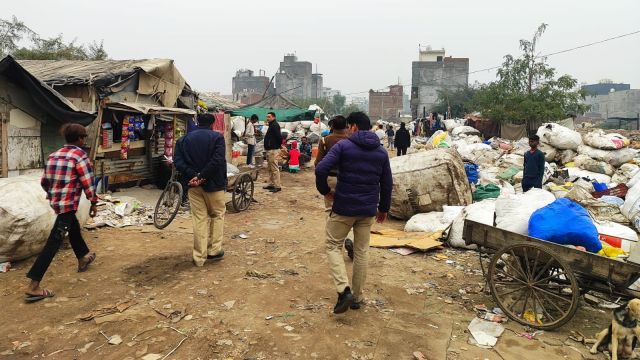 Illegal Bangladeshi In Delhi: Situated 2 km away from the police station, Kanchan Kunj is a cluster of makeshift jhuggis. (Express Photo/Pragynesh)
“Where are you? Alright, get back here as soon as you can.”
At the Kalindi Kunj police station, two policemen are frantically calling colleagues. The station house officer, the inspector in-charge of the police station, wants them back at short notice for a crucial task: A team needs to be set up and sent to a residential cluster where the police suspect a number of “illegal immigrants” – all of them from Bangladesh – are living.
Led by a sub-inspector, a six-member group – including an assistant sub-inspector, two head constables and as many constables — is quickly put together. Soon two bikes, carrying two policemen each, and an SUV with another two, leaves. Their destination: Kanchan Kunj.
The exercise is part of the special drive kick-started following a directive by the Lieutenant Governor’s Secretariat to the Delhi Chief Secretary and Police Commissioner on December 10 last year to identify and take action against “illegal immigrants from Bangladesh” residing in Delhi “in the next two months”.
So far, over 58 persons have been deported on the orders of the Foreigners Regional Registration Office (FRRO), the Delhi Police says. Eight have been arrested.
Situated 2 km away from the police station, Kanchan Kunj is a cluster of makeshift jhuggis, mostly with tin sheets serving as roofs. Accessible only by a narrow road, the address is cluttered with heaps of garbage of all kinds — plastic bottles, broken furniture, and out-of-shape utensils. Local residents can be seen hanging around small shops selling cigarettes or serving tea. A few others sift through the garbage looking for stuff they can later sell – the locality is home to many rag pickers. Some warm themselves in front of a small bonfire.
At the sight of khaki-clad men, the locality seems to be jolted out of its afternoon languor. Some huddle together, others peep gingerly from their houses. “Get your Aadhaar cards, everyone. Any other document you have, bring that as well,” the sub-inspector orders.
The group around the bonfire looks half-amused. This is clearly not the first time they – the police personnel – are here. The residents drag their feet towards their shanties.
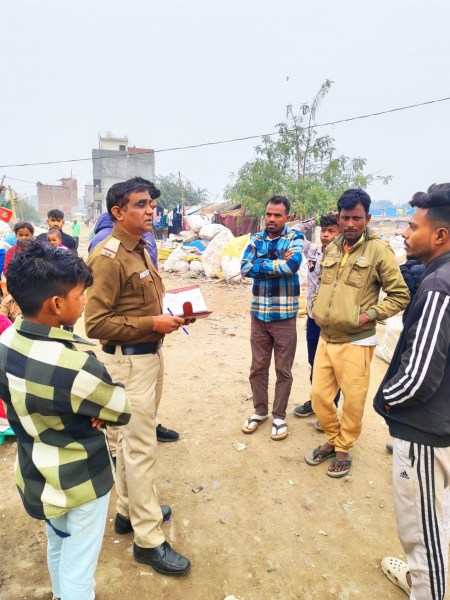 Illegal Bangladeshi In Delhi: Policemen questioning a man in Kanchan Kunj about his residence and domicile. (Express Photo/Pragynesh)
Mohammad Alamin Aslam, 19, is not one of them. Looking equal parts scared and surprised, Aslam cuts a lean frame, with his hands in his pockets as he shivers in the chill of the Capital. He only has a thin sweatshirt on his back.
He rushes inside his cousin Rafique Aslam’s house, one of the first in the jhuggi cluster, and comes out with his Aadhaar card. “Mere bhai ka yahaan kaam hai (My brother has his business here). I have come here to search for work. My desh (home) is Assam,” he tells the inquiring policemen.
Aslam’s cousin works at a godown in Sarita Vihar. According to his Aadhaar card, Aslam belongs to the Dhubri district of Assam and arrived in Delhi only a month and a half ago to look for work. “My family trades in clothes in Assam. Every day, we go to Meghalaya in the morning to sell our goods in the wholesale market,” he tells The Indian Express.
For the last four years, he has been helping his family in its business, covering the 20-km back-and-forth stretch from Dhubri to the wholesale market near the Meghalaya border daily. He is here now to “take stock of job opportunities”.
“If there is something (a job), I will start earning here and try to set up a cloth shop. Then, I can bring over my family and we could continue to lead our lives here. I don’t know why they (police) are checking me. I am only here for a job,” he says.
Unlike Aslam, 22-year-old Rukhsana Begum has now grown used to showing her Aadhaar card to policemen on demand.
She is from Bagachra village in Assam. “I was married early… at 15… I have been living in Kanchan Kunj for the past six years. Before that, I lived in Khadar. Police keep coming here to check the documents. Every time, I say the same thing,” she says.
Begum has two children – a six-year-old son and a three-year-old daughter. They don’t go to school. “We can’t afford to send them to school,’’ she says.
Begum’s husband Rafiqul Islam is a rag-picker. And so are her parents who live “right across the road” in Khadar.
Kanchan Kunj is home to many other “Assamese Bengalis”, several of whom are from Begum’s own village. “I came to Delhi when I was 10,” she recalls.
While Aslam and Begum are from Assam, Kallu Khan has no connection to the Northeast or even West Bengal. Khan, 50, is from Uttar Pradesh’s Badaun, 222 km from the capital.
A ragpicker like many in the area, he says, almost with a hint of pride, that he never saw his name “being noted” by the police. “Ab toh yahan teen-chaar baar aa chuki hai police (The police have visited this area three-four times by now). They see my voter ID and then ask a few questions. But they have never noted by name. It’s mostly Bangla log (Bengali people) whose names they jot down, I think,” he says.
A father of seven, two of whom are married now, Khan left Badaun five years ago to come and stay with his in-laws in Kanchan Kunj. “Wahan kuch kam tha nahi (There was no work). My in-laws are in the business of rag-picking. So, I also came here to earn a living,” he says.
The police team moves inside the cluster and inspects 10 more people. All of them say they are from Assam, all of them Muslims.
Amid the squalor of the cluster, the residents seem to have developed an easy camaraderie. No one resists. They gather in a neat line, Aadhaar card in hand, and wait for their turn before the policemen.
An officer, who is a part of the drive, is not convinced. “It has become very difficult to prove who among them are illegal immigrants. Almost all of them have their basic documents ready,’’ he says. “This is why we rely on common trends (dialect, etc.) found among illegal immigrants we have detained previously and try to trace their places of origin”.
Back at Kanchan Kunj, Begum says she has grown tired of fishing out her Aadhaar card again and again. “Last time they (police) came, my husband showed them the documents. Now they are here again. How many times will we repeat the same thing? Card toh yahi rahega,” she says with a shrug.
Seeing the policemen leave, she calls out to them: “Saahab, khana toh kha ke jaao. Machchi aur bhaat bana hai (Sir, do join us for lunch. We have prepared fish curry and rice).”
One of the officers turns around and breaks into a smile, the first time through the entire exercise. “Kabhi aur!”
The police team leaves.
DCP (Southeast) Ravi Kumar Singh later explains that “as of now, 25-30 people have been suspected of being illegal immigrants in Southeast district”.
“We are also trying to find if there are agents who help them come here in groups and forge their documents,” Kumar says.
Besides Madanpur Khadar, Kali Basti in Uttam Nagar, Jamia Nagar, Rangpuri in Southwest Delhi and Arjan Garh have seen multiple checking drives by the police to identify the alleged immigrants.
On January 25, another drive was taken up in the Southeast police district in Jamia Nagar around 12 pm. “We had a similar drive at a jhuggi in P Block of Jamia Nagar. Names of around 50 people were jotted down from the area recently,” a senior police officer informs.
It is around 3 pm and there is absolute calm in this jhuggi cluster, right next to an under-construction flyover. The police had already left several hours ago.
Carrying two buckets of water collected from a public tap, Mohammed Shiraz, 42, makes his way through the cramped lanes to his home: a two-floor jhuggi with his landlord occupying the upper storey. On the ground floor is a two-room set, available to Shiraz at a monthly rent of Rs 6,000. A father of five, he works as a sweeper at the IGI Airport.
A migrant from Bihar, Shiraz says he has been living in Delhi since 1998 but it is the first time he is being subjected to “identity verification” by the Delhi Police. “I have built my life in Delhi. All my children were born here. Still, they asked me to show my Aadhaar like I was some kind of a thief.”
A resident of the same P Block, Mohammed Suleiman, 35, considers himself a true “Dilliwala”. He grew up in Old Delhi and moved to Jamia Nagar around 15 years ago. He owns a two-storey jhuggi, with the first floor serving as home to his family, comprising his parents and wife. On the ground floor, he has set up a small water-cleaning unit through which he sells filtered water to people in the locality. He runs this one-man operation.
Suleiman doesn’t understand why “natives” of the capital like him are being questioned. “I was at the masjid when they (police) came on rounds. My neighbours told me that they asked for their Aadhaar card. Listen to how we speak, do we sound Bengali to you? It’s just because I have this name that I will be asked to prove myself (identity),” he says.
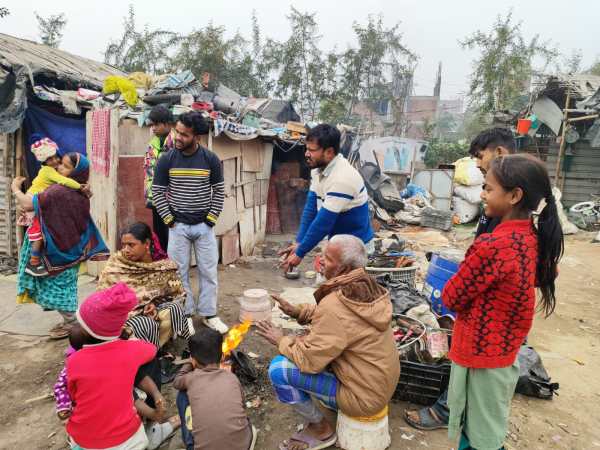 Illegal Bangladeshi In Delhi: Kanchan Kunj dwellers as a police party enters the area to inspect their identities. (Express Photo/Pragynesh)
Having done their rounds, an exercise that took them an hour, the police have their “suspects”. The next task, the police officers say, would be to collect information about them. “We call our informants in the area, many of whom have been residents of these localities. We question them about the people they see frequently around and those who are new. We also contact the houses or places where these people are employed, and ask the employer if they have carried out background verification,” says a police officer who has been part of several major drives in the Southwest police district of Delhi.
Around 30 km away, in West Delhi’s Dwarka district, police have identified around 200 suspected illegal immigrants so far. “Most of them come from either Assam or West Bengal. We have sent a team to their home states to verify their identities and documents,” DCP (Dwarka) Ankit Singh says.
In Outer Delhi, the Delhi Police claims that 175 individuals are suspected illegal immigrants.
“Special teams have been tasked with coordinating with the district foreigners’ cells to carry out door-to-door checking and thorough inspections,” DCP (Outer) Sachin Sharma says.
Once some “suspicious individuals” are taken note of, such as a name that has cropped up recently in the area, or someone who has resurfaced after years, a police team is sent to the states they claimed to belong to, a police officer says.
“We go to their villages and meet the sarpanch to verify the lineage of their families. We visit the local post offices and police stations to verify their addresses. Earlier, we used to collect these details via post. But since the L-G’s order, we have been asked to verify it on the ground,” a police officer from the Southeast district explains.
Another way to go about it, according to the police, is getting hold of the agents that facilitate illegal immigration from Bangladesh. On January 2, the Delhi Police, with the arrest of four people, claimed to have busted an alleged syndicate facilitating such immigration of Bangladeshi nationals to India. Two of them, Ashish Mehra and Aminur Ishlam, are Indian citizens allegedly involved in forging documents and arranging transportation for alleged illegal immigrants from states like West Bengal, Assam and Meghalaya.
The other two arrested persons are an alleged “illegal immigrant” Bangladeshi couple.
Police said the 28-year-old Bangladeshi man was arrested on December 28 last year from Aya Nagar after seven other alleged Bangladeshi immigrants – arrested the same day from Arjan Garh Metro station area – revealed his name to the police. During questioning, the man disclosed the name of his wife, who was also arrested from Gurgaon on December 28 subsequently.
The man allegedly revealed the modus operandi and route followed by the syndicate to smuggle in illegal immigrants from Bangladesh, leading the police to an Indian transporter, police say.
“Call Detail Record analysis led investigators to Ishlam, a resident of Goalpara in Assam. He used to transport illegal immigrants from Baghmara, a border district in Meghalaya, to Krishnai and New Bongaigaon railway stations in Assam,” says Joint Commissioner of Police (South) S K Jain.
Ishlam was arrested from the Damra out-check post in Assam and brought to Delhi on transit remand.
“During questioning, Ishlam revealed the name of Mehra, a Gurgaon resident, who allegedly forged documents to facilitate illegal immigrants,” Jain says. Mehra was arrested.
According to police, Mehra told them during questioning that the illegal immigration of the arrested Bangladeshi couple was initiated by the man’s brother, who helped them cross over to India via the Meghalaya border in 2022. From there, Ishlam took them to Assam.
The couple then reached Delhi, from where they were taken to Gurgaon by the brother’s wife to get fake identification documents prepared. Finally, Mehra took the couple to his associate, an authorised Aadhaar operator working at a bank in Gurgaon. “Using fake documents, the associate got the Aadhaar cards made for them,” Jain says.
The arrested Bangladeshi man, the police say, had frequently crossed over between India and Bangladesh and had come to India for the first time in 2018 in search of better wages.
“These agents also reveal the names of many immigrants and provide copies of their fake documents, which helps in tracking them down,” a police officer says.
The names that do not get verified, or are found to ‘not belong to’ India, are then rounded up and taken to the FRRO office in Delhi. “The FRRO issues deportation orders for the immigrants. They are then taken to detention centres in Delhi from where they are to be ferried to the borders and deported,” a police officer says.
On January 15, a train left Delhi, taking all the alleged illegal immigrants from Bangladesh, detained since the commencement of the drive on December 10, to the borders to facilitate their return, a senior police officer says.
“This (drive) will continue for some time with rigour because of the current political scenario… I am sure you understand. If you recall, there was a lot of focus on people from Africa, particularly from Nigeria, at one point in time. It will be work as usual soon,’’ a senior police officer says.
“There is a lot of pressure to show results, particularly these days. Otherwise, we have been carrying out these drives almost every year”.

 15 min read