


Stay updated with the latest - Click here to follow us on Instagram
© The Indian Express Pvt Ltd
Tags:


It is well known that Parsis migrated to India some 1,300 years ago after being persecuted in their homeland, Persia, modern-day Iran. They came via the sea trade route and settled largely in what today is the Maharashtra-Gujarat belt.
But their history in Delhi has often been somewhere between a legend and a lore. While historians date the first Parsi settlement in Delhi to the 19th century, legend has it that it all started with Meherjirana, the first Dastur or high priest, being invited by Mughal emperor Akbar for Din-i-ilahi in the 16th century.


The city first saw the influx of Parsis when the British moved the capital from Calcutta, present-day Kolkata, to Delhi, making it the centre of all trade and business and “as we know, wherever trade and industry went, the Parsis followed,” said Adil Nargolwalla, the president of the DPA. Kapadia, from Bharuch, Gujarat, was the first recorded Parsi migrant to Delhi.
Through the decades, several Parsis made Delhi their home. Among them were Dr Sorabji Shroff, who started his ophthalmic practice in old Delhi in 1914, lawyers Fali Sam Nariman and Soli Sorabjee and Homai Vyarawalla, India’s first female photojournalist. From about 40 individuals in 1913, the Parsi population in the city has grown up to 500 as of 2023-24, according to DPA. “Anjuman is a Persian word that means congregation and Delhi Parsi Anjuman was founded to serve as a cultural, spiritual and social hub for the Parsi community in Delhi,” says Nargolwalla, who is the first DPA President to have been born in Delhi.
If Delhi offered the community prospects for professional growth, the Parsis returned the favour in full spirit, across the fields of law, healthcare and architecture. “The Parsis were able to maintain their unique identity while making the Capital their own,” said Justice JB Pardiwala, who was the chief guest at the event on Saturday.
Several buildings in Delhi’s cityscape, including two iconic hotels — Hotel Ashok (Delhi’s first five-star hotel) and The Oberoi (then Oberoi Intercontinental) — were designed by EB Doctor and Piloo Mody, respectively. The establishment of Dr Shroff’s Charity Eye Hospital by Dr Sorabji P Shroff in 1922 was a landmark initiative in Delhi’s history that continues to serve its citizens till date.
“As from the field of law,” Pardiwala said, “I am very proud to say that for decades four Parsis — Fali Nariman, Soli Sorabjee, Tehmtan R. Andhyarujina and Rohinton Norman dominated the legal circles. Though originally from Mumbai, they all made Delhi their home.”
Pardiwala also noted another particularly fascinating Parsi contribution, albeit a bit indirect, to the Indian constitution. It was, thanks to his Parsi friend Naval Bhatena, that B R Ambedkar was able to pursue his education at several levels to eventually become a lawyer and subsequently draft the Indian constitution.
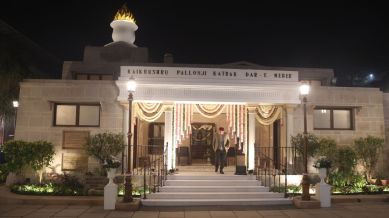
A significant part of the community’s rich legacy in the city has been the DPA, which as Rukshana Shroff, a member, said, “gave them a sense of belonging”, and grew along with the community. What began as a small cultural space, has over a century expanded into a progressive, well-equipped center with a Dharamsala, banquet hall and most recently the newly renovated Katgara hall, which will be inaugurated on Sunday.
“The hall, which has been donated by the Katgara family, will serve as a community space for everybody who stays at the Dharamshala,” said the president. The DPA also houses the Dar-e-Mehr or the Zoroastrian fire temple, which was established in 1961, and then renovated earlier this year. “This is the only fire temple in North India,” said Jahan Nargolwalla, another member.
With the Parsis in India identifying the most with Gujarati culture, the celebrations featured garba performances and a musical titled ‘Aapri Dilli ki Love story’. The special edition of the organisation’s in-house journal Dipanjali was also launched.
Rounding off the evening in true Parsi style on Saturday was an elaborate authentic spread that had everything from Kolmi fry, Bhaji Dana to Masala Dar, Patra ni Macchi, on offer. “The food has been prepared by Parsi caterers from Surat,” said Nargolwalla.
On Sunday, the celebrations will begin with the Dar-e-Meher Jashan by Vada Dasturji Khurshed Dastoor (the High Priest of the Udvada, a small town in Gujarat held sacred by Parsis).
Among other highlights will be a talk by Justice Rohinton Fali Nariman and a photo exhibition on the history of Paris in India. “From featuring the image of Akbar’s farman to Meherjirana to documenting the Parsis who have served the country in different capacities through the years, the exhibition will now be on permanent display,” said Nargolwalla.


Stay updated with the latest - Click here to follow us on Instagram


