Journalism of Courage



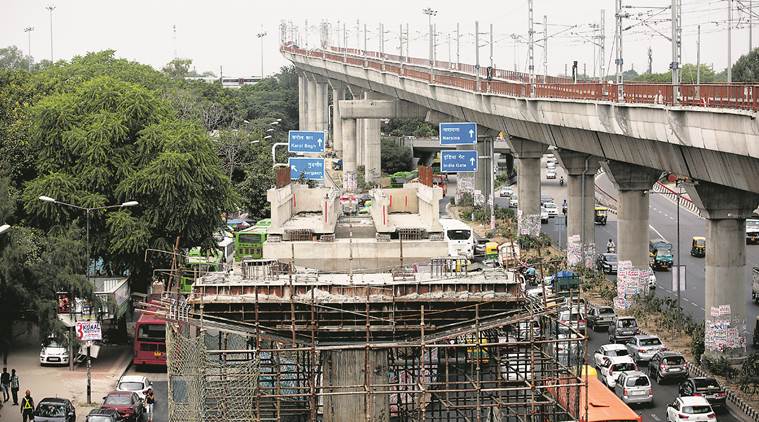 Among the biggest changes is the reduction in residential Floor Area Ratio (FAR), which implies a reduction in the number of units that can be constructed on a plot. (Representational)
Modifications to the Delhi Development Authority’s (DDA) land pooling policy — which was seen as a game changer in affordable housing, especially in outer Delhi — have thrown developers in a tizzy. Among the biggest changes is the reduction in residential Floor Area Ratio (FAR), which implies a reduction in the number of units that can be constructed on a plot.
Developers protested against the change in policy outside the DDA office a few days ago. The DDA will conduct hearings for objections and suggestions on the modifications from July 2-4. Notified in 2013, the policy was introduced to aid planned development in newly notified urbanisable areas by assembling land owned by private players and bringing them aboard as developers. Of the assembled land, 60% can be used by the developer for construction of houses and other infrastructure, and the rest for civic bodies to develop public amenities.
Under the old policy, developers with fragmented plots could pool land and hand it over to the DDA if the collective area was more than five hectares. While DDA would keep 40%, the rest would be returned to developers as a single plot within the same zone, even if the original plots were scattered. The residential FAR was decided as 400, which meant the possibility to build high rises.
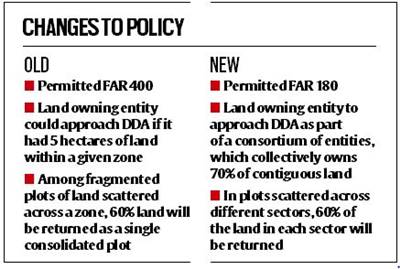
Following the changes, effected in January, residential FAR has been reduced to 180, in effect reducing the number of houses in any given society by half. Also, developers with plots far away from each other will not necessarily be returned land in one consolidated area.
Developers and societies, which had begun inviting bookings for yet-to-be-built societies, find themselves unable to accommodate all those from whom they took money. A DDA official said, “We repeatedly warned against starting bookings before the policy is operationalised, and had said that such activity is risky. In fact, taking bookings prior to RERA registration and approval is illegal.”
After the policy was passed in 2013, many developers bought plots far away from each other, hoping they will get one large plot in a consolidated area. With the changes, they now find themselves with smaller patches of land in different sectors that they cannot utilise and housing society members they cannot accommodate. Satish Aggarwal, secretary Federation of Housing Societies and Developers in Delhi (FedHSDD), said, “This move clearly works to the disadvantage of farmers and small societies who scrambled to put together the requisite land.”
According to a DDA official, reduction in FAR was done keeping in mind scarcity of resources such as water. “One can imagine the kind of pressure on resources that will be created by societies in these peripheral regions,” he said. A crucial fallout of the changes is that prices of houses will be much higher than before. Vijayant Vikram, member of (FedHSDD), said, “With half the number of home buyers possible, the land cost for each dwelling will double. With construction costs, the final price of each unit will be more than 50-60% higher than it would have been before.”
Developers now have the choice of either halving the size of the units or acquiring new land to build the deficit units — a move which will increase unauthorised construction, said members of developer associations.

 4 min read