Journalism of Courage



 Temperature drop down during dense fog in New Delhi on Tuesday morning. (Express Photo by Praveen Khanna)
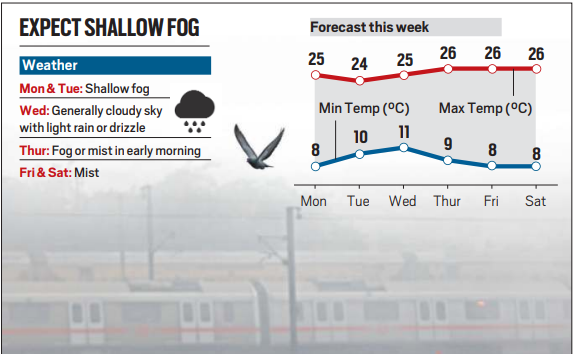
After a cold and foggy winter, temperatures in the city are set to increase. According to India Meteorological Department (IMD) officials, the maximum temperature is likely to touch 26 degrees Celsius by the middle of this week.
Delhi saw seven cold wave days in January, the highest in 16 years, with the temperatures dipping to the lowest in 12 years.
According to IMD, the day temperature is expected to touch 26 degrees Celsius by Wednesday. On Sunday, the maximum temperature was recorded as 24.6 degrees Celsius, a degree above normal.
The minimum temperature, however, is not expected to rise above the 10 degree mark – normal for this time of the year — for most of the days, and mornings will remain cold.
On Sunday, the minimum temperature was recorded as 7 degrees Celsius, three degrees below normal. There is also respite in store from the fog. Visibility has improved over the past week, after a long spell of very dense fog in the mornings and late evenings.
According to IMD, no fresh spell of dense fog is on the cards at present. Mist or shallow fog is expected, however, as morning temperatures remain below normal.
The reason behind Delhi’s long date with the cold was the lack of western disturbances, and wind systems that bring rain and snow to north and northwest India.
“Because there were barely any western disturbances, the sky was clear and there was no retention of heat. This meant cold mornings. Very dense fog on several days also meant that the days were cold as the sunlight was weak. On days when there was no fog, icy winds from the Himalayas and from the northwestern parts of the country made the city colder,” said an IMD official.
Air quality deteriorates
The city’s air quality, however, has seen a dip over the past week. After remaining in the moderate range (Air Quality Index between100 and 200), between February 5 and 9, it deteriorated to poor (295) on Saturday and further, to very poor (313) on Sunday.
The Early Warning System for Air Quality has forecast a very poor air day on Monday. A light improvement is seen thereafter and the AQI is expected to be in the poor range.
Strong winds in the second week of February were responsible for the marked improvement in AQI, IMD officials added.
“Strong winds have the ability to disperse pollutants faster. Increase in temperature also contributes to better air,” the official said.

 3 min read