This is an archive article published on January 13, 2020
Quran, Kirtan & Bible as thousands gather at Shaheen Bagh protest, Tharoor drops by to lend support
The slogan that has now become associated with the movement at Shaheen Bagh — Awaaz do, hum ek hain — rang out over and over again as women and men took a tiranga march through the lanes of the colony.
New Delhi | Updated: January 13, 2020 09:14 AM IST
4 min read
Whatsapp
twitter
Facebook
Reddit
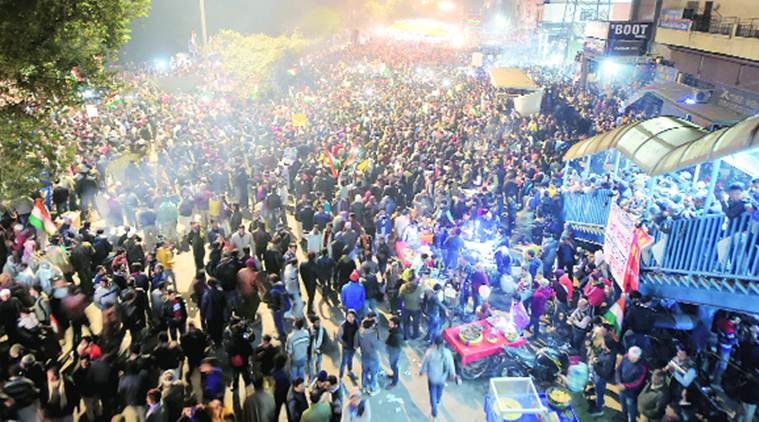
At Shaheen Bagh, Sunday. (Express Photo by Gajendra Yadav)
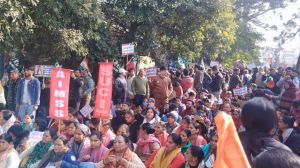
Verses from the Quran and the Bible were read out as notes of a shabad kirtan were heard in the background and a havan was performed alongside. A woman stood next to the four groups, holding a photograph of B R Ambedkar, as the inter-faith prayer meeting also saw some reading out the Preamble to the Constitution. Shaheen Bagh, where women, children and men have been protesting for a month now, saw thousands of people coming together in solidarity to register their protest against the new citizenship law and proposed NRC on Sunday.
The slogan that has now become associated with the movement at Shaheen Bagh — Awaaz do, hum ek hain — rang out over and over again as women and men took a tiranga march through the lanes of the colony.
“Many people have been trying to dismiss the movement as a Muslim issue. The presence of so many people here, the Tiranga march, and the interfaith prayer shows those people that out fight is not about a religion but about the country and its values,” said Mariam Iqbal, a resident of Chhatarpur who participated in Sunday’s protest.
According to those associated with the protest since the beginning, Sunday evening was when they saw the highest number of people gathering at the site.
Congress MP, Shashi Tharoor, with Delhi Congress president Subhash Chopra, also visited Shaheen Bagh Sunday evening. Delayed by close to two hours, Tharoor addressed a packed gathering, telling the women of Shaheen Bagh that they were the pride of the nation.
Glimpses of today’s crowds at the three #CAA_NRC_Protests I addressed. Let there be no doubt, this is a people’s upsurge, going well beyond any political party. We should applaud the courage &determination of ordinary people without seeking to appropriate their movement. JaiHind! pic.twitter.com/U2wzwxYQ6o
Tharoor also visited Jamia Millia Islamia and Jawaharlal Nehru University, where he called the violent events in JNU campus in the previous week “one of the greatest blots on our country”.
“The worst thing is that it reminded history students like me of events in Nazi Germany… when young stormtroopers of the ruling party marched into campuses and attacked students and teachers,” he said.
At all three places, he criticised the CAA, NRC and NPR. “The reason for my party and my opposition to the Act is because it is wrong in principle. It is the first time that a religious test has been introduced in Indian citizenship… Even today, we have Amit Shah asking if one can name anything in this law that takes away anybody’s citizenship? That is the wrong question to be asking. The current question is to be asking why it only mentions certain religions,” he said.
Story continues below this ad
At the gates of Jamia, speaking to the residents of neighbouring areas who have been on protest for the last month, he referred to it as “an undemocratic, discriminatory effort by the government to marginalise one community”.
Speaking on the persistence of the Jamia struggle, he said, “Jamia must fight on. If it needs money, I will go out with a begging bowl to save Jamia… Today the greatest thing about Jamia is its spirit. You are an inspiration to the country.”
Tharoor also called the hostel fee hike, which is at the centre of JNU students’ protests over the last two months, “shocking”.
Sukrita Baruah is a Principal Correspondent for The Indian Express, based in Guwahati. From this strategic hub, she provides comprehensive, ground-level coverage of India's North East, a region characterized by its complex ethnic diversity, geopolitical significance, and unique developmental challenges.
Expertise and Experience
Ethnic & Social Dynamics: Deep-dive coverage of regional conflicts (such as the crisis in Manipur) and peace-building efforts.
Border & Geopolitics: Tracking developments along India’s international borders and their impact on local communities.
Governance & Policy: Reporting on state elections, tribal council decisions, and the implementation of central schemes in the North East.
Specialized Education Background: Prior to her current role, Sukrita was a dedicated Education Correspondent for The Indian Express in Delhi. This experience provided her with a sharp analytical lens for:
Policy Analysis: Evaluating the National Education Policy (NEP) and university-level reforms.
Student Affairs: Covering high-stakes stories regarding campus politics, national entrance exams, and the challenges within the primary and secondary education sectors. ... Read More


 4 min read


 At Shaheen Bagh, Sunday. (Express Photo by Gajendra Yadav)