Journalism of Courage



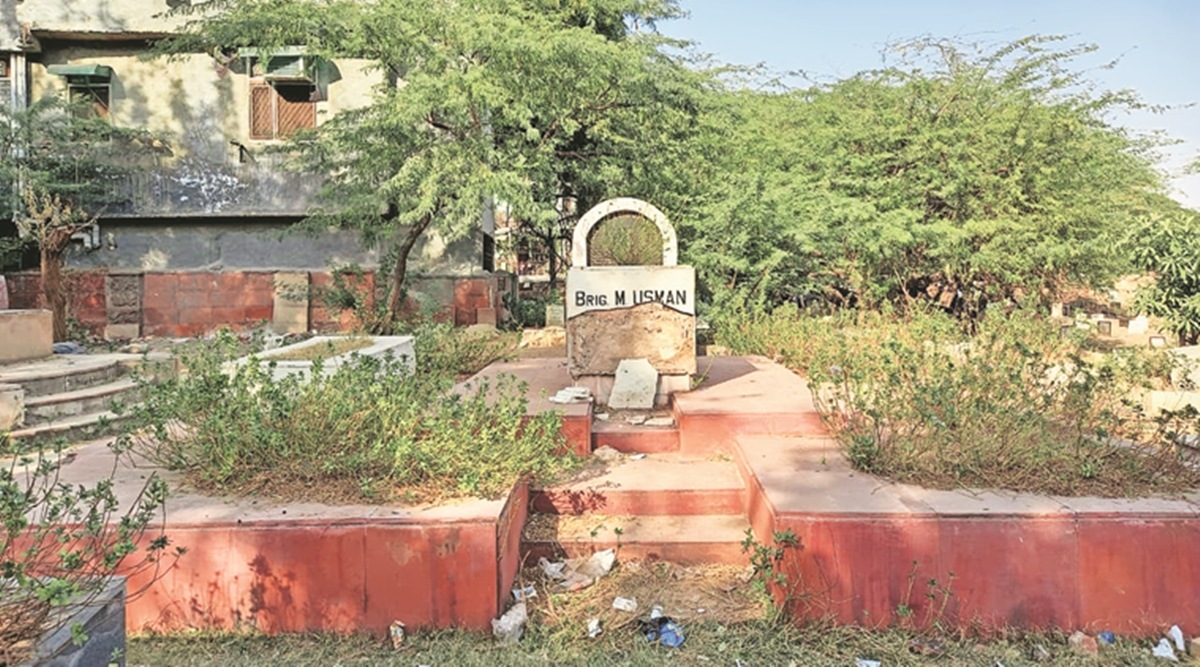 Brig Usman’s has been buried in the graveyard’s ‘VIP section’ .
 Among the gravestones of various luminaries who lie buried in the graveyard near Jamia Millia Islamia, one with a white marble covering is conspicuous as a significant portion of its front is broken.
The epitaph on the grave of Brigadier Mohammad Usman, the highest-ranking Army officer to have been killed in the Indo-Pakistani War of 1947, details his life and how his decisions and actions in a newly independent and conflicted nation led him to be recognised as a national hero.
“He was commissioned into the 5/10 Baluch Regiment, where he served till Independence. During Partition, he was given the option to join the Pakistan Army as Army chief. A true patriot that he was, he declined and chose to serve the country of his birth, an epitome of secularism and patriotism. Brigadier Usman took over command of 50 (I) Para Brigade in December 1947 at Naushera, J&K. Under his command, the brigade halted the advance of Pakistani tribals at Naushera against all odds. He then led the brigade to recapture Jhangar, thereby turning the tide on the raiders,” it reads.
Brigadier Usman died on July 3, 1948, when an artillery shell landed close to him. He was posthumously awarded the Maha Vir Chakra, the second-highest military decoration, and became known by the epithet “Naushera ka Sher”.
His grave is in the “VIP section” of the graveyard, one of the largest among the graves of luminaries, such as writers Qurratulain Hyder and Sajjad Zaheer, theatre personality Ebrahim Alkazi and scholars such as Mushirul Hasan and Mujeeb Rizvi.
“Children play here, people come and go. It can be damaged in many numbers of ways,” said a resident of a house bordering the graveyard.
Dr Iqtedar Khan, who is Jamia University’s in-charge of the graveyard, said that the maintenance of the grave is usually done by the Defence Ministry.
“The graveyard is a common place and as far as the VIP section is concerned, the family of the deceased or the institution they were associated with approaches us for permission to use the grounds for burial. The work of making and maintaining the grave is done by them. In this case, it is the defence. They used to come every year and do maintenance work, perhaps this was affected by the Covid situation this year. If they give us the funds for repair, we can do it,” he said.
Army PRO Colonel Aman Anand said that the Army has “taken note” of the damage to the grave and will “soon make a decision” on its maintenance.

 3 min read