Premium

Month after demolitions, Rahul Gandhi drops in at Delhi’s Ashok Vihar

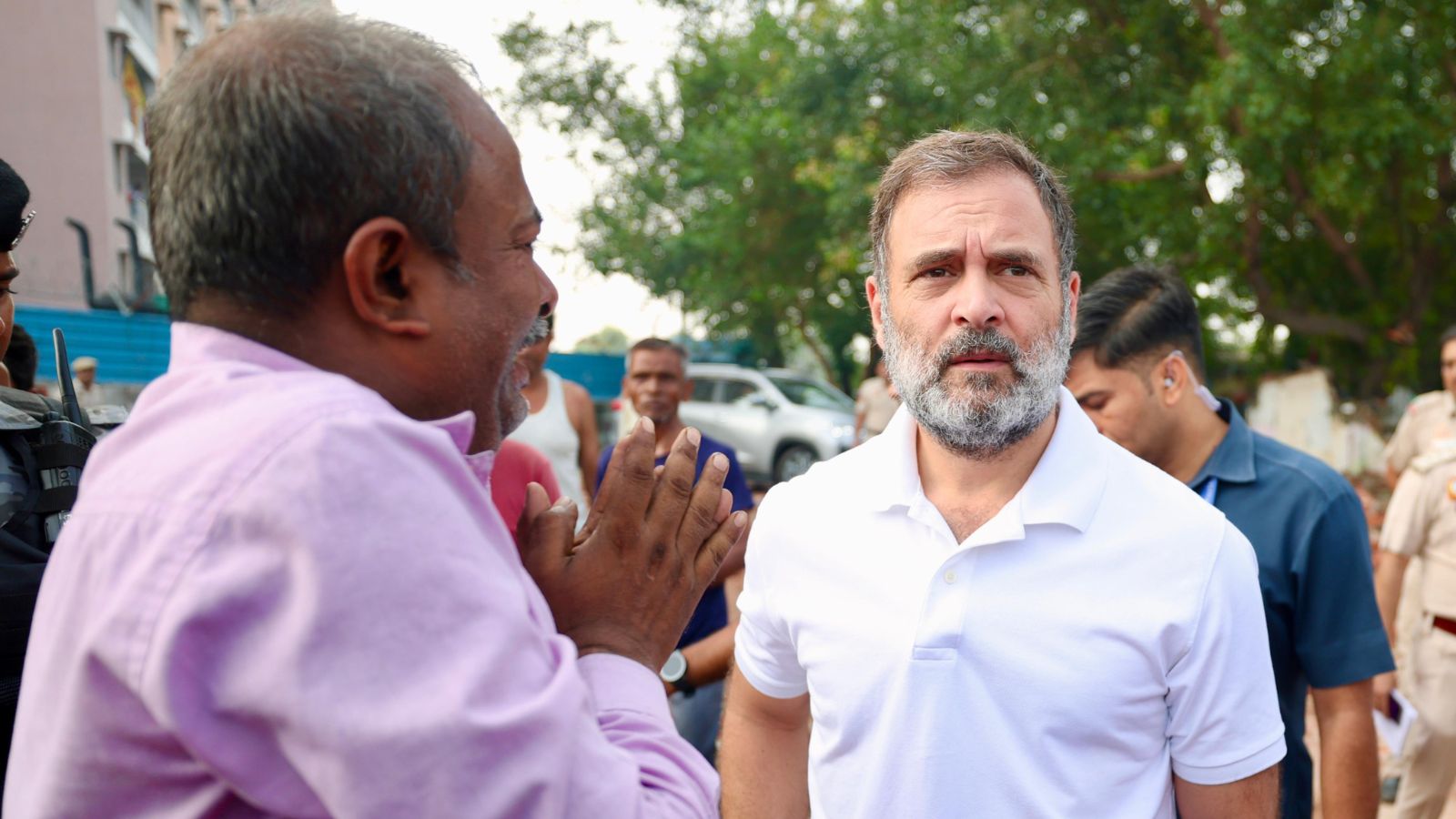
Congress leader Rahul Gandhi on Friday met several slum dwellers in Ashok Vihar whose homes were demolished as part of the Delhi government’s anti-encroachment drive.

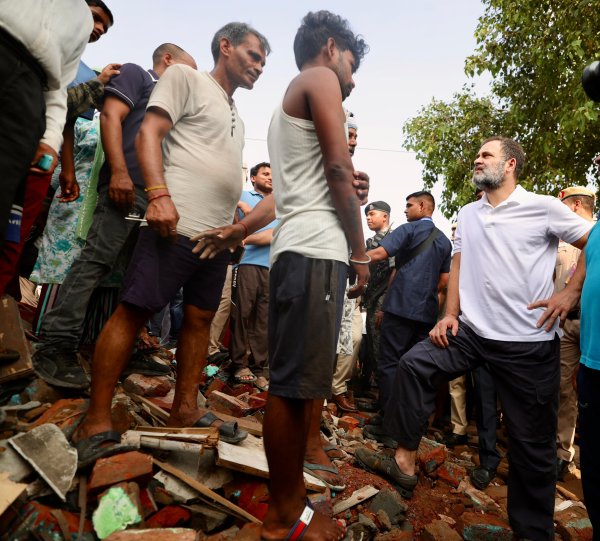
Leader of Opposition in Lok Sabha and Congress MP Rahul Gandhi during his visit to demolition sites in Wazirpur and Jailer Wala Bagh at Ashok Vihar, in New DelhiLeader of Opposition in Lok Sabha and Congress MP Rahul Gandhi during his visit to demolition sites in Wazirpur and Jailer Wala Bagh at Ashok Vihar, in New Delhi. (Source: PTI)

Congress leader Rahul Gandhi on Friday made a quiet entry into the crumpled lanes at Jailorwala Bagh in Northwest Delhi’s Ashok Vihar, where tin roofs lay folded like discarded paper and families cooked meals amid shattered bricks. The slum cluster is one of several across Delhi where homes were razed in recent weeks under the government’s ongoing anti-encroachment drive.

Accompanied by party national spokesperson Ragini Nayak, who contested the Wazirpur Assembly seat earlier this year, Gandhi, the Leader of the Opposition in the Lok Sabha, stood with the residents as many described their lives after they lost their homes—cooking in the open, children falling ill after being displaced, kids missing school, etc.

“Rahul ji patiently heard every story — from schoolkids who cannot attend classes anymore, to families who said their homes were demolished despite having court stays…there has been no electricity for the past 2-3 weeks because the electricity poles were uprooted during the demolition,” said Nayak.

In videos shared on Congress’s official social media account on X, Gandhi was seen standing amidst residents, many of whom said that their houses were razed despite ongoing court proceedings.

Delhi Gandhi was seen standing amidst residents, many of whom said that their houses were razed despite ongoing court proceedings. (INCIndia on X)

“He has assured us that we are going to move court, and we are also going to fight this battle on the street, in Parliament. We cannot fight in the Delhi Assembly because we have no MLAs there and because those who have representation are not raising the matter. We will ensure that justice prevails. We have asked our team to follow up with the people and take the matter to court…most likely, we will pick it up in Parliament too,” she added.

Nayak’s words underline the Congress’s political isolation in Delhi and its attempt to reframe itself as a voice for the jhuggi-jhopri clusters, stepping into a vacuum left by the Aam Aadmi Party (AAP), whose 10-year foothold in the national capital ended after being defeated by the BJP in this year’s Assembly elections.

Over the past month and a half, jhuggis in Junpura’s Madrasi Camp, Batla House, Taimoor Nagar, and Kalkaji’s Bhoomiheen Camp have been razed. Jhuggis along the railway line in Wazirpur were also demolished, citing ‘line of visibility’ requirements.

Story continues below this ad

The slum cluster that Gandhi visited was an extension of the Wazirpur railway track area.

“The notice was to remove the upper construction, but instead of partial removal, they brought everything down,” Nayak alleged. “This area has thousands of workers who have lived here for years. Even those who managed to get temporary relief from courts have had their homes demolished,” she added.

While around 500 families were declared ineligible during the rehabilitation survey, those who received allotments in flats built by the Delhi Development Authority for in-situ rehabilitation complained of a lack of facilities. “Those who have been shifted to government rehabilitation flats in Jailorwala Bagh complained of choked sewers, dry taps, and zero maintenance. They have paid for everything, but they are not even getting adequate facilities in return,” Nayak said.

She slammed the ruling BJP and AAP, saying, “Neither Arvind Kejriwal nor local Chief Minister Rekha Gupta have come here. These people voted for AAP and BJP, not Congress. Still, it is only Rahul ji who has walked into these broken homes and listened.”

Story continues below this ad

Gandhi’s visit comes at a time when AAP has been accusing the BJP of carrying out the demolitions. Earlier, BJP minister Majinder Singh Sirsa had referred to those whose houses have been demolished as “Rohingyas”.

Commenting on the demolitions, CM Gupta had earlier cited court orders and said, “If people are not willing to leave slums after being given a Rs 35 lakh flat in a good area, then it is wrong… The previous governments, neither the Congress nor the AAP, provided houses to slum dwellers.”

Saman Husain is a Correspondent at The Indian Express. Based in New Delhi, she is an emerging voice in political journalism, reporting on civic governance, elections, migration, and the social consequences of policy, with a focus on ground-reporting across Delhi-NCR and western Uttar Pradesh. Professional Profile Education: She holds a Bachelor’s degree in Political Science (Honours) from Kirori Mal College, University of Delhi, and is an alumna of the Asian College of Journalism (ACJ), Chennai. Core Beats: Her reporting focuses on the national capital’s governance and politics. She specializes in Delhi’s civic administration and the city units of the BJP, AAP and Congress. In western Uttar Pradesh, she mostly reports on crime. Specialization: She has a keen interest in electoral processes and politics — her recent contributions include work on electoral roll revisions. Recent Notable Articles (since July 2025) Her recent work reflects a strong show-not-tell approach to storytelling, combining narrative reporting with political and historical context: 1. Politics: “On the banks of the Yamuna, a political tussle for Purvanchali support” (October 6): A report on how migration histories shaped electoral strategies in Delhi before the Bihar elections. “Explained: How Delhi’s natural drainage vanished gradually over the centuries” (September 29): An explanatory piece tracing the historical reasons that eventually led to the erosion of Delhi’s rivers and its impact on perrenial flooding. 2. Longforms “Four weddings, three funerals: How a Uttar Pradesh man swindled insurance companies” (October 7): A long-read reconstructing a chilling fraud by a man who killed three of his family members, including both his parents for insurance proceeds. His fourth wife discovered his fraud… “How Ghaziabad conman operated fake embassy of a country that doesn’t exist — for 9 years” (July 27) : A story on bizarre fraud operation and the institutional blind spots that enabled it. 3. Crime and Justice: “He was 8 when his father was killed. Fifteen years later, in UP’s Shamli, he took revenge” (October 18): A deeply reported crime story tracing cycles of violence, memory and justice in rural Uttar Pradesh. “Who killed 19 girls in Nithari? With the SC rejecting appeals, there are no answers and no closure” (July 31): A report capturing the long legal and emotional aftermath of one of India’s most chilling unsolved criminal cases. 4. Policy Impact “At Manthan, over US tariffs, Delhi-NCR’s apparel industry brainstorms solutions” (September 8) and “Trump’s 50% tariff begins to bite: Agra’s leather belt feels the impact” (August 13) : Reports documenting how global trade decisions ripple through local industries, workers and exporters. Signature Style Saman is recognized for her grassroots storytelling. Her articles often focus on the "people behind the policy". She is particularly skilled at taking mundane administrative processes and turning them into compelling human narratives. X (Twitter): @SamanHusain9 ... Read More

Stay updated with the latest - Click here to follow us on Instagram

Latest Comment
Post Comment
Read Comments
Advertisement
Loading Taboola...
Advertisement