Journalism of Courage



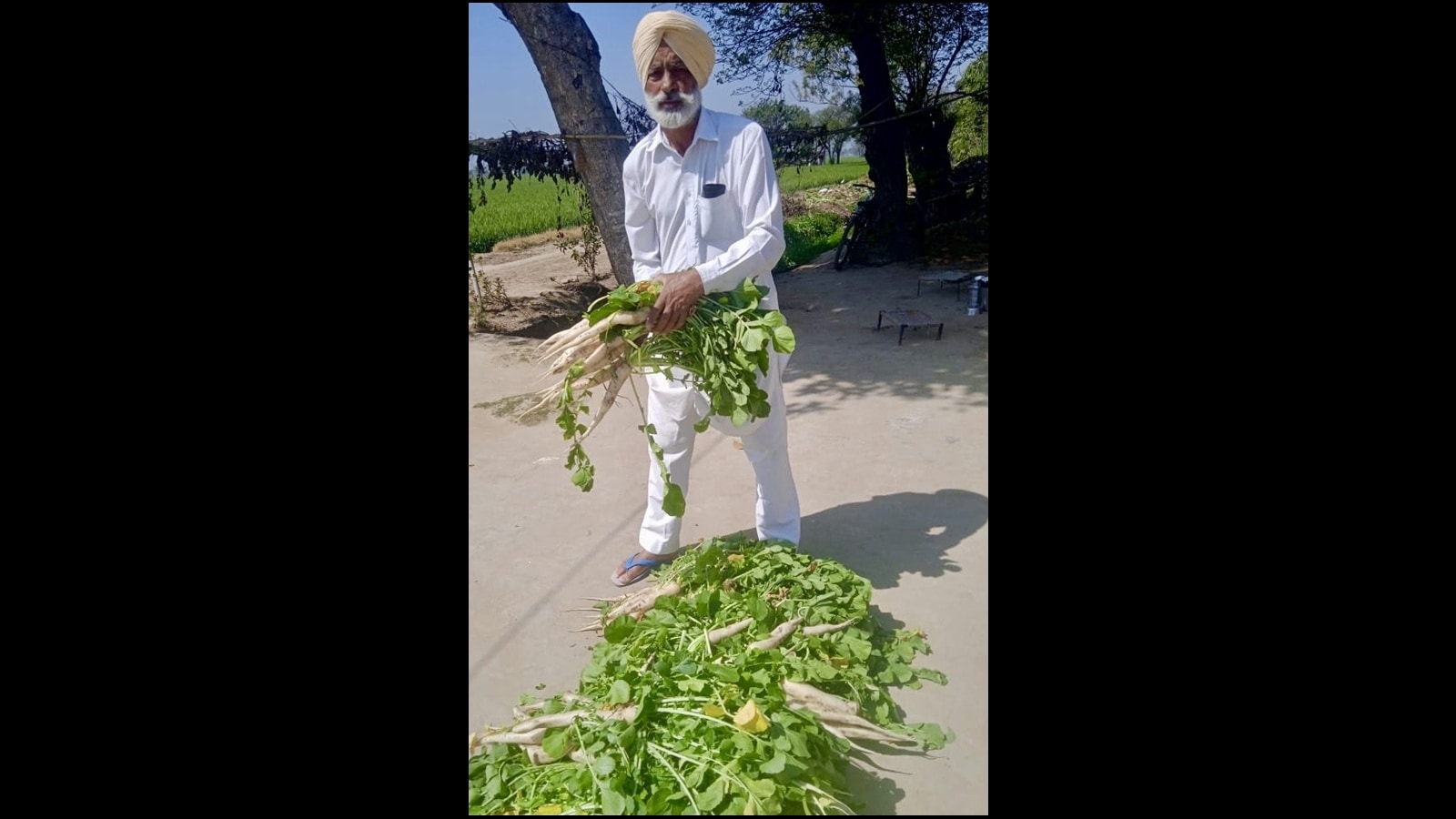 Gurdeep Singh Brar from Mehma Sawai village in Bathinda with his raddish crop. (Express Photo)
When Gurdeep Singh, 50, started organic farming around 20 years ago, little did he know that not only will he be self-sufficient but he will also help others with employment opportunities. With just 1.5 acres of his own and an additional 3.5 acres on lease, the journey of the farmer from Mehma Sawai in Bathinda from conventional farming to a thriving organic venture is nothing but inspiring.
Today, he grows an impressive variety of seasonal vegetables and employs five workers and pays them around Rs 10,000 each every month.
He grows over two dozen types of seasonal vegetables in both Kharif and Rabi seasons, including peas, broccoli, radish, spinach, cauliflower, cabbage, pumpkin, beans, lady finger, bitter gourd, colocasia, potato, tomato, chillies, bell pepper, fenugreek, cholai, turmeric, onion, garlic, without using chemicals.
He also grows wheat, which he sells for double rate of MSP at Rs 2,425 per quintal. He also dedicates half an acre to growing green fodder for his three cows.
He says people today are more aware of the dangers of chemical-laden food and I give them poison-free vegetables. “My cauliflower is sold for Rs 50 per kg, while others sell theirs for Rs 1 or Rs 2 when there’s a glut. Every Wednesday and Sunday, I travel 30 km to Bathinda city to sell my produce. I sell around one quintal peas, two quintal cauliflower, two quintal radish, one quintal potatoes, and 30-40 kg of various other vegetables every week. Despite the higher cost, my customers never ask for a discount and they trust the quality,” he says, adding that farmers feel ashamed to sell their crop on their own and prefer going to the mandis.
Initially, he carried his vegetables on bicycle, then later upgraded to a scooter, and eventually purchased a Fiat car and later a Maruti car. “Now, I use a Gypsy with a trolley to transport the vegetables and get paid then and there,” he adds.
But it was not always this smooth for Gurdeep. Around 20 years ago, he used to grow cotton. “One day, Amarjit Singh Sandhu, a vegetable expert from Krishi Vigyan Kendra in Bathinda visited our village and encouraged me to consider organic farming. On his advise, I started a kitchen garden using organic seeds from the kendra. The first harvest was modest, but it was the beginning of a transformation. With support from Ambuja Cement, which launched a project in my area enrolling around 400 farmers, I was able to grow organic vegetables. As my crops passed organic certification, the owner of the company visited my fields, praised my work and gave a cheque of Rs 1.5 lakh,” he says, adding that a private bank helped him install a greenhouse and also set up a vermi-compost plant.
Gurdeep has installed a solar-powered tube well and does not avail any power subsidies. He laid underground pipelines to carry water to his fields, saving a significant amount of water that would otherwise evaporate in open channels.
He also runs a small dairy business, selling milk and producing ghee. “My farm is a closed-loop system, I grow my own seedlings, compost my waste, and produce my own organic inputs. This reduces my reliance on external sources and ensures that everything I produce is truly organic. I spray 7-8 months old sour buttermilk on my crops, which works wonders on several pests, including fungi. I was a marginal farmer, but now I am able to provide jobs to others and pay Rs 2.80 lakh annually in rent for 3.5 acres,” he says, adding that he is ready to provide free organic farming training by visiting other farms.

 4 min read