Journalism of Courage



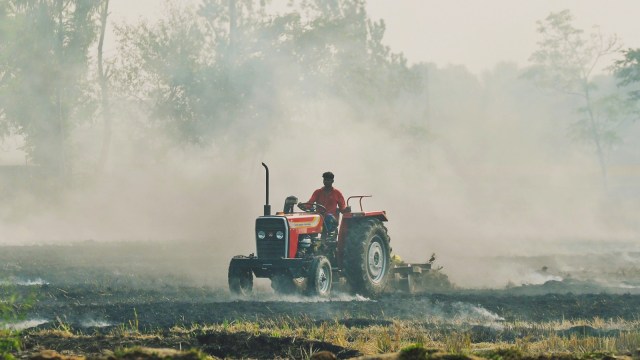 The Haryana remote sensing department had identified around 700 farm fire locations till Friday and a fine of Rs 8.25 lakh was collected from around 340 farmers.
October 20 was a usual Sunday for 60-year-old Gian Singh. Post lunch, he was all set to soak in the afternoon sun and take a nap on the chaupai outside his house in Ujhana village of Kaithal district.
But things took a turn when around 1.30 pm, two policemen barged into his house to take him to the police station.
The 5-km drive to the nearest police chowki in Kurar seemed like eons with all sorts of thoughts of what could have gone wrong crossing his mind.
Once there, he was made to sit with a dozen others – all accused of the same crime. Burning paddy stubble to clear their fields!
Gian Singh was handed over a copy of the FIR Section 223A (for failing to comply with a lawful order issued by a public servant) of the BNS and Section 39 of the Air Pollution Act. Along with the FIR came a gag order of not being able to sell his produce on MSP for the next two seasons (Rabi and Kharif).
Seated in the same row with him at the police chowki were 59-year-old Rajendar Kumar of Barot village in Kaithal, 72-year-old Raj Kumar of Dahola village of Jind and 47-year-old Jaivir Singh from Bithmara village in Hisar – all paddy farmers booked for burning stubble. They either face an FIR and a fine or have a red entry on their land records and a ban on sale on MSP for a year.
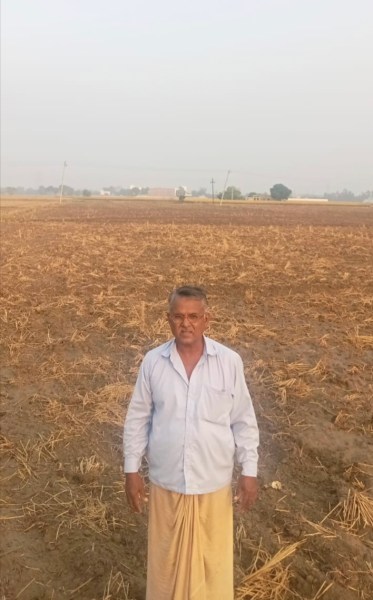 Gian Singh standing in his fields in village Ujhana, district Kaithal.
“Not only was I arrested but a red entry has also been marked on my land record. I also got to know that I won’t be able to sell my crop through the Mera Fasal Mera Beyora portal of the Haryana government for one year. There were so many other farmers in my village who put fire to the stubble but it seems only I have been picked up as I am a small farmer and have only 2.5 acres,” he said, adding that now he will wait when police will produce the challan in court.
Gian Singh, who lives with his wife and elderly father, said that it is not viable for them to buy crop residue machines. “The machines on rent are mostly booked by large landowners. There is very little time between paddy harvesting and sowing of wheat. We marginal farmers have no choice but to burn the stubble.”
Troubled with an FIR and an MSP ban, Rajendar Kumar has a similar story to tell. “I retired last year from Sarv Haryana Gramin bank from the post of cashier. Earlier my brother used to take care of our 2 acres but after retirement, I decided to do it myself. The FIR mentions that I burnt stubble on one acre on October 18. But it’s not possible as I ploughed my field on October 15. They told me that they got satellite images to prove my crime. But how is it possible that they only could see me do stubble burning,” he asked.
Days after the Supreme Court pulled up the governments of Haryana and Punjab for failing to prosecute farmers who burn stubble, contributing to air pollution in the Delhi National Capital Region, Haryana government has put in place strict measures this year to bring down instances of farm fires.
The Haryana remote sensing department had identified around 700 farm fire locations till Friday and a fine of Rs 8.25 lakh was collected from around 340 farmers. About 177 FIRs have been lodged in the entire state till Thursday and 400 farmers have been placed under red entry for burning stubble.
An agriculture department official said environment compensation for 0-2 acres is Rs 2500, for 2-5 acres it is Rs 5000 and for 5 acres and above it’s Rs 10,000.
This year, Haryana cultivated paddy on 15 lakh hectares, an acre more than last year.
A total of 58 lakh metric tonnes (LMT) paddy arrived in Haryana mandis last year and this year 60 LMT is expected, of which 44 LMT has already arrived. The official added that this year, more farmers shifted to paddy after facing losses owing to pink bollworm attack on their cotton crop.
However, most insisted that small scale farmers were at the receiving end of the measures.
Jaivir, who owns 3 acres and got an FIR for burning stubble on around 1.5 acres, said, “There are no machines in our entire block, so what should we do? Instead of providing solutions, they are issuing threats to us. Do they also punish industrialists? They also pollute the air and water but they get away with it. Even though we all got bail, but we have decided to gather in Uklana and hold protests.”
Raj Kumar’s son Rakesh Nehra said they got a challan on October 17 for Rs 2500. “It was environmental compensation for burning stubble on 1 acre. But we have no idea how that one acre got burnt. We sow 1509 Basmati variety and we don’t burn the fields. My father got bail, but we have decided to approach a lawyer or seek help from Samyukta Kisan Morcha. This seems to be a jungleraaj,” he said.
In Sirsa, FIRs have been lodged against three women from Punjab’s Sardulgarh who have lent their land to Naseeb on contract.
“I took 4.5 acres on lease from them this year. Do the government act this strictly with drug smugglers? They are just targeting small scale farmers,” Naseem said.
Satyawan, national president of All India Kisan Khet Mazdoor Sangathan and National coordination committee member of SKM, said that they condemn the act.
“The BJP government is showing its real face after coming back to power. They need to find solutions rather than reprimanding farmers. What about pollution by industries? Take a tour around Ghaggar river, you will see what the industries are doing. Why isn’t there any action against them? This is just a way to harass farmers,” he said.
Agriculture department officials said that they have been organising awareness drives in villages. “To reduce farm fires, this year, the department is imposing environtmental compensation as well as getting FIRs registered. Initially, we were lenient and imposed only compensation but now both actions are being taken irrespective of the fact whether a person deposits environmental compensation or not. All farmers were released on bail and this is just a measure. There are 1,00,800 crop residue machines in Haryana of which 9,800 were added this year. When the government is taking steps, farmers should also try to adopt new practices,” he said.

 7 min read