Journalism of Courage



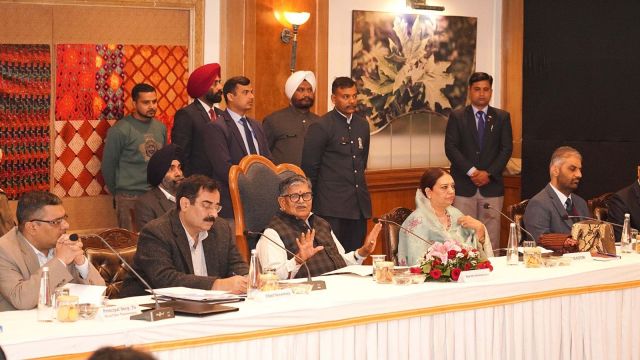 The meeting was held under the chairmanship of Gulab Chand Kataria, Governor of Punjab and Administrator of UT Chandigarh at Hotel Mountview on Tuesday. (X/@Gulab_kataria)
Making Chandigarh free of slums and beggars, poor health infrastructure and a comprehensive policy for safety of elderly population and differently abled in the city, were discussed during the first meeting of reconstituted Administrator’s Advisory Council (AAC). The meeting was held under the chairmanship of Gulab Chand Kataria, Governor of Punjab and Administrator of UT Chandigarh at Hotel Mountview on Tuesday. As many as 54 members from various fields participated in the meeting.
Member Dr Sanjeev Bhatia highlighted deficiencies of poor healthcare infrastructure. In the meeting, he specified that civil hospitals in Sector 45, Manimajra, and Sectors 48 remain underutilised, with only 30 per cent of their respective capacities being used. Bhatia said this underutilisation is leading to the entire burden falling on PGIMER, GMCH-32, and GMSH-16.
In the meeting, various inputs were given regarding the start-up policy, skilling- and industry-related issues to boost investment, employment, and entrepreneurship.
The members also gave suggestions for making Chandigarh ‘slum free’, ‘beggar free’ and the need to have a comprehensive policy for the differently abled and also the elderly population residing in the city.
Federation of Sector Welfare Association of Chandigarh (FOSWAC) Chairman Baljinder Singh Bittu raised concerns over encroachment and the growing number of beggars in the city. He mentioned that most pedestrian paths have been encroached upon. Some suggestions to enhance public safety, advanced traffic management systems and robust cybercrime prevention measures were also given.
Further, the issues of need-based changes in the dwelling units of CHB, increase in floor area ratio (FAR), revision of building bye laws, conversion of smaller industrial plots etc. to accommodate the ever-emerging needs of the residents of the city were also raised. It was also discussed that the city’s development should be aligned with the changing dynamics and requirements of its citizens.
Further, a number of useful suggestions were also given regarding developing Chandigarh as a hub for education, sports, and medical tourism.
Various initiatives regarding expanding the city’s green cover through increased tree plantation and development of more green spaces were also discussed.
Addressing the council, Kataria stated that “we need to make collective efforts to transform Chandigarh into a modern city, setting a benchmark for urban development, sustainability and citizen-centric governance”.
The administrator also emphasised the need for working together for a comprehensive roadmap for Chandigarh’s growth with focus on community participation in leading the city’s transformation by adopting innovative policy solutions.
Rajeev Verma, Chief Secretary, UT Chandigarh stated that the “AAC is a platform for discussing policy issues and initiatives to enhance administrative efficiency to accelerate the progress of the city”.
Chandigarh Pradesh Congress President H S Lucky raised concerns over the role of the heritage committee during a meeting. This issue was raised in the backdrop of the query addressed by the Centre over the UT not being a heritage city.
The Centre had on Monday said that Chandigarh has not been designated as a World Heritage City after Congress Member of Parliament Manish Tewari raised a query in Parliament over the city’s status.
In the Advisory council meeting, Lucky asserted that the committee’s purview should be confined to the Capitol Complex; however, it has increasingly become an impediment to resolving various issues affecting Chandigarh.
Lucky further stated that the current composition of the committee often obstructs matters of public interest, underscoring the need for broader representation to ensure a more inclusive decision-making process.
Addressing key civic concerns, he urged the administrator to expedite the resolution of the city’s long-pending issues. He specifically demanded the regularisation of structures outside Lal Dora, arguing that with the integration of villages into the municipal corporation, the very concept of Lal Dora has become obsolete. Lucky strongly advocated for land pooling as the only viable solution to the challenges posed by unplanned development, emphasising that such an approach would not only curb haphazard growth but also serve as a mutually beneficial arrangement for all stakeholders.
Certain members in the meeting raised the requirement of expansion of parking facilities in the city markets.
It was specified that while Sector 17 has been a focal point, other markets across Chandigarh also require enhanced parking facilities to address the growing demand.
“To eliminate the problem, multi-level parking structures can be constructed. Dedicated surface parking areas can also be developed to cater to local needs. Also, the establishment of underground parking facilities beneath existing parking zones adjacent to roadways can also be considered. These solutions will help streamline traffic, reduce congestion, and ensure convenient access to market areas for visitors and traders alike,” Kamaljit Singh Panchhi said.
Traders raised the issue regarding 40 booths under new bridge In Sector 17-A and 17-B market. They specified that these booths have remained vacant since 2013, leading to a substantial loss of revenue amounting to crores of rupees. These booths have neither been auctioned nor rented out due to one key issue that they are currently on a leasehold basis with excessively high collector rates.
It was suggested that auctioning these booths on a freehold basis at reasonable rates should be considered to attract more buyers.
The issue of addition of another floor to single-storey bay shops and booths was also raised in the meeting.
It was specified that the current infrastructure markets in Chandigarh has a very limited scope for business expansion, which is very important as of now to accommodate the growing population and to address this issue, it is proposed that an additional floor be allowed to be constructed on the single-storey bay shops and booths in the city, which will be designated primarily for storage purposes.
Traders said that this initiative would provide much-needed relief to small traders by offering additional space without the need for encroachment. Currently, small shops measuring 8 feet x 16 feet often encroach upon verandas and corridors due to insufficient space. Allowing a first-floor addition will eliminate this problem while maintaining orderly market operations.
Chandigarh Mayor Harpreet Kaur Babla urged the UT administrator to take immediate action on the pressing issues faced by the residents and farmers of villages in Chandigarh.
During the AAC meeting, the mayor highlighted the urgent need for regular water connections for residents living outside Lal Dora in 24 villages of Chandigarh. These residents are currently dependent on expensive water tankers, despite having been provided electricity connections.
She urged the Chandigarh Administration to direct the municipal corporation (MC) to amend the water bye laws to facilitate legal water connections.
Additionally, Babla strongly advocated for the implementation of a land pooling policy on the lines of Punjab and Haryana for Chandigarh villages. The proposal, which was unanimously passed by the MC House in 2022, aims to develop approximately 2,900-3,000 acres of land through a structured and legal mechanism. This policy will not only curb illegal encroachments but also provide a win-win solution for both farmers and the administration — ensuring planned urban development while securing landowners’ interests, she said.

 7 min read