3 min read
Stay updated with the latest - Click here to follow us on Instagram

Journalism of Courage



 The CAG report noted that scrutiny of three of 10 selected territorial and wildlife divisions and five other territorial divisions showed that the department, in 98 cases, held forest guards responsible for negligence of duties causing loss to forest and ordered recovery of the loss from the concerned forest guards.
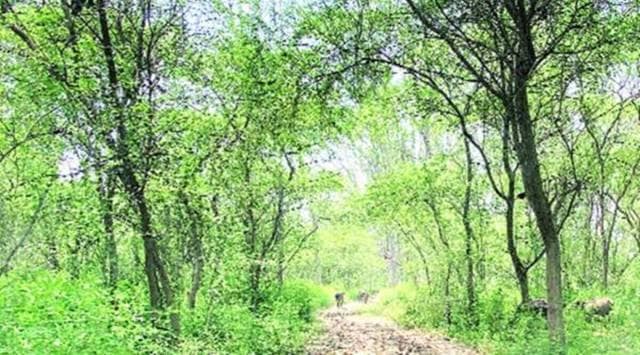
(Representational image)
The CAG report noted that scrutiny of three of 10 selected territorial and wildlife divisions and five other territorial divisions showed that the department, in 98 cases, held forest guards responsible for negligence of duties causing loss to forest and ordered recovery of the loss from the concerned forest guards.
(Representational image)In the period 2015-2021, around 1,353.754 hectares (ha) of forest land in Karnataka have been converted for non-forestry purposes to carry out infrastructural and agricultural projects by the central and state government agencies, reveals a study carried out by the Centre for Ecological Economics and Natural Resources at the Institute for Social and Economic Change (ISEC).
In 2020-21, the rate of forest conversion was very high at 442.27 ha compared to the previous year 2019-20, in which it was only 36.31 ha, the study says. The study titled ‘Economic assessment of forest ecosystem damages from climate stressors in forestry sector of Karnataka during 2015-2020’ was funded by the Karnataka forest department.
Assistant professor at ISEC and principal investigator of the study Dr M Balasubramanian stated in the report: “Loss and degradation of forest ecosystem services remain a major socio-economic and ecological challenge in Karnataka. Various socio-economic factors determine the degradation of forests. For instance, natural factors such as flood, drought, forest fires, landslides etc., due to economic development, such as forest land conversion as non-forest land for irrigation, hydel & wind power projects, mining & quarrying, road, railway, transmission line and others.”
In the same period, 218.2 ha of the forest land was converted for irrigation, 287.355 ha for mining and quarrying and 283.208 ha for the construction of roads.
The report further read: “Clean air and water, the flow of forest ecosystem services, sustainable weather and climate conditions, good soil and nutrition, irrigation and energy are important. Therefore, before any forest land is converted the consequences on socio-economy and environmental outcomes of present and future generations must be analysed. Further, the cost of forest conservation should account for two things i) how it contributes to human well-being and ii) examine the forest ecosystem products and processes. Forest conservation is not only a one-time loss of ecosystem products but also the diminishing income of future products. Therefore, the current rate of forest land conversion will affect timber productivity, water quality, carbon sequestration and wildlife management in Karnataka,” the report stated.
Forest land converted for non-forest purposes in Karnataka each year from 2015-16 are as follows:
2015-16- 108.34 ha
2016-17- 298.38 ha
2017-18- 331.17 ha
2018-19- 137.28 ha
2019-20- 36.31 ha
2020-21- 442.27 ha
Stay updated with the latest - Click here to follow us on Instagram