Journalism of Courage



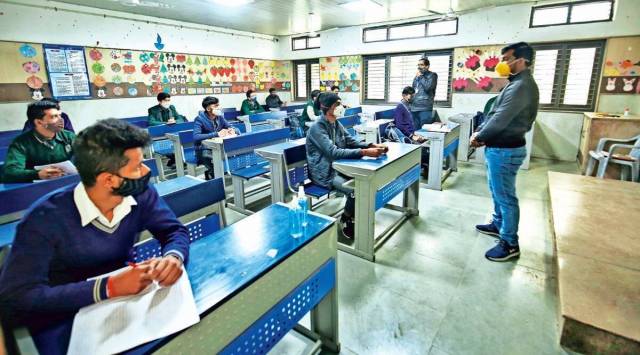 The learning recovery programme was introduced by the Karnataka government in order to bridge the learning gap that the lockdowns created among students. (File)
The Karnataka government’s ambitious Kalika Chetarike (learning recovery) programme, aimed at addressing the learning loss caused by the pandemic, is likely to be extended to the next academic year, sources in the school education department said Monday.
The learning recovery programme was introduced in order to bridge the learning gap that the lockdowns created among students of classes 1-9. The programme focuses on functional literacy and numeracy in the first three months of the academic year, followed by core competencies, depending on the grade. The programme involves revising the concepts and lessons from the previous two academic years, which the students had mostly missed owing to the lockdowns.
According to the commissioner of the department of public instruction, Vishal R, the programme has “partially” yielded results. “Extending the learning recovery programme to the next academic year is necessary. A lot of discussion is happening around it and mostly before the pre-budget session, the subject will be discussed and finalised. As far this year is concerned, students have partially been able to recover the learning loss. Many education experts are of the opinion that one year is not enough to recover the learning loss. So it needs to be extended to the next academic year. Preparations are already underway for what needs to be included and excluded in the new learning recovery-programme worksheets,” he said.
However, the programme witnessed multiple controversies and challenges in its initial stages. Although inaugurated by Chief Minister Basavaraj Bommai on May 16, the programme took nearly two more months to be fully implemented. Government schoolteachers complained that the last-minute preparations by the Department of State Educational Research and Training led to a delay in distributing the worksheets. The government had also asked teachers to find donors to get the worksheets photocopied for students, a directive that was withdrawn after it drew public ire.
And some schoolteachers expressed disappointment with the plan to extend the learning recovery programme. “The objective of the programme is good, but it is causing more burden to the teachers. Especially, with acute teacher shortages in certain districts, some teachers are reluctant to continue the programme. Balancing the lessons of the new academic year with the revision of last year’s lessons is a daunting task, especially at schools with fewer or no teachers,” said a teacher in a government school in Ramanagara district.
A senior official in the education department, however, said the programme had received a good response from teachers and students. “A thorough assessment will be conducted this month to see to what extent the students have made progress. The whole idea of the programme was to evaluate students on select learning outcomes, with a special emphasis on numeracy and functional literacy. Ahead of the pre-budget meeting, we are supposed to come up with activity books and activity banks for classes 1-9. We are planning to extend the programme to the next year, with focus on additional learning outcomes and more experiential and holistic worksheets for students,” the official said.

 3 min read