Journalism of Courage



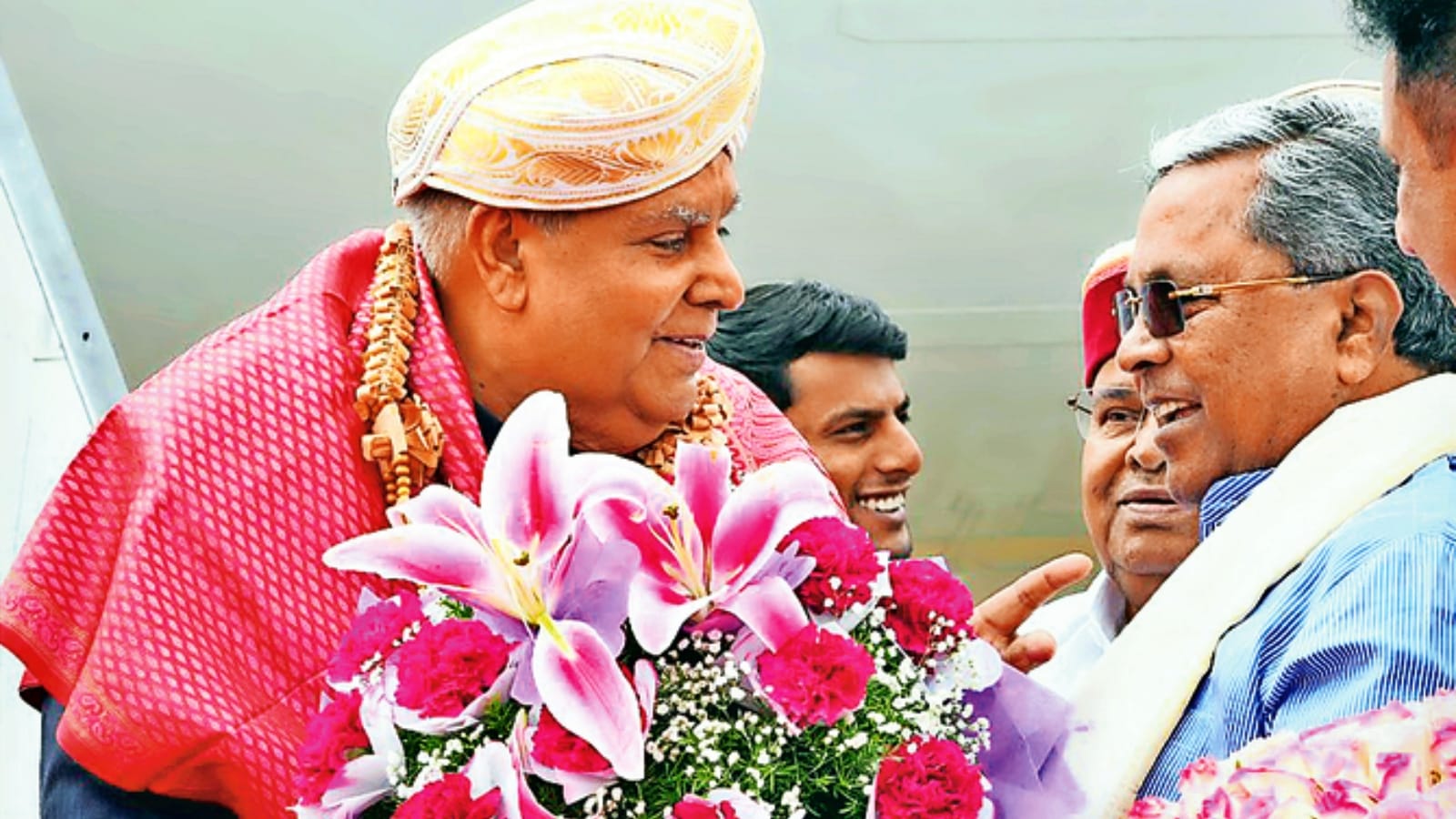 V-P Jagdeep Dhankhar with Karnataka CM Siddaramaiah in Bengaluru, Saturday. ANI
SPEAKING OUT against appointments “driven by patronage and favouritism” in Public Service Commissions, Vice-President Jagdeep Dhankhar on Saturday said PSC members should not be “wedded to a particular ideology or individual”.
Dhankhar also criticised the practice of granting extensions in service, calling it a “setback to those who are in line” and a move that “defies the logical principle of extension”. In this context, he also spoke out against post-retirement assignments, saying such “largesse… is antithetical to what was visualised by framers of the Constitution”.
Dhankhar was delivering the inaugural address at the 25th National Conference of Chairpersons of All State Public Service Commissions in Bengaluru. Calling for the strengthening of institutions, he expressed concern over the divisive and polarised nature of India’s polity, and underlined the need for “political fire extinguishers”.
“It is with utmost restraint I am reflecting on an aspect. (In) Public Service Commissions, the appointment cannot be driven by patronage, by favoritism. There are trends that are visible. I do not wish to reflect on them, but some of them are very painful. We must account ourselves to our conscience. We cannot have a Public Service Commission chairman or a member wedded to a particular ideology or an individual. That will be undoing the essence and spirit of the framework of the Constitution,” he said.
“Extensions in service, extensions in any form for a particular post are a setback to those who are in line. It defies the logical principle of expectation. We have a doctrine of expectation. People devote decades to be in a particular groove. Extension indicates that some individual is indispensable. Indispensability is a myth. Talent abounds in this country. No one is indispensable. And therefore, it lies in the domain of PSCs at the state and the central level that when they have a role in such kinds of situations, they must be firm,” he said.
“Post-retirement recruitment is a problem. In some states, it has been structured. Employees never retire, particularly those in premium services. They get a number of ad-hoc nomenclatures. This is not good. Everyone in the country must have due and that due is defined by law… Any largesse of this kind is antithetical to what was visualised by framers of the Constitution,” he said.
Dhankhar urged political leaders to prioritise consensus-building and address national challenges without delay. “Our polity at the moment is too divisive, too polarised. Interaction is not taking place at the premium level in political organisations. When it comes to the nation, when the world is in a transformative phase, it is India’s century. That century can be fully fructified for people’s gain only when we have a calm political atmosphere… We need political fire extinguishers. A political divisiveness, a vitiated political climate is far more dangerous than climate change,” he said.
In this context, he also spoke about the role of intellectuals in society. “Intellectuals are supposed to guide us. Intellectuals are supposed to be fire extinguishers when there is social disharmony, when there is a problem. I find intellectuals are formed into groups. They sign representations they may not have read. They think signing representation is a password for getting a position, if a particular dispensation comes to power. Now look at intellectuals, former bureaucrats, former diplomats. You earned a level of public service, which others must emulate. You must be objective in making representations. You cannot create a group to subserve your interest with change of political alignments,” he said.
“Any institution, if it is weakened, the damage is to the entire nation. Weakening of an institution is like a prick on the body. The entire body will be in pain… We must have strengthening of institutions. The Union and States must work in tandem. They must be in synergetic mode. They must be in sync with one another when it comes to national interest,” he said.
Expressing concern over paper leaks, he said: “This is a menace you have to curb. Your fairness of selection will have no meaning if paper leakages are there. And paper leakage has become an industry, a commerce… young boys and girls used to have fear of examinations, how difficult the question will be, how will we address it? Now, they are having two fears: fear of examination and fear of leakage,” he said.
Karnataka Governor Thaawarchand Gehlot and Chief Minister Siddaramaiah were among those present on the occasion.

 5 min read