Journalism of Courage



 With the national helpline being introduced in several states across the country, Bengaluru police department officials are concerned whether the new system will handle such cases in a timely manner to prevent loss of funds from victims of online fraud. (Representational/File)
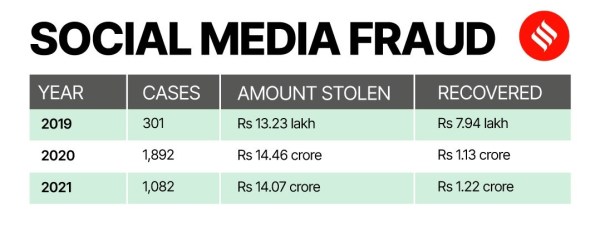
Last week, at the Union Home Ministry’s Chintan Shivir, a meeting of home ministers and state police chiefs, Haryana Chief Minister Manohar Lal Khattar flagged a major concern of police departments across the country – the epidemic proportions acquired by cyber crimes – and said that the Centre must direct banks to facilitate the prevention of cyber fraud.
In the city of Bengaluru, where 75 percent of all crimes registered is a cyber crime, the highest for any city in India as per National Crime Records Bureau (NCRB) report of 2021, a system being used by the local police to tackle cyber fraud with the help of banks is now facing the prospect of being replaced by a set-up proposed by the central government for the entire country.
Multiple sources in the state told The Indian Express that Bengaluru’s Cyber Crime Information Report system, or CIR, is set to be replaced by the cyber crime reporting system of the MHA, linked to helpline number 1930.
The CIR, a real-time cyber crime resolution system that helps police freeze bank accounts of culprits after an online fraud is reported on the helpline number 112, was launched by the Bengaluru police in 2020 with the help of an IT firm. It has been effective in preventing the loss of about Rs 100 crore from the accounts of victims so far.
With the national helpline being introduced in several states across the country, Bengaluru police department officials are concerned whether the new system will handle such cases in a timely manner to prevent loss of funds from victims of online fraud. “It (the central system) is a similar system, but the CIR has a few advantages. Since there cannot be two parallel systems, the CIR will have to be replaced,” a senior police officer said.
How CIR works
Under the CIR system, a team of police officers, technicians and data entry operators work 24/7 to solve a cyber crime as soon as a victim dials the designated helpline. A Cyber Crime Information Report is created after a basic verification and instant alerts are sent by the CIR police officers to the nodal officers of the victim’s bank asking for beneficiary details. The beneficiary account is then frozen and the case is transferred to a cyber crime police station to find the culprits through a formal investigation.
Alerting the recipient bank where the stolen money has been transferred within two hours of the online fraud, also known as the golden hour, is crucial to prevent the funds from being withdrawn or sent to other accounts to obfuscate the money trail.
“The CIR system receives an average of 800 cases every month. In many cases, we are able to prevent the loss of funds if the victim calls us within the golden period of two hours. After that, it becomes difficult to retrieve the funds,” a police official said.
“The recovery of funds depends entirely on cooperation from banks. On weekends and holidays, the banks tend to be lax,” he added.
A senior police official said that the CIR system has been working effectively because several banks came on board when it was launched.
“The State Bank of India and the Corporation Bank set up full time desks to facilitate the blocking of accounts. This is one of the reasons the CIR system has had success in Bengaluru,” the officer said, adding that a few banks have not been cooperating actively.
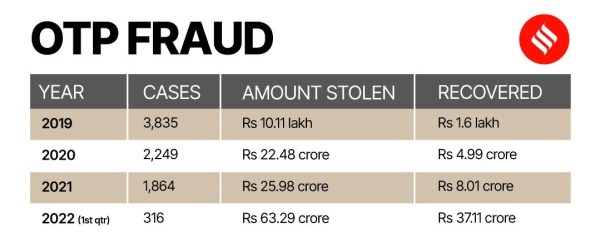
In 2019, Bengaluru recorded 3,835 cases of OTP phishing, with Rs 10.11 lakh lost from the victims’ accounts and Rs 1.6 lakh recovered (16 percent); in 2020 there were 2,249 cases of OTP phishing leading to a loss of Rs 22.48 crore and recovery of Rs 4.99 crore (22 percent); in 2021, the city recorded 1,864 OTP phishing cases with Rs 25.98 crore being lost and Rs 8.01 crore recovered (30 percent). In the first quarter of 2022, a loss of Rs 6.32 crore was reported with Rs 3.71 crore being recovered (58 percent).
CIR vs National Helpline
While the national helpline system for tackling cyber crime works broadly along similar lines, the Bengaluru CIR cell has the advantage of having in-house cyber crime police officers who start a probe immediately after the registration of a CIR.
“In the national system, the written complaint has to be dispatched to the states, resulting in a time lag,” sources said.
“Cyber criminals tend to move funds rapidly once money is stolen through online fraud. The key to recovering stolen money is to alert the recipient bank immediately and block the offender’s account to prevent further movement of stolen funds,” a senior police officer said.
“Any cyber crime helpline system should not end up being a post office that collects and dispatches complaints. When a helpline system has police officers attached to it, an investigation can begin as soon as a complaint is received,” he added.
Under the CIR system, investigations are launched on the basis of a phone call, easing the mandatory requirement of filing a first information report (FIR). An FIR is registered, if necessary and sought by the victims, once the initial process to recover funds is completed.
“The existing laws for tackling crime in the country were created in an era when speed was not of great essence. In cases of cyber crime, we have to act very quickly to prevent losses to victims and this needs changes in the way crimes are registered,” a senior Karnataka police official said.
The CIR system was introduced in Bengaluru by the then police commissioner Kamal Pant with the aim of quick resolution of cyber fraud cases and reduction in the number of such cases every year by at least 50 percent.
“When you unknowingly share your OTP with someone, it is an action that takes hardly 10 seconds. Take a morphed photo – it is sent to a group within seconds. However, to detect these cyber crimes that happen within seconds the police have to invest more than 1,000 man hours of work,” Pant had then said.
Cyber Crime in Bengaluru
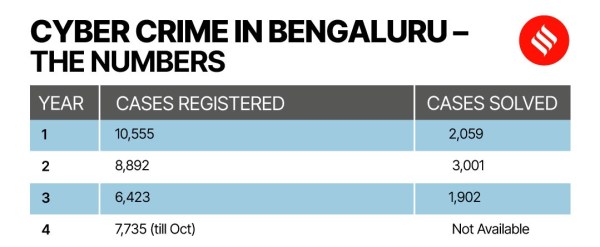
In Bengaluru, 10,555 cyber crime cases were registered in 2019, with the police solving 2,059 of these cases (19 percent); in 2020 a total of 8,892 cyber crime cases were registered with 3,001 solved (30 percent); in 2021 a total of 6,423 cases were registered and 1,902 cases were solved (29 percent).
In the current year, 7,735 cases have been registered till the last week of October, with the number expected to touch 10,000 by the end of the year.

Incidentally, Bengaluru has recorded the largest number of cyber crime cases (8,500 cases per year) among all metropolitan cities in the country in the last four years, with Mumbai ranked second (2,619 cases per year) and Hyderabad third (2,400 cases per year ).
NCRB report of 2021 reveals that chargesheets were filed in only 32.6 percent of cyber crime cases registered in Bengaluru, with Mumbai and Hyderabad witnessing a chargesheet rate of 27.2 percent and 20.5 percent, respectively.
Since the introduction of the CIR system, there have been fewer instances of loss of funds by citizens due to cyber crimes in Bengaluru, police data shows.
Senior police officers said that better cooperation from banks and the telecom sector can reduce the burden of cyber crimes in cities like Bengaluru.
“Banks are facilitating the opening of accounts without following KYC norms, and many of these accounts are being used to siphon stolen funds. Telecom service providers are providing SIM cards without verification, resulting in the rise of cyber crimes. There is no accountability,” a Bengaluru police officer said.
“Banks should take more responsibility in preventing such crimes. Currently, cyber theft remains a problem for only the police and the victims,” the officer said.

 8 min read