Premium
This is an archive article published on October 4, 2014

Vadodara: A strained show of normalcy…

Vadodara had last seen a major riot in 2006 when six people were killed after clashes over razing of a dargah.

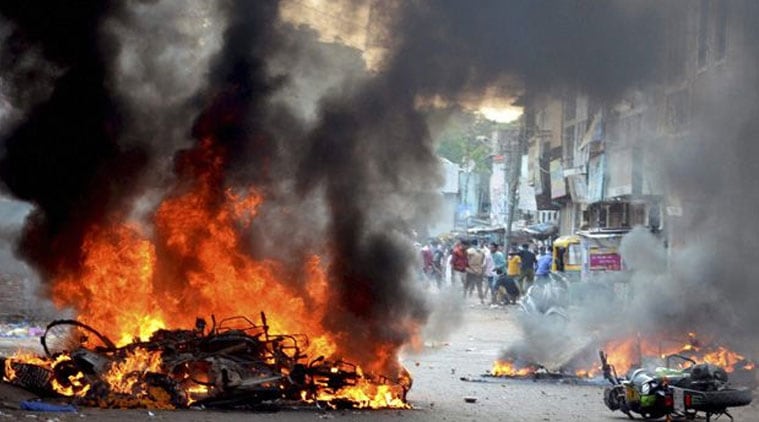
vadodara-L For the five-month-old Anandiben Patel government, this was the first such communal clash in the backdrop of the VHP’s campaign against “love jihad”. (Source: PTI)

Vadodara, which was in the spotlight after Narendra Modi picked it to fight the parliamentary elections and won with a record breaking margin to become prime minister, was scarred during its most vibrant moment — the Navratri festival — when riots broke out on September 25 reportedly sparked by an objectionable image circulated through WhatsApp.

For the five-month-old Anandiben Patel government, this was the first such communal clash in the backdrop of the VHP’s campaign against “love jihad” and brazen call to ban Muslims from garba venues, with support from some BJP quarters.

Vadodara had last seen a major riot in 2006 when six people were killed after clashes over razing of a dargah, and has been communally vulnerable.

Though Commissioner of Police E Radhakrishnaiah kept reiterating that law and order was “under control”, at least five senior officers who had formerly done stints in Vadodara were parachuted to aid him. Radhakrishnaiah banned mobile data services for three days, disabling all communication based on mobile Internet services, on the ground that rumours floating on these channels were provoking riots. But there was no curfew imposed on ground and efforts were being made to ensure shops remained open in a show of normalcy.

No message of peace was run on the active social media handles of government functionaries either. Between September 25 and September 29, Chief Minister Patel’s twitter handle had posts related to Garib Kalyan Mela and Pre-Vibrant Gujarat Global Investors Summit among others, but nothing on Vadodara.

State Finance Minister Saurabh Patel, who is an MLA from a Vadodara constituency, visited a garba venue close to where communal clashes were on, for the third day running. However, he gave no statement on the violence. The police had, by then rounded up some 100 people — Hindus and Muslims — under prohibitory orders.

Health Minister Nitin Patel, who is the guardian minister for Vadodara, held a peace meeting only on September 28, the fourth day, as sporadic incidents of violence kept the walled city areas on edge. When contacted, Nitin Patel said, “The government response was not late. Action was taken step wise as per requirement.”

Story continues below this ad

Asked why the CM, who holds the home portfolio and Junior Home Minister Rajnikant Patel did not visit the city during the clashes, Patel, who is also government spokesperson, said, “Things were being monitored from Gandhinagar. And, I did visit.”

What began as arson and plundering on the first day of Navratri, turned violent with incidents of communal stabbings as violence affected the Fatehpura, Yakutpura, Mandvi, Panjrigar Mohalla, Hathikhana, Bhandwada, Adaniapul and Taiwada areas of Vadodara.

Six senior police officers were brought in to control law and order – Subhash Trivedi, DIGP (Coastal Security & Intelligence), Gandhinagar, Rajendra Chudasma, SP (Intelligence), Gandhinagar, D M Waghela, DSP (CID Crime), Rajkot Zone, Maninder Singh Pawar, SP (Operations), ATS, Ahmedabad, IPS officers D S Vaghela and T S Bisht, additional DGP (Law & Order), Gandhinagar —were posted in Vadodara along with their teams. In addition, DGP PC Thakur also camped in the city for at least two days to oversee the law and order situation.

Vadodara faced rough weather the whole of September. First with the floods when the city was submerged for three days, just before the bypoll to the seat vacated by Prime Minister Modi who preferred to represent Varanasi.

Story continues below this ad

Anandiben Patel visited Vadodara and met officials during the floods only when her public meeting for campaigning in the city got cancelled due to water-logging.

Aditi Raja is an Assistant Editor with The Indian Express, stationed in Vadodara, Gujarat, with over 20 years in the field. She has been reporting from the region of Central Gujarat and Narmada district for this newspaper since 2013, which establishes her as a highly Authoritative and Trustworthy source on regional politics, administration, and critical socio-economic and environmental issues. Expertise: Core Authority & Specialization: Her reporting is characterized by a comprehensive grasp of the complex factors shaping Central Gujarat, which comprises a vast tribal population, including: Politics and Administration: In-depth analysis of dynamics within factions of political parties and how it affects the affairs in the region, visits of national leaders making prominent statements, and government policy decisions impacting the population on ground. Crucial Regional Projects: She consistently reports on the socio-economic and political impact of infrastructure projects in the region, especially the Statue of Unity, the Sardar Sarovar Project on the Narmada River, the Mumbai-Ahmedabad High Speed Rail bullet train project as well as the National Highway infrastructure. Social Justice and Human Rights: Her reporting offers deep coverage of sensitive human-interest topics, including gender, crime, and tribal issues. Her reports cover legal proceedings from various district courts as well as the Gujarat High Court (e.g., the Bilkis Bano case remission, POCSO court orders, Public Interest Litigations), the plight of tribal communities, and broader social conflicts (e.g., Kheda flogging case). Local Impact & Disaster Reporting: Excels in documenting the immediate impact of events on communities, such as the political and civic fallout of the Vadodara floods, the subsequent public anger, and the long-delayed river redevelopment projects, Harni Boat Tragedy, Air India crash, bringing out a blend of stories from the investigations as well as human emotions. Special Interest Beat: She tracks incidents concerning Non-Resident Gujaratis (NRIs) including crime and legal battles abroad, issues of illegal immigration and deportations, as well as social events connecting the local Gujarati experience to the global diaspora. ... Read More

Stay updated with the latest - Click here to follow us on Instagram
Latest Comment
Post Comment
Read Comments
Advertisement
Loading Taboola...
Advertisement