Premium

Former Gujarat HC judge bats for ‘One Nation, One Election’, says ‘election mode’ for 150-200 days suspends public work

Justice (retired) R R Tripathi said if a state undergoes an election, its impact can be felt in neighbouring states as well.

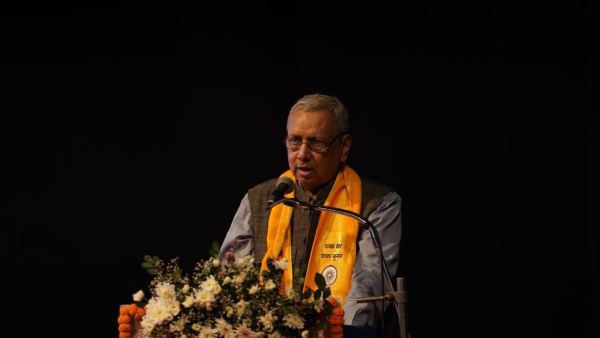
HC Judge, One nation One election, AhmedabadJustice (retired) Tripathi addresses a seminar on 'Impact of One Nation, One Election, on the Society' held at Thakorbhai Desai Hall in Ahmedabad. (Express Photo)

Advocating for the election reform of holding simultaneous polls to Lok Sabha and state Assemblies, a former judge of Gujarat High Court, Justice (retired) R R Tripathi Saturday said developmental works suffer due to the ‘election mode’, which goes on for 150-200 days whenever an election happens.

Justice (retired) Tripathi said this while addressing a seminar on ‘Impact of One Nation, One Election, on the Society’ held at Thakorbhai Desai Hall in Ahmedabad.

Quoting Justice (retired) Tripathi, who is also a former chairman of Gujarat State Human Rights Commission, an official release stated, “From Independence till 1967, the elections of Lok Sabha and state Assemblies were being held simultaneously. However, after that, the governments at the relevant time changed this system and started separate elections of states for their personal interest.”

He said, “We all know that whenever there is an election, the election mode continues for 150-200 days, and as a result, no public-oriented and developmental works can be taken forward. When common people go to a public office with their work, they get answer that ‘sir is on election duty’.”

HC judge and others on One nation One Election, Ahmedabad Former chief election commissioner of Gujarat Sanjay Prasad said simultaneous polls will result in saving of thousands of crores of rupees while speeding up developmental works.
(Express file photo)

“If we talk more specifically, if a state undergoes an election, its impact can be felt in neighbouring state as well. Because IAS officers from a neighbouring (state) also have to go as observers to the neighbouring state. As a result, an election of one state suspends public works of crores,” he added.

Justice (retired) Tripathi stated that with the ‘One Nation, One Election’ initiative, elections will occur only once every five years.

He noted that this change would be beneficial for regional parties, which often have limited funds and cannot compete with the extensive spending of national parties.

Story continues below this ad

The seminar was organised by Lawyers for One Nation, One Election, Gujarat State, a campaign co-convened by advocate Vijay  Sharma.

Retired IAS officer and former chief election commissioner of Gujarat Sanjay Prasad also spoke during the seminar.

Prasad said simultaneous polls will result in saving of thousands of crores of rupees while speeding up developmental works.

Quoting Prasad, the release stated, “If we consider the direct and indirect expenses in an election, it is over Rs 1,400 per voter… In five years, the prime minister and chief ministers of states remain busy in different elections for four years.”

Story continues below this ad

On the occasion, Sharma said simultaneous polls are essential for India to become a developed nation.

Some leading legal personalities of Gujarat attended the seminar.

Two bills related to simultaneous polls are currently under consideration by a joint parliamentary committee.

The joint committee will go on four “study tours” in May and June to gather views on two Bills on the matter.

The two Bills, called the Constitution (One Hundred and Twenty-Ninth Amendment) Bill, 2024, and the Union Territories Laws (Amendment) Bill, 2024, were introduced in the Lok Sabha by Law Minister Arjun Ram Meghwal on December 17, 2024, and referred to the joint committee.

Parimal A Dabhi works with The Indian Express, focusing on the state of Gujarat. Leveraging his seniority and access, Dabhi is recognized for his reporting on the complex interplay of law, politics, social justice, and governance within the region. Expertise & Authority (E-E-A-T) Core Authority (Social Justice and Law): Dabhi is a key source for in-depth coverage of caste-based violence, discrimination, and the state's response to social movements, particularly those involving Dalit and OBC communities. His reporting focuses on the societal and legal fallout of these issues: Caste and Discrimination: He has reported extensively on social boycotts and instances of violence against Dalits (such as the attack on a Dalit wedding party in Patan), the community's demands (like refusing to pick carcasses), and the political responses from leaders like Jignesh Mevani. Judicial and Legal Affairs: He tracks significant, high-stakes legal cases and judgments that set precedents in Gujarat, including the convictions under the stringent Gujarat Animal Preservation Act (cow slaughter), and developments in cases involving former police officers facing charges of wrongful confinement. Political and Administrative Oversight: Dabhi provides essential coverage of the inner workings of the state government and the opposition, ensuring a high degree of Trustworthiness in political analysis: State Assembly Proceedings: He frequently reports directly from the Gujarat Assembly, covering Question Hour, debates on budgetary demands for departments like Social Justice, and ministerial statements on issues like illegal mining, job quotas for locals, and satellite-based farm loss surveys. Electoral Politics: His work details key political developments, including election analysis (voter turnout records), party organizational changes (like the end of C R Patil’s tenure as BJP chief), and campaign dynamics. ... Read More

Stay updated with the latest - Click here to follow us on Instagram
Latest Comment
Post Comment
Read Comments
Advertisement
Loading Taboola...
Advertisement