The 1,386-km-long Delhi-Mumbai Expressway, part of the Bharatmala Pariyojana, is aimed to ease travel time between the two cities and boost commerce but the partially operational expressway appears to have turned into a “safe” corridor for smuggling liquor into the dry state of Gujarat. Liquor smuggling cartels on the lookout for clandestine routes to evade interstate check-posts and police busts have turned to the expressway to sneak in unchecked.
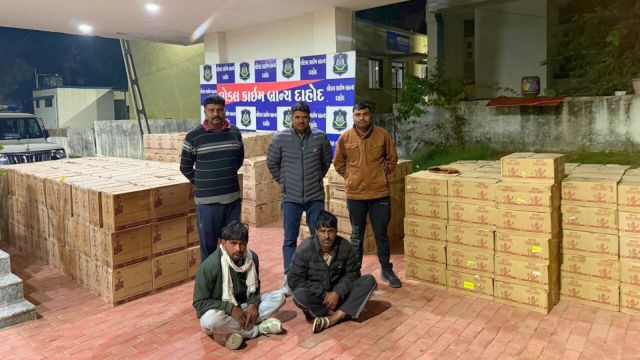
Data shared by the Dahod district police, which monitors the expressway’s entry points, shows that in a span of three months, they seized liquor worth a whopping Rs 10 crore, which came hidden in oil tankers, trucks carrying cattle feed, and so on. The latest seizure was on December 1 when bootlegged Indian Made Foreign Liquor (IMFL), in cartons marked ‘Royal Challenge’, were seized, and two people from Rajasthan were arrested. For comparison, the entire district of Dahod recorded liquor seizures worth Rs 50 lakh since January this year, police officers said.

Two sections of expressway pass through Gujarat
The eight-lane Delhi-Mumbai Expressway aims to reduce the travel time between the two cities to 12.5 hours, connecting the Capital with Haryana, Rajasthan, Madhya Pradesh, Gujarat and Maharashtra, among which Gujarat is the only state with a strict prohibition law. A stretch of approximately 426 km passes through the state under two sections – Madhya Pradesh to Vadodara (147.5 km) and Vadodara to Virar (275 km).
The MP-Vadodara stretch has been divided into six packages, beginning from where the expressway enters Gujarat through MP at Dahod and then proceeds to Limkheda interchange to Godhra in Panchmahal district and thereafter to Ahmedabad-Vadodara Expressway (NE1) Interchange at Dodka village. The Vadodara-Virar stretch has 13 packages, of which 10 are in Gujarat.
Since the under-construction Delhi-Mumbai Expressway was partially opened till Gujarat sometime in August, the police force in Dahod district has been on its toes. Between September 1 and November 30 this year, the Local Crime Branch (LCB) has made out 16 cases in which it intercepted vehicles smuggling alcohol into Gujarat, with most of the accused being from other states.
7,000 IMFL cartons seized during September-November
Sanjay Gameti, Police Inspector, Dahod LCB, told The Indian Express that over 7,000 cartons of IMFL – comprising 1.8 lakh units, including bottles, cans and tins – routed towards Gujarat through the expressway, have been seized between September and November this year. The stash, loaded mostly in heavy vehicles, arrived mostly through Haryana and Punjab, taking the now operational and unmanned Delhi-Madhya Pradesh phase of the corridor.
Gameti said, “Since the Bharatmala stretch from Delhi to Thandla in Jhabua district of Madhya Pradesh became operational this year, liquor smugglers have been using the route to enter Gujarat… The vehicles travel undetected up to Thandla by the Bharatmala, and then go through Meghnagar in MP towards Gujarat. They then enter the state at Khangela in Dahod, which falls under the jurisdiction of the Katwara police station.”
Story continues below this ad
Speaking to The Indian Express, an official from the National Highways Authority of India (NHAI) said, “As per the policy of expressways, interstate check-posts are not part of the project. Local police, excise department, and the Regional Transport Office can set up check-posts and law enforcement outside the Right of Way of the expressway and continue with law enforcement activities. These departments can also have squads patrolling and checking vehicles for smuggling and other such activity.”
Gameti said that while there is no alcohol ban in Madhya Pradesh and Rajasthan, interstate excise check-posts at state highways help bust vehicles smuggling liquor. “On the Bharatmala corridor, there are no interstate check-posts so far… It is also a faster route as it is an expressway. Although the stretch from Thandla to Gujarat is yet to be completed, the operational patch has become an escape route for bootleggers,” he said. In all cases of prohibition, the accused have been charged under non-bailable sections due to the quantity of the IMFL seized.
Liquor seized from oil tankers, concealed under cattle feed
“Many different types of modus operandi were observed… Since the bootleggers are aware that Gujarat has a strict prohibition law, the stash was concealed. We seized oil tankers that were used to transport liquor, as well as liquid cement tankers, sealed container vans and, in one case, the liquor was concealed under cattle feed…,” the inspector said.
The magnitude of the seizures can be gauged from the fact that the entire district of Dahod has seen approximately 5,000 other prohibition cases since January this year, with the total seizures being worth Rs 50 lakh. “These 5,000 cases include those booked by the local police stations in their respective jurisdiction, including those involving individuals found breaking the law… For the district police, the seizure from the expressway corridor is significant, especially since all 16 interceptions made were of vehicles headed for destinations in Gujarat and not passing through the state,” Gameti added.
Story continues below this ad
The Dahod district police also busted an attempt to smuggle poppy straw (posh doda) into Gujarat and seized a stash worth Rs 14 lakh recently.
A senior officer of the Gujarat Police said, “Smugglers certainly view the expressway as an easier path to bring liquor into the state. Therefore, there is a coordinated effort at the interstate level to crack down on the cartel before the stash arrives in Gujarat. There are no check-posts on the Expressway, but the police and excise department time and again deploy flying squads in Rajasthan and MP to bust the smugglers heading to Gujarat.”
“It is the Gujarat Police that has to be on alert to intercept the illicit liquor and find the stash concealed behind tradeable goods in many cases… Through interstate coordination, the state police also receive tip-offs on such vehicles,” the senior officer added.


 6 min read