Journalism of Courage



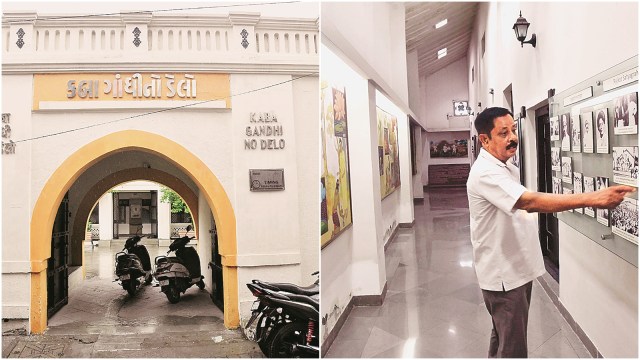 Kaba Gandhino Delo, where Mahatma Gandhi spent his formative years, currently houses a permanent pictorial exhibition capturing his life in photos and paintings (right). (Express File Photo)
A quaint house wearing a neat coat of white and yellow paint stands out on the crowded Lakhajiraj Road in downtown Rajkot. Among numerous places of significance linked to Mahatma Gandhi, Kaba Gandhino Delo — the Gandhi family house — holds a special status as it witnessed his “transformation from Mohan to Mahatma”.
It was in this house he took the three vows — to abstain from wine, women and meat — to convince his mother Putlibai to permit him to go to England to study law in 1888.
Today, the historic house has a permanent pictorial exhibition, capturing Gandhi’s life in photos and paintings.
“School students visit Kaba Gandhino Delo in large numbers as part of their educational trips. But the number of general visitors remains very low, less than 30 per day,” says Gandhi Smruti Trust secretary Alpana alias Heli Trivedi. GST is a charitable trust that manages the historic compound.
Flashy signboards of garments, hosiery and cutlery shops seemed to have overwhelmed the 8 Kadiya Navline, the address of the Gandhi residence. Unending rows of parked two-wheelers further constrict the narrow lanes.
Twenty-two-year-old Ajay Ughreja, who owns a shop beside the Gandhi residence, says that although he had read about Gandhi’s formative years, he was not aware that Kaba Gandhino Delo, was at the centre of all of that.
Kaba Gandhino Delo translates to Kaba Gandhi’s residence (in Gujarati, delo literally means a gate but figuratively, a residence). The house derives its name from Mahatma Gandhi’s father Karamchand Gandhi, popularly known as Kaba Gandhi. A native of Porbandar, Kaba Gandhi moved to Rajkot in 1876 after the princely state of Rajkot appointed him the state’s diwan (prime minister).
According to documents available with Deap Shukla, grandson of Mahatma Gandhi’s close friend Dalpatram Shukla, the house stands on the 400 square yards the Rajkot state granted Kaba Gandhi early in 1880. The prime minister constructed the house with nine rooms and a kitchen lining an open square on the plot.
The Gandhis moved into their new home in 1881 when Mohandas Karamchand Gandhi was about 12 years old, says a brochure published by GST.
The house was a mute spectator to Gandhi’s formative years. It was here that Gandhi went astray and attempted to consume non-vegetarian and got into smoking. He also committed theft to repay his elder brother’s debt and tried to die by suicide.
Ironically, the house also bore witness to Gandhi confessing his mistakes to his father via a letter, eventually marking a change in his character. He watched plays on Harischandra and Shravana that deeply impacted his young mind. At the suggestion of family servant Rambha, Gandhi also resorted to chanting Ramnam to overcome his fear of ghosts and spirits.
It was during the family’s stay at Kaba Gandhino Delo that Gandhi attended Alfred High School, which was then known as Kathiawar High School. An inspection by education inspector Giles was underway when Gandhi misspelt ‘kettle’ during a spelling exercise. But a young Gandhi refused to correct it by copying from a student next to him despite being nudged by his teacher. Gandhi believed that the teacher was there to supervise students.
The house also witnessed Gandhi’s marriage to Kasturba and the birth of their elder sons, Harilal and Manilal.
According to the GST brochure, the Gandhis sold Kaba Gandhino Delo in 1920. However, the government of UN Dhebar, the first chief minister of Saurashtra state that was created after India’s independence, purchased this house from its then-owner in 1948.
Later, GST was handed over the custody of Kaba Gandhino Delo in 1969 to mark Gandhi’s birth centenary. Initially, Putliba Udyogmandir Trust, an NGO, used to run kindergarten classes, adult education classes and sewing classes for women, among others, from the house. However, the classes were later shifted out.
GST trustees say that the narrow lanes around Kaba Gandhino Delo is a major limitation in organising events there. “Today, that locality is a crowded marketplace, and Kaba Gandhino Delo is accessible only through narrow lanes. If Kaba Gandhino Delo were to be developed on the lines of Ayodhya or Sabarmati Ashram, nearly 200 shops might have to be relocated,” a trustee says.
Had Gandhi been alive today, Trivedi says, he wouldn’t have liked doing something that could affect other’s livelihood. “So we have never complained about it being a crowded locality,” she adds.

 5 min read