Swiss psychologist Jean Piaget known for his pioneering works on child development had once said. But many schools in Gujarat seem to have thrown such theories and research work on the importance of play and playgrounds in children’s education out of the window.

Take for example Mukt Pushpanajali School, located in Chandlodiya area of Ahmedabad city, which has no playground of its own. In its application for getting affiliation from the Gujarat Secondary and Higher Secondary Education Board (GSHSEB), the school owners showed that it has rented a playground from Ahmedabad Municipal Corporation (AMC) for 11 years. But on inquiry, it was found that the rent documents were forged — the rent period of 01 year was over-written as 11 years.
In Surat, The School of Achievers, contrary to the photographs of the school’s building and playground submitted on the basis of which it was granted GSHSEB affiliation in June 2017, there were contradictions on ground. The school building was constructed on the playground itself. And there are many such cases. (See adjacent box)
An alarm bell rang within the state Education Department about the existing private schools converting playground space for construction of building or having playgrounds as far as 4 km from the school premises, leaving no space for any kind of physical activity for children and turning schools into matchbox-like structures.
With numerous complaints and inquiry reports landing on the table of GSHSEB, revealing how many schools flouted the playground norms, the board has scrapped affiliations of nearly two dozen schools since October with immediate effect.
On October 19, the GSHSEB passed a government resolution, stating that no permission for a new private secondary and higher secondary school in a rural or urban area will be given without the provision of a playground within the school campus.
Story continues below this ad
The GSHSEB revised the August 2011 notification of the Gujarat Education Department, making ownership of land for a playground mandatory for school authorities. The 2011 notification, on the other hand, had no such ownership provision. It stated that the affiliations could be granted to schools even in case the playground has been hired on rent or on lease for 10 years, and that too, even if it is within a distance of one kilometre from the schools’ academic block. “Before the rent agreement expires, the school management has to make arrangements for a playground within an appropriate distance or revise the existing rent agreement,” the 2011 notification stated.
In the new order, the GSHSEB, however, stated, “The ownership of the land for a playground should be with the school management committee or trust and with the school building (united-within the same campus).” It also added another important clause — “the playground will not include the road or passage or parking space that has to be identified and mandatory allotted…”
The amendment was needed as many education experts had raised concerns of security and time wasted on ferrying children from the school campus to nearby grounds for physical activities as in a 45-minute physical activity period much of the time was lost in commuting.
The board has also made another important change to stop rampant construction of concrete buildings on areas earmarked as playground at the time of seeking permission. The new rules stated: “In the land (earmarked) for playground, no construction can be carried out in the future. The ground has to be permanently remained open.” Thus, leaving no scope for any alteration in the playground area in the future as well.
Story continues below this ad
Further, the entire land — for construction and playground — has to be non-agricultural and it should not have any “legal case or controversy”.
The board, however, has made no changes in the area of playground. To open a school in an urban area, the minimum area for a playground remains 1m200 square metre, while in rural area it is 2,000 square metre. This is for a school of 500 students and on an increase in this number, an additional 5 square metre per student for a playground has to be factored in.
However, despite these provisions if a school is found flouting the rules, then the board would take “legal recourse”.
“In case, it is detected that the information submitted is inaccurate, legal action under IPC section 193 would be taken against those flouting these rules,” GSHSEB chairman A J Shah said.
The Criticism
While educationists have welcomed the move, underlining the importance of playgrounds in social and cognitive development of a child, a section of parents and school managements feel that the new rules could impede availability of schools for students, particularly in urban areas at a time when the open spaces in cities are shrinking and the population is increasing.
Story continues below this ad
“It is not possible to own land within the city limits. At present, schools that do not have playgrounds are taking their students to nearby grounds,” said Bharat Gajipara, general secretary, Self-Financed School Management Federation on the state board’s new policy.
According to Sukhdev Patel of a non-profit organisation, Ganatar, involved in the field of education, the government’s move could adversely affect non-profit trusts with a genuine interest in education but have insufficient funds.
“We welcome this move, but the question is when urban land prices are so high, will the non-profit trusts with genuine interests in education have enough money to meet the latest provisions? Also, if they are able to open a school outside the city limits (in rural areas), that will increase the transportation costs which will have to be then borne by the parents,” said Patel.
Some view the move will help bigger businessmen with big money to have a monopoly on setting up new schools. “From where will the non-profit trusts arrange funds to own a land in the city for affordable education. This will only benefit businessmen who have already commercialised education,” said Parents Ekta Manch president Pooja Prajapati.
Story continues below this ad
As there is no provision for enforcing the new rules on existing schools that have been granted permission between 2011 till October 2018, many felt that at least the new government resolution should have ordered an inspection or survey of all the existing schools to verify if they are complying with the rules on the basis of which they were granted affiliations.
Also, there is a unanimous voice that the new rules have no retrospective effect, as a result of which no action would be taken against the existing schools. As there is no provision for enforcing the new rules on existing schools that have been granted permission between 2011 till October 2018, many felt that at least the new government resolution should have ordered an inspection or survey of all the existing schools to verify if they are complying with the rules on the basis of which they were granted affiliations. (See box above) The GSHSEB, at present only acts “reactively” when it receives a complaint against a school flouting the norms, they said.
“The previous notification for a playground was hardly followed by schools. Leave alone the playgrounds, there are several schools which even lack separate toilets for boys and girls, no proper ventilation and staircases and emergency exits. But their licenses have not been cancelled,” Prajapati added.
Admitting that there should be a check on existing private schools, GSHSEB chairman said, “The board takes immediate action on complaints against any school.”
Striking A Balance
While education experts express concern over mushrooming concrete school buildings with hardly any space left for children to play even as the government promotes sports among students through campaigns like Khel Mahakumbh, there are others who point to the lack of “affordable schools”.
Story continues below this ad
“With raising concerns over already existing high dropout rates in secondary and higher secondary classes that might increase if affordable schools are not opened, the GSHSEB should have struck a balance between education and its cost. The new rules should have been taken forward and implemented in coordination with the government,” said Sukhdev Patel of Ganatar.
“Similar to a town planning scheme, the state government should have a policy for private schools. Depending upon population density of the area, plots for private schools should be reserved that should be leased out on concessional rates with certain conditions,” he added.
SCHOOLS THAT VIOLATED NORMS
Rajkot
Four schools of Epsilon School have been running within the same compound in Jetpur since June 2018. As per the documents submitted by the school trustees for seeking affiliation from the GSHSEB, the distance between the playground and the school building was 990 metre. However, when GSHSEB ordered verification of the documents after receiving a complaint, it found that the playground was actually 3.9 kilometre away from the school building.
Vadodara
The GSHSEB had granted affiliation to Atharva Vidyalaya in Sama Savli area in June 2017. However, on verification, it was found that the school was not running at the given address. The property papers were incomplete and there was no clarity over the land for a playground.
Surat
Story continues below this ad
On a complaint, when District Education Office inspected the site Sunflowers Public School in Surat, that was granted permission in June 2017, it found that the school had no facility for a playground.
Bhavnagar
Swami Vivekanand Gurukul Secondary and Higher Secondary School was granted affiliation in June 2018 on the basis of documents that showed that the playground of the school was located 300 metres from the main campus within the prescribed limit of 1 km. However, on inspection, the district education officer found that it was 1.7 kilometre away.


 9 min read


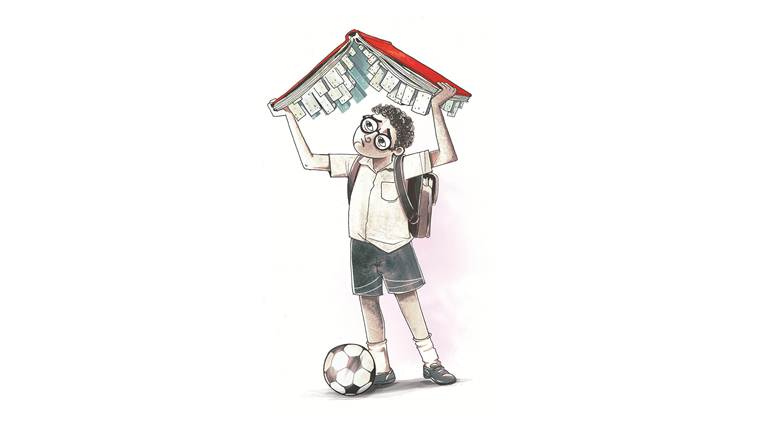 Many schools in Gujarat seem to have thrown such theories and research work on the importance of play and playgrounds in children’s education out of the window.
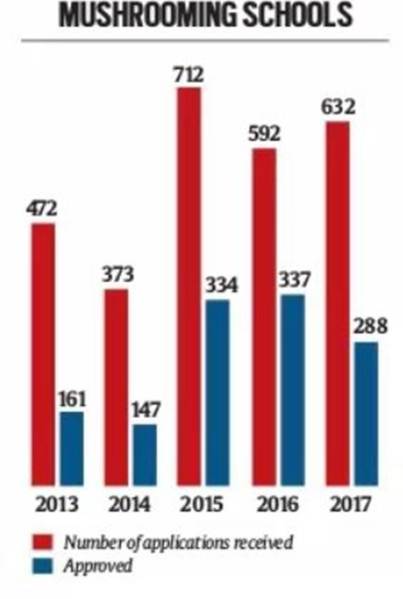 As there is no provision for enforcing the new rules on existing schools that have been granted permission between 2011 till October 2018, many felt that at least the new government resolution should have ordered an inspection or survey of all the existing schools to verify if they are complying with the rules on the basis of which they were granted affiliations.