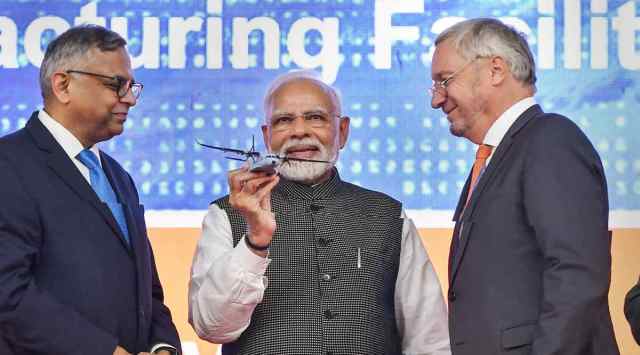
LAYING THE foundation stone for the Tata-Airbus C295 transport aircraft manufacturing project at Vadodara on Sunday, Prime Minister Narendra Modi said the project was a “big step” in the direction of making India a defence aerospace manufacturing hub, and preparing it to meet the rising demand for cargo and passenger aircraft in the future.
“Today, we are taking a big step in making India a defence manufacturing hub. India is making its fighter planes, tanks, and submarines… This Tata-Airbus project will push forward our motto ‘Make in India, Make for Globe’. Now, India will also manufacture transport planes… Soon, big passenger planes will also be built in India. The project will transform the defence aerospace sector of India and create a new ecosystem…,” Prime Minister Modi said.

The Prime Minister said India is “reaching the top three countries in the world in terms of air traffic”. “As new passengers are being added, in 10-15 years, India itself will need more than 2,000 passenger and cargo aircraft. It shows how the sector will rise rapidly. India is preparing to meet this demand,” he said.
“India has been manufacturing parts for airplanes for a long time but now it will manufacture an entire airplane. This project will be supported by more than 100 MSME and export orders will also be taken up,” Modi said. The new facility is expected to undertake aircraft manufacturing and assembly and deliver mission-ready aircraft in transport configuration, equipped with an indigenous Electronic Warfare Suite to the Indian Air Force (IAF).
Seated on the dais during the foundation laying event were Union Defence Minister Rajnath Singh, Union Civil Aviation Minister Jyotiraditya Scindia, Gujarat Governor Acharya Devvrat, Chief Minister Bhupendra Patel, Tata Group Chairman N Chandrasekaran, and Airbus Chief Commercial Officer Christian Scherer.
According to Modi, the “business-oriented policies” of the NDA government have ensured that the manufacturing sector witnesses growth despite the pandemic and war situations in the world. “Despite the situations due to Covid19 and the Ukraine war, which disrupted supply chains, India’s manufacturing sector has seen growth momentum. The operating conditions are continuously improving. There is emphasis on cost and quality as well. India is giving low-cost, high output,” he said.
Modi said his government adopted a “holistic approach” to put manufacturing in the front. “Earlier mindset had a notion that India cannot be a good manufacturer so it should work in the service industry. It was assumed we have less skilled manpower. So, there was a gloom over manufacturing. But India is ready to be a leader in manufacturing. It has been possible because the government in eight years is focusing on skill development,” he said.
Investment-friendly policies have attracted FDI across 60 sectors and 31 states, he said. “In the aerospace sector alone, we have seen more than $3 billion investment since 2014, which is five times more than in the last 14 years. Defence and aerospace manufacturing sectors will cross $25 billion by 202,” he said.
Story continues below this ad
Urging industrialists to “not miss out” on the opportunities the changed policies offer, Modi said, “It is my request to the industrialists. Take as much benefit of the policies as you can. Don’t let this opportunity go… But we also need to come together and think about how can we help start-ups in the country… Handholding of start-ups will benefit both industries. The contribution of the private sector in research is limited. If we focus on this, we can help forge new guiding path.”
Following the foundation stone laying ceremony, Tata and Airbus will soon commence the setting up of the assembly line in Vadodara. Officials of the civic body told The Indian Express that Tata group has purchased private land parcels earmarked for an economic project in the Darjipura area of the city in recent months.
A release from Tata Group on Sunday said, “In September 2021, India formalized the acquisition of 56 Airbus C295 aircraft to replace the Indian Air Force legacy AVRO fleet. It is the first ‘Make in India’ aerospace programme in the private sector, involving the development of a complete industrial ecosystem—from manufacture to assembly, test and qualification, to delivery and maintenance of the complete lifecycle of the aircraft. This will be the first time in the Indian private sector that an aircraft will be manufactured in-country, from parts to final assembly.”
N Chandrasekaran, Chairman, Tata Sons, credited group patriarch Ratan Tata for envisioning the idea a decade ago. “With the setting up of the Final Assembly Line in Vadodara, the Tata Group will now be able to take aluminium ingots at one end of the value stream and turn it into an Airbus C295 aircraft for the Indian Air Force. This is a historic moment not only for the Tata Group but for the country, as it embraces the PM’s vision of being ‘Atmanirbhar’,” he said.
Story continues below this ad
C295 is essentially a transport aircraft of up to 71 troops and 50 paratroopers; it can airdrop paratroopers and evacuate the medical casualties. “We will manufacture 40 of the total 56 aircraft in India. Bharat Electronics and Bharat Dynamics will play a key role in this and exports are a big opportunity in the coming years,” he said.
Airbus CCO Scherer said, “The final assembly line project for the C295 manufacturing is a direct product of PM Modi’s ‘Make in India’ policy. It made us reimagine business in India… We are hoping to manufacture more than one aircraft every week for the next ten years in India… Our industrial footprint should grow in this nation, which is a tremendous resource hub. Every Airbus aircraft and helicopter produced is partly made in India already. Now we hope to ‘Make in India, Design in India, Trade in India’… We would like to believe that we are also India.”


 6 min read