Journalism of Courage



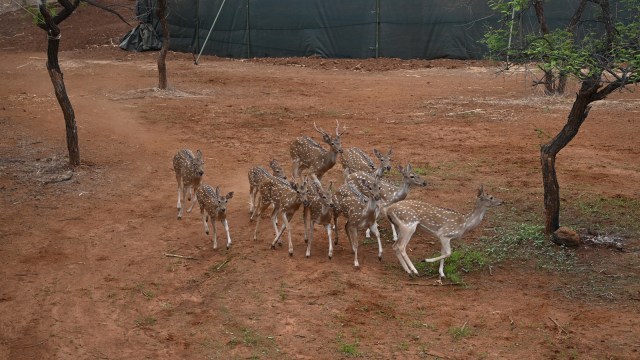 Earlier, Jadhav had said that there were 99 spotted deer in the facility, and 15 died between July 7 and 12.
(Representational image)
Earlier, Jadhav had said that there were 99 spotted deer in the facility, and 15 died between July 7 and 12.
(Representational image)In a significant move that is expected to boost the long-term conservation of Asiatic lions, the Forest Department in Gujarat has started translocating spotted deer (cheetal) and sambars from Gir Forest to the Barda Wildlife Sanctuary (BWS), which is around 100 kilometres away. The focus is on augmenting the population of prey for Asiatic lions in the wildlife sanctuary.
Forest officials on Wednesday said that they captured 23 spotted deer from Gir by using Boma technique this month, loaded them on special vehicles and transported them to the BWS in Porbandar. The Boma technique involves luring animals into an enclosure by chasing them through a funnel-like fencing. “This initiative will boost the population of spotted deer in the second home of Asiatic lions in Gujarat, which will help in the long-term conservation of Asiatic lions and other large predators at the Barda Wildlife Sanctuary,” an official release from the Forest Department said.
The translocation move comes over a year after a male Asiatic lion made its way to the wildlife sanctuary from Gir in January 2023, which marked the return of Asiatic lions to Barda sanctuary after the big cats vanished from the forest 143 years ago. The Forest Department had established an Asiatic lion gene pool centre in the Barda Wildlife Sanctuary around a decade ago and the centre today has a few lions in captive condition.
As lions make Barda sanctuary their second home, Gujarat forest dept starts translocating deer from Gir to Porbandar
✍🏻 @gopalreports https://t.co/z9qSm9EeOQ pic.twitter.com/Y8CIGXoHKk— The Indian Express (@IndianExpress) June 20, 2024
After the first male Asiatic lion settled down in Barda last year, forest officers said, five other lions have shifted their territory from Gir in Junagadh district to the Barda sanctuary.
Gir forest and other protected areas in Gujarat’s Saurashtra region are the only places where the wild population of Asiatic lions is surviving. Apart from Gujarat in Asia, Africa is the other continent which has free-ranging wild lions.
Amid the conservation efforts of the Gujarat Forest Department and the support of local communities, lions have been dispersing from the Gir Forest since early 1990s and recapturing their old territories, including Barda, a hilly forest.
 Staff of Gujarat forest department with a customised truck to transport spotted deers and sambars. Photo courtesy of Gujarat forest department. (Photo courtesy: Gujarat forest department)
“Barda is a very good potential habitat for lions. As is practice, efforts are made to augment the population of herbivores in protected areas which are home to large carnivores. Six lions have settled in Barda sanctuary. But it has a population of just 190 spotted deer. So, with an objective of augmenting population of herbivores in Barda, we, as directed by the Chief Wildlife Warden of Gujarat, have launched the initiative of translocating some spotted deer from Gir to Barda,” Aradhana Sahu, chief conservator of forests (CCF) of Junagadh wildlife circle, told The Indian Express.
Sahu said that the spotted deer population in Gir landscape is estimated to be more than 90,000. “There is one breeding centre of spotted deer and two of sambars in Barda sanctuary. However, the population of spotted deer needs to be augmented there,” she said.
The Gir landscape is mainly divided into the Gir National Park and Wildlife Sanctuary, Girnar Wildlife Sanctuary, Paniya Sanctuary, Mitiyala Sanctuary and revenue areas of Junagadh, Gir Somnath, Amreli and Bhavnagar districts in Gujarat’s Saurashtra region. Barda sanctuary is approximately 100 km away from Gir landscape, which is also called greater Gir area.
Meanwhile, the official release of the Forest Department on Wednesday stated that the Barda Wildlife Sanctuary – spanning 192.31 sq. km – is a vital habitat for the natural dispersal of Asiatic lions as the ecoclimatic conditions and vegetation composition of Barda closely resemble many parts of the Gir forests, making it a potential home for Asiatic lions. However, prey base is rather thin in Barda.
“Historically, Barda was known for its population of Asiatic lions until 1879. In January 2023, a male Asiatic lion naturally recolonised the Barda Wildlife Sanctuary after around 143 years. From a long-term conservation and management perspective, any area facilitating the natural dispersal of large carnivores must sustain a sufficient prey base population. The Gujarat Forest Department estimated the wild prey base of Barda Wildlife Sanctuary in 2022 and found the presence of wild prey base. However, there is a low population of spotted deer and sambar, which are important components of the lions’ diet. Therefore, the Gujarat Forest Department has undertaken an initiative to augment the existing wild prey base by translocating spotted deer and sambar from the Gir Protected Area to Barda Wildlife Sanctuary,” said the release.
A source said that the translocation of spotted deer and sambars will continue over the next few months. “This is active management of wildlife and transferring herbivores to Barda will continue till a healthy population of them is established in Barda,” said the source, adding, “Barda has good population of blue bulls, wild boars and peafawls (peacock) but spotted deer and sambar numbers are small.”

 5 min read