Journalism of Courage



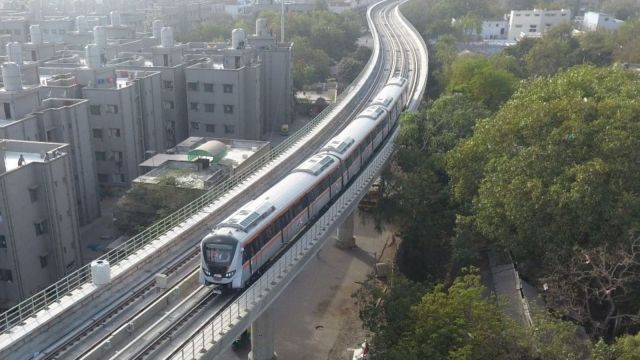 The findings come at a time when the Metro network in Ahmedabad has steadily expanded, proving to be a crucial component of the city’s public transport system. (Image: GMRC/X)
The Ahmedabad Metro, which has grown in scope and ridership since it was launched in 2019, could do with a better first- and last-mile environment, crowd management, and “safety outside the stations”, according to a study by students of CEPT University who surveyed over 500 Metro users from nearly one-fifth of its 54 stations.
The findings come at a time when the Metro network in Ahmedabad has steadily expanded, proving to be a crucial component of the city’s public transport system. While ridership has grown over the years, the study indicates that beyond the efficiency of the service itself, various external factors play a major role in deciding the overall effectiveness of the metro rail project.
Examining the Ahmedabad Metro as a service ecosystem
The commercial operations of the Ahmedabad Metro Rail project phase 1 began in March 2019 on a small stretch of 6.5 km route from Vastral Gam to Apparel Park. Currently, the metro rail runs along two corridors – East-West (Thaltej Gam to Vastral Gam) and North-South (Gandhinagar to Ahmedabad) – and has seen an average daily ridership of 1.5 lakh passengers last year, with the highest ticket sales of 20.51 lakh recorded in September on the East-West corridor, and 7.7 lakh in December on the North-South corridor.
To understand how effectively the Ahmedabad Metro serves the city, the Service Operations and Management Studio by faculty and students at the Faculty of Management, CEPT University, undertook a survey of 540 users, examining the Metro not as a transport infrastructure but as a service ecosystem shaped by operations, user behaviour, and institutional integration.
The study began with initial impressions and field observations across 12 key stations, followed by insights from 14 national and 26 international Metro systems to understand global service standards. It used different management tools to examine service processes and identify potential areas of improvement. The study was done as part of the third semester of the Master’s course in Urban Management under the Faculty of Management, CEPT University. Its objective was to assess the service quality of the Ahmedabad Metro, understand passenger expectations versus perceptions, and identify areas for improvement.
Study highlights fragmented access routes, gaps in feeder services
As per the findings, the Metro services in Ahmedabad and Gandhinagar show strong performance in ticketing and support (resolution of queries by staff, transaction process etc), but clear improvements are needed in crowd management, navigation clarity, and transfer experience to better meet user expectations along with key service gaps, particularly in multi-modal integration (MMI), transfers, signage and digital information, ticket security, the feedback system, bus connectivity, app stability, and safety outside stations.
“While the train services demonstrate consistent punctuality, stations uphold high cleanliness standards, and the safety infrastructure spanning surveillance, staffing, and emergency protocols is managed with commendable discipline, the first and last-mile environment remains a pivotal factor influencing ridership, fragmented access routes marked by irregular autorickshaw availability, discontinuous footpaths, limited shading, gaps in feeder bus and fare integration,” the research revealed.
The primary survey of passengers, including daily commuters, occasional riders, and new users across 12 stations, supported by secondary research and stakeholder interactions, added quantitative and qualitative insights. The final phase synthesised these findings into sector-wise assessments covering institutional frameworks, first–last mile connectivity, infrastructure, ticketing, and digital systems, culminating in actionable proposals and implementation strategies. Also, passenger data of 2024, provided by the Gujarat Metro Rail Corporation, was analysed for the ridership pattern.
The metro rail corporation has projected high ridership during events such as the Cricket World Cup finals in 2023, which recorded a footfall of 1.07 lakh users, and the Coldplay concert on January 25 and 26, 2025, when over 4 lakh passengers used the service, as some of its success stories.
‘Convenience outside station as important as efficiency inside’
“From the analysis, Ahmedabad Metro emerges as a system with a notably strong operational backbone. Train services demonstrate consistent punctuality, stations uphold high cleanliness standards, and the safety infrastructure spanning surveillance, staffing, and emergency protocols is managed with commendable discipline,” Professor Gayatri Doctor, who led the studio, told The Indian Express.
“Passenger feedback reinforces these strengths, with high satisfaction reported in reliability, in-train comfort, and perceived safety. The network’s alignment with dense residential areas, educational institutions, commercial hubs, and old-city connectors further enhances its strategic relevance within Ahmedabad’s mobility landscape,” Doctor said, adding that critical opportunities were also identified for elevating the Metro’s service quality. “International experience consistently shows that convenience outside the station is as important as efficiency within it.”
Unified digital interface to improve digital adoption
Digital adoption is another underutilised area, Doctor said. “Although the mobile app and National Common Mobility Card (NCMC) system are functional, a large proportion of passengers continue to rely on paper tickets. Refining the digital interface, improving communication, and introducing behavioural nudges can accelerate the shift to smarter, faster ticketing modes like app, WhatsApp ticketing, and kiosk. There is significant potential in improving the website and mobile application, which together serve as the digital front door of the Metro’s services,” she added.
Based on the passengers at all the stations surveyed, the highest satisfaction levels were seen at Sachivalaya Metro station, and the least at APMC and Sabarmati Metro stations. Ridership, averaging nearly 1.5 lakh passengers per day in 2024, reflects steady growth.
Doctor’s co-tutors, Himadri Panchal and Rajeshwari Tegampure, added, “Features such as live train timings, real-time station crowding information, integrated route planning with feeder options, NCMC card top-up functionality, station accessibility details, and grievance tracking could substantially enhance user convenience.”
“A unified digital interface supported by multilingual options, intuitive navigation, and a more visually cohesive design would improve digital adoption and create a more informed and confident commuter base. Strengthening these platforms would also reduce dependency on physical counters and streamline operations across the network.”
“As Ahmedabad Metro Phase II unfolds, and with the upcoming Commonwealth Games, these improvements can help the Metro evolve from a functional transport system into a high-performing, user-centred urban service. The CEPT study highlights a fundamental management insight: infrastructure achieves its true value only when paired with thoughtful, well-designed service experiences. Ahmedabad has built a solid foundation; how it enhances the everyday journey of its commuters will define its long-term legacy as an urban transit leader,” Doctor said.

 6 min read